


A Call for a Fairer, More Effective, and Accountable Arbitrum DAO
Note: This proposal has been revised based on community feedback. The goal is no longer to sunset the DIP, but to restore the fair and effective framework of v1.5.
This proposal calls for rolling back the detrimental changes introduced in the Delegate Incentive Program (DIP) v1.6 and v1.7. We advocate for a return to the v1.5 framework, which was previously approved by an on-chain vote and established clear, objective KPIs for delegate performance.
Last update: 04/09/2025
After in-depth analysis and considering community feedback, it's clear there is strong sentiment to continue the DIP. However, the program requires significant changes.
The drop in quality and participation can be traced directly to the unsanctioned and poorly conceived changes introduced by @SEEDGov since version 1.6.
The proposal was edited to make the DIP more inclusive rather than sunsetting it.
The Delegate Incentive Program (DIP) was created to encourage active and thoughtful governance participation. However, recent versions have distorted its purpose. Instead of fostering a healthy ecosystem, the changes introduced in v1.6 and v1.7 have made the program unfair, unstable, and subjective.
The program’s managers (PMs) at @SEEDGov have consistently ignored community feedback, applied rules retroactively, and created a system that penalises smaller delegates while failing to hold large, inactive ones accountable. Their proposed “fix” (v1.7) only exacerbates these problems by raising the entry barrier tenfold, cutting delegate compensation by 40%, and requesting a 25% raise for themselves.
The current version of the program is broken, its management has lost the community’s trust, and it is doing more harm than good. It’s time to restore the program that worked.
This proposal calls for a complete rollback of the DIP to the v1.5 framework.
The DIP is no longer a fair system of rewards. It has become a system of patronage, where payments depend on the personal, opaque judgment of the Program Managers, not on clear, objective work.
The program has shifted from a predictable system to a “black box” where the PMs decide what has “quality” and “impact.”
The program’s management has been marred by constant failures, making it impossible for anyone to rely on.
These aren’t just opinions. The negative impact of the DIP is clear from the data and the words of the delegates themselves.
The moment the unfair v1.6 rules were introduced, the number of delegates getting paid fell off a cliff.
| Month | DIP Version | # of Paid Delegates | Total Payout (USD) |
|---|---|---|---|
| December 2024 | 1.5 | 49 | $262,228 |
| January 2025 | 1.51a | 32 | $205,534 |
| February 2025 | 1.6 (New Rules) | 21 | $90,244 |
| March 2025 | 1.6 | 25 | ~$100,000 |
Source: Figures discussed in delegate chat logs and forum posts.

The number of compensated delegates was cut by more than half as soon as the new rules took effect. One delegate calculated that 10 out of the 11 delegates who were disqualified in February were “small delegates” hurt by the VP multiplier.
Even delegates who supported the program’s goals, like L2BEAT, have seen it fail. @krst Urbański of L2BEAT stated the DIP should help top delegates afford staff and reward passionate, smaller delegates. Version 1.6 did the exact opposite: it punished smaller delegates and failed to hold large, inactive delegates accountable for their lack of participation. The program has failed to achieve the very outcomes that its key supporters envisioned.
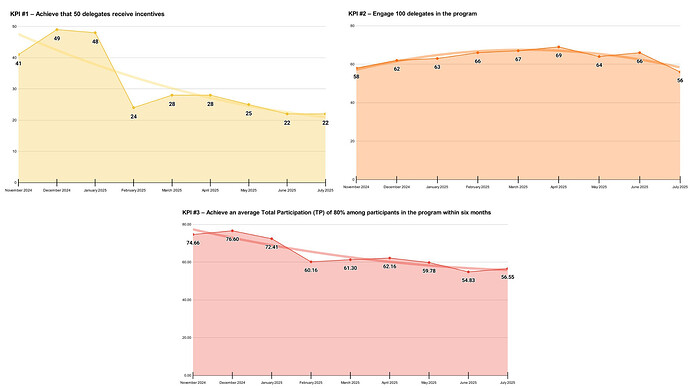
The original v1.5 proposal, approved on-chain, included specific KPIs set by @SEEDGov. The program is now failing to meet them.
As a reminder, these were the approved KPIs of the DIP, as per the onchain approval of the original DIP 1.5 version.
KPIs
In this new iteration of the DIP, we aim to establish the following KPIs:
- Achieve that 50 delegates receive incentives.
- Engage 100 delegates in the program.
- Achieve an average Total Participation (TP) of 80% among participants in the program within six months.
- Introduce improvements to the program after six months.
In the replies to this proposal, Paulo Fonseca has done a deep dive into the KPIs @SEEDGov hosted during the v1.5 vote
The most experienced delegates are walking away because the program is unstable.
“We’re now reducing involvement as we can’t know what (if any) compensation we will receive. Working up front without knowing if or how much you’ll be paid isn’t sustainable .” — cr1st0f, representing ACI, a major protocol delegate
“Most professional delegates would prefer some baseline/bottom line assurance. No bottom-end confidence until two weeks after month-end isn’t consistent enough for many delegates.” — DonOfDAOs, delegate
After months of criticism, the PMs proposed an update (v1.7) that confirmed their disconnect from the community. Instead of fixing the problems, they doubled down on them:
This proposal is not a good-faith effort to improve the program. It is an attempt to silence critics, entrench power, and reward the program’s managers at the expense of the delegates.
The community feedback has been clear: the DIP should continue, but not in its current broken state. The predatory changes from v1.6 and v1.7 must be removed. Rolling back to v1.5 will restore a stable, predictable, and inclusive program that allows delegates of all sizes to contribute meaningfully to the DAO.
At SEEDGov, we remain committed to continuously gathering community feedback and making the necessary decisions to ensure that Arbitrum DAO has the best Delegate Program in the space.
We ask that @SEEDGov honours this commitment and respects the community’s feedback by supporting this rollback.
By voting to revert to v1.5, we will:
Voting Strategy: Ranked choice voting Voting Privacy: Shielded Voting Voting options:
If the proposal passes and changes the status quo, the changes will apply to the last 3 months of the DIP: August, September, and October
A Call for a Fairer, More Effective, and Accountable Arbitrum DAO
Note: This proposal has been revised based on community feedback. The goal is no longer to sunset the DIP, but to restore the fair and effective framework of v1.5.
This proposal calls for rolling back the detrimental changes introduced in the Delegate Incentive Program (DIP) v1.6 and v1.7. We advocate for a return to the v1.5 framework, which was previously approved by an on-chain vote and established clear, objective KPIs for delegate performance.
Last update: 04/09/2025
After in-depth analysis and considering community feedback, it's clear there is strong sentiment to continue the DIP. However, the program requires significant changes.
The drop in quality and participation can be traced directly to the unsanctioned and poorly conceived changes introduced by @SEEDGov since version 1.6.
The proposal was edited to make the DIP more inclusive rather than sunsetting it.
The Delegate Incentive Program (DIP) was created to encourage active and thoughtful governance participation. However, recent versions have distorted its purpose. Instead of fostering a healthy ecosystem, the changes introduced in v1.6 and v1.7 have made the program unfair, unstable, and subjective.
The program’s managers (PMs) at @SEEDGov have consistently ignored community feedback, applied rules retroactively, and created a system that penalises smaller delegates while failing to hold large, inactive ones accountable. Their proposed “fix” (v1.7) only exacerbates these problems by raising the entry barrier tenfold, cutting delegate compensation by 40%, and requesting a 25% raise for themselves.
The current version of the program is broken, its management has lost the community’s trust, and it is doing more harm than good. It’s time to restore the program that worked.
This proposal calls for a complete rollback of the DIP to the v1.5 framework.
The DIP is no longer a fair system of rewards. It has become a system of patronage, where payments depend on the personal, opaque judgment of the Program Managers, not on clear, objective work.
The program has shifted from a predictable system to a “black box” where the PMs decide what has “quality” and “impact.”
The program’s management has been marred by constant failures, making it impossible for anyone to rely on.
These aren’t just opinions. The negative impact of the DIP is clear from the data and the words of the delegates themselves.
The moment the unfair v1.6 rules were introduced, the number of delegates getting paid fell off a cliff.
| Month | DIP Version | # of Paid Delegates | Total Payout (USD) |
|---|---|---|---|
| December 2024 | 1.5 | 49 | $262,228 |
| January 2025 | 1.51a | 32 | $205,534 |
| February 2025 | 1.6 (New Rules) | 21 | $90,244 |
| March 2025 | 1.6 | 25 | ~$100,000 |
Source: Figures discussed in delegate chat logs and forum posts.
The number of compensated delegates was cut by more than half as soon as the new rules took effect. One delegate calculated that 10 out of the 11 delegates who were disqualified in February were “small delegates” hurt by the VP multiplier.
Even delegates who supported the program’s goals, like L2BEAT, have seen it fail. @krst Urbański of L2BEAT stated the DIP should help top delegates afford staff and reward passionate, smaller delegates. Version 1.6 did the exact opposite: it punished smaller delegates and failed to hold large, inactive delegates accountable for their lack of participation. The program has failed to achieve the very outcomes that its key supporters envisioned.
The original v1.5 proposal, approved on-chain, included specific KPIs set by @SEEDGov. The program is now failing to meet them.
As a reminder, these were the approved KPIs of the DIP, as per the onchain approval of the original DIP 1.5 version.
KPIs
In this new iteration of the DIP, we aim to establish the following KPIs:
- Achieve that 50 delegates receive incentives.
- Engage 100 delegates in the program.
- Achieve an average Total Participation (TP) of 80% among participants in the program within six months.
- Introduce improvements to the program after six months.
In the replies to this proposal, Paulo Fonseca has done a deep dive into the KPIs @SEEDGov hosted during the v1.5 vote
The most experienced delegates are walking away because the program is unstable.
“We’re now reducing involvement as we can’t know what (if any) compensation we will receive. Working up front without knowing if or how much you’ll be paid isn’t sustainable .” — cr1st0f, representing ACI, a major protocol delegate
“Most professional delegates would prefer some baseline/bottom line assurance. No bottom-end confidence until two weeks after month-end isn’t consistent enough for many delegates.” — DonOfDAOs, delegate
After months of criticism, the PMs proposed an update (v1.7) that confirmed their disconnect from the community. Instead of fixing the problems, they doubled down on them:
This proposal is not a good-faith effort to improve the program. It is an attempt to silence critics, entrench power, and reward the program’s managers at the expense of the delegates.
The community feedback has been clear: the DIP should continue, but not in its current broken state. The predatory changes from v1.6 and v1.7 must be removed. Rolling back to v1.5 will restore a stable, predictable, and inclusive program that allows delegates of all sizes to contribute meaningfully to the DAO.
At SEEDGov, we remain committed to continuously gathering community feedback and making the necessary decisions to ensure that Arbitrum DAO has the best Delegate Program in the space.
We ask that @SEEDGov honours this commitment and respects the community’s feedback by supporting this rollback.
By voting to revert to v1.5, we will:
Voting Strategy: Ranked choice voting Voting Privacy: Shielded Voting Voting options:
If the proposal passes and changes the status quo, the changes will apply to the last 3 months of the DIP: August, September, and October


I think i don’t have to say more, as the Delegates you have mentioned have come out and defended my claim.
I think i don’t have to say more, as the Delegates you have mentioned have come out and defended my claim.
Gm @SEEDGov,
Thank you for your statement. While you have offered a defence of the program, it is contradicted by both the program's own performance data and the direct testimonies of numerous delegates in this thread. To ensure a fair discussion, I want to clarify the record by presenting the evidence shared by the community.
Gm @SEEDGov,
Thank you for your statement. While you have offered a defence of the program, it is contradicted by both the program's own performance data and the direct testimonies of numerous delegates in this thread. To ensure a fair discussion, I want to clarify the record by presenting the evidence shared by the community.
We don’t see any arguments supporting the claim that the program has “failed.” Labeling it as unfair is, ironically, a subjective assessment in itself.
Let's unpack your first statement The Evidence: The program has failed to meet all four of its own original, DAO-approved KPIs . Delegate @paulofonseca’s detailed analysis shows a clear, data-driven failure:
KPI #1 – Achieve that 50 delegates receive incentives – :cross_mark: FAIL
KPI #2 – Engage 100 delegates in the program – :cross_mark: FAIL
KPI #3 – Achieve an average Total Participation (TP) of 80% among participants in the program within six months – :cross_mark: FAIL
KPI #4 – Introduce improvements to the program after six months – :cross_mark: FAIL
KPIs are something used to measure how good we are in reaching our overarching goal, in this case, 'encourage active participation in @Arbitrum DAO governance'
A program that fails to meet any of its own success metrics can only be described as a failure. - Baer.eth
Original Goal: To be inclusive by engaging 100 total delegates and paying 50 delegates per month.
Financial ROI vs. Community Health:
Original Goal: To measure the health of the delegate community by achieving an 80% average Total Participation score.
New Goal: To measure the program's financial return on investment by maximising the "ARB per USD spent" Quantitative vs. Subjective Goals:
Original Goal: The first three KPIs were simple, quantitative metrics (number of delegates, participation score).
New Goal: While some KPIs are quantitative, one is now a subjective task for the Program Manager: to "identify" valuable contributors.
Second, the claim that the program creates a “caste system” or makes it “nearly impossible” for smaller/newer delegates to qualify is not supported by data. Looking at July’s results:
I think i don't have to say more, as the Delegates you have mentioned have come out and defended my claim.
Multiple delegates, including @Ignas and @dragonawr have added to the discussions saying how the program should be more inclusive. And there is solid proof of how your PM led to decline in contribution.
I think the most honourable thing to do is to take accountability and work on improving the program.
Finally
On Community Support and the v1.7 Vote
SEEDGov Claim: “The alleged ‘loss of confidence’ is hard to justify, given that just two weeks ago, the DAO overwhelmingly approved version 1.7 of the program.”
The Evidence: Equating a single vote with broad community support is disingenuous, as other delegates have pointed out.
Gm everyone,
First, I want to extend a sincere thank you to everyone who has contributed to this discussion. The level of thoughtful feedback has been incredible and is a testament to the strength of this community.
Gm everyone,
First, I want to extend a sincere thank you to everyone who has contributed to this discussion. The level of thoughtful feedback has been incredible and is a testament to the strength of this community.
A special thank you to @paulofonseca for his detailed, data-driven analysis. His work provides the objective proof that this program has failed to meet its own self-defined KPIs. This data is the core evidence that prompted my proposal and shows that the issues we feel are not just subjective; they are measurable failures.
I also want to acknowledge the powerful testimonies from delegates like
@Hawheik , @DonOfDAOs , @dragonawr , and @Ignas . Their statements that they are leaving or have been pushed out by the program's mismanagement and unfairness highlight the real human cost of the current system. When a program drives away talented and dedicated contributors, it has failed in its most fundamental mission.
The most important theme in this discussion is the question of
"Reform vs. Sunset," thoughtfully raised by @baer.eth , @karpatkey , and @404DAO . Your concern that my proposal lacks a clear plan for what comes next is entirely valid, and I would like to clarify my intent.
My call to "sunset" the program was not meant to suggest an end to delegate incentives forever. It was a call for a necessary clean break. The history of this program, especially the flawed v1.7 "fix" (which cut delegate pay while increasing the manager's, raised the entry barrier 10x, and removed accountability), has shown that incremental reform under the current structure is not working. We cannot build a strong foundation on a flawed one.
Therefore, I fully support the suggestion from @baer.eth. The productive path forward is to build a new program from the ground up, based on the principles we are all aligned on.
@paulofonseca have announced in the community call the other day that he is already working on such an initiative, let's get this second phase of the proposal rolling.
Whether this vote to sunset the current program passes or not, the message from the community is clear: the status quo is unacceptable. I am happy to work with everyone here to build the replacement that Arbitrum DAO deserves.

Gm @Instinct,
Thank you for putting this proposal forward. You've done an excellent job of capturing the deep frustration that many of us feel with the DIP in its current state.
As we discussed in DMs, I wanted to bring some of my feedback here to the forum to share with the wider community.
Gm @Instinct,
Thank you for putting this proposal forward. You've done an excellent job of capturing the deep frustration that many of us feel with the DIP in its current state.
As we discussed in DMs, I wanted to bring some of my feedback here to the forum to share with the wider community.
While your post correctly identifies the problems, my sense from speaking with other delegates is that the primary desire is not to eliminate the program, but to reform it into something that is fair, predictable, and genuinely serves the DAO.
Based on these conversations, here is what a successful and supported program would look like:
1. Predictability and Stability: Delegates need a system with clear, objective rules that are not constantly changing. We need to know that our effort will be rewarded based on a transparent framework, not on the shifting, subjective opinions of a Program Manager.
2. Rewarding "Skin in the Game": The program should place a higher value on tangible contributions and commitment. This could mean higher minimum VP or ARB holdings, but more importantly, it means rewarding delegates who actively lead community initiatives, like the work done by @Tekr0x.eth , @TempeTechie and many others (ergo, non FDN/AAE lead initiatives but directly by the community.)
3. Reduced Subjectivity and Transparent Enforcement: The "black box" of subjective scoring must end. Rules should be applied consistently and transparently to everyone, without private enforcement or decisions that feel arbitrary.
My concern is that a vote to simply sunset the program is a vote without a clear plan for what comes next. It leaves a vacuum and doesn't address the underlying need to incentivize high-quality participation. this has also been echoed my multiple delegates on the forum.
Perhaps a better path forward would be to work together with delegates like @paulofonseca or Us (@daoplomats) on a counter-proposal that outlines the principles of a DIP v2.0 one built on the foundations of predictability and fairness that the community is asking for.

We spent a good amount of time following what’s happening regarding Delegate Incentive Program and to be fair, I think it’s one of those topics that will have various opinions. We echo rather than sunsetting the DIP, it is better to apply some changes as time goes as experiments. One thing to do note is that we are aware some of points that are based on how much delegation has, it could be considered unfair to new and under represented but at the same time, it’s also rational argument that in theory, active and contributing delegates should be able to secure delegations. Of course, in reality, this doesn’t happen and this is also why for certain DAOs such as Uniswap and Compound, there are programs to delegate to active delegates via delegation from DAO treasury program. But that’s a separate discussion that DAO might need to have one day.
Gm @SEEDGov,
Thank you for your statement. While you have offered a defence of the program, it is contradicted by both the program's own performance data and the direct testimonies of numerous delegates in this thread. To ensure a fair discussion, I want to clarify the record by presenting the evidence shared by the community.
Gm @SEEDGov,
Thank you for your statement. While you have offered a defence of the program, it is contradicted by both the program's own performance data and the direct testimonies of numerous delegates in this thread. To ensure a fair discussion, I want to clarify the record by presenting the evidence shared by the community.
We don’t see any arguments supporting the claim that the program has “failed.” Labeling it as unfair is, ironically, a subjective assessment in itself.
Let's unpack your first statement The Evidence: The program has failed to meet all four of its own original, DAO-approved KPIs . Delegate @paulofonseca’s detailed analysis shows a clear, data-driven failure:
KPI #1 – Achieve that 50 delegates receive incentives – :cross_mark: FAIL
KPI #2 – Engage 100 delegates in the program – :cross_mark: FAIL
KPI #3 – Achieve an average Total Participation (TP) of 80% among participants in the program within six months – :cross_mark: FAIL
KPI #4 – Introduce improvements to the program after six months – :cross_mark: FAIL
KPIs are something used to measure how good we are in reaching our overarching goal, in this case, 'encourage active participation in @Arbitrum DAO governance'
A program that fails to meet any of its own success metrics can only be described as a failure. - Baer.eth
Original Goal: To be inclusive by engaging 100 total delegates and paying 50 delegates per month.
Financial ROI vs. Community Health:
Original Goal: To measure the health of the delegate community by achieving an 80% average Total Participation score.
New Goal: To measure the program's financial return on investment by maximising the "ARB per USD spent" Quantitative vs. Subjective Goals:
Original Goal: The first three KPIs were simple, quantitative metrics (number of delegates, participation score).
New Goal: While some KPIs are quantitative, one is now a subjective task for the Program Manager: to "identify" valuable contributors.
Second, the claim that the program creates a “caste system” or makes it “nearly impossible” for smaller/newer delegates to qualify is not supported by data. Looking at July’s results:
I think i don't have to say more, as the Delegates you have mentioned have come out and defended my claim.
Multiple delegates, including @Ignas and @dragonawr have added to the discussions saying how the program should be more inclusive. And there is solid proof of how your PM led to decline in contribution.
I think the most honourable thing to do is to take accountability and work on improving the program.
Finally
On Community Support and the v1.7 Vote
SEEDGov Claim: “The alleged ‘loss of confidence’ is hard to justify, given that just two weeks ago, the DAO overwhelmingly approved version 1.7 of the program.”
The Evidence: Equating a single vote with broad community support is disingenuous, as other delegates have pointed out.
Gm everyone,
First, I want to extend a sincere thank you to everyone who has contributed to this discussion. The level of thoughtful feedback has been incredible and is a testament to the strength of this community.
Gm everyone,
First, I want to extend a sincere thank you to everyone who has contributed to this discussion. The level of thoughtful feedback has been incredible and is a testament to the strength of this community.
A special thank you to @paulofonseca for his detailed, data-driven analysis. His work provides the objective proof that this program has failed to meet its own self-defined KPIs. This data is the core evidence that prompted my proposal and shows that the issues we feel are not just subjective; they are measurable failures.
I also want to acknowledge the powerful testimonies from delegates like
@Hawheik , @DonOfDAOs , @dragonawr , and @Ignas . Their statements that they are leaving or have been pushed out by the program's mismanagement and unfairness highlight the real human cost of the current system. When a program drives away talented and dedicated contributors, it has failed in its most fundamental mission.
The most important theme in this discussion is the question of
"Reform vs. Sunset," thoughtfully raised by @baer.eth , @karpatkey , and @404DAO . Your concern that my proposal lacks a clear plan for what comes next is entirely valid, and I would like to clarify my intent.
My call to "sunset" the program was not meant to suggest an end to delegate incentives forever. It was a call for a necessary clean break. The history of this program, especially the flawed v1.7 "fix" (which cut delegate pay while increasing the manager's, raised the entry barrier 10x, and removed accountability), has shown that incremental reform under the current structure is not working. We cannot build a strong foundation on a flawed one.
Therefore, I fully support the suggestion from @baer.eth. The productive path forward is to build a new program from the ground up, based on the principles we are all aligned on.
@paulofonseca have announced in the community call the other day that he is already working on such an initiative, let's get this second phase of the proposal rolling.
Whether this vote to sunset the current program passes or not, the message from the community is clear: the status quo is unacceptable. I am happy to work with everyone here to build the replacement that Arbitrum DAO deserves.
Gm @Instinct,
Thank you for putting this proposal forward. You've done an excellent job of capturing the deep frustration that many of us feel with the DIP in its current state.
As we discussed in DMs, I wanted to bring some of my feedback here to the forum to share with the wider community.
Gm @Instinct,
Thank you for putting this proposal forward. You've done an excellent job of capturing the deep frustration that many of us feel with the DIP in its current state.
As we discussed in DMs, I wanted to bring some of my feedback here to the forum to share with the wider community.
While your post correctly identifies the problems, my sense from speaking with other delegates is that the primary desire is not to eliminate the program, but to reform it into something that is fair, predictable, and genuinely serves the DAO.
Based on these conversations, here is what a successful and supported program would look like:
1. Predictability and Stability: Delegates need a system with clear, objective rules that are not constantly changing. We need to know that our effort will be rewarded based on a transparent framework, not on the shifting, subjective opinions of a Program Manager.
2. Rewarding "Skin in the Game": The program should place a higher value on tangible contributions and commitment. This could mean higher minimum VP or ARB holdings, but more importantly, it means rewarding delegates who actively lead community initiatives, like the work done by @Tekr0x.eth , @TempeTechie and many others (ergo, non FDN/AAE lead initiatives but directly by the community.)
3. Reduced Subjectivity and Transparent Enforcement: The "black box" of subjective scoring must end. Rules should be applied consistently and transparently to everyone, without private enforcement or decisions that feel arbitrary.
My concern is that a vote to simply sunset the program is a vote without a clear plan for what comes next. It leaves a vacuum and doesn't address the underlying need to incentivize high-quality participation. this has also been echoed my multiple delegates on the forum.
Perhaps a better path forward would be to work together with delegates like @paulofonseca or Us (@daoplomats) on a counter-proposal that outlines the principles of a DIP v2.0 one built on the foundations of predictability and fairness that the community is asking for.
We spent a good amount of time following what’s happening regarding Delegate Incentive Program and to be fair, I think it’s one of those topics that will have various opinions. We echo rather than sunsetting the DIP, it is better to apply some changes as time goes as experiments. One thing to do note is that we are aware some of points that are based on how much delegation has, it could be considered unfair to new and under represented but at the same time, it’s also rational argument that in theory, active and contributing delegates should be able to secure delegations. Of course, in reality, this doesn’t happen and this is also why for certain DAOs such as Uniswap and Compound, there are programs to delegate to active delegates via delegation from DAO treasury program. But that’s a separate discussion that DAO might need to have one day.

@paulofonseca @SEEDGov better just to keep discussion focused on the proposal at hand – avoid filling up the thread with a tit-for-tat back-and-forth.
@paulofonseca @SEEDGov better just to keep discussion focused on the proposal at hand – avoid filling up the thread with a tit-for-tat back-and-forth.

Thank you for the discussion so far, we have found it to be insightful.
While the DIP certainly requires the DAO’s attention (as Patrick summarized), the most recent iterations represent steps in the right direction - making governance more effective, while reducing some of the unproductive noise.
Thank you for the discussion so far, we have found it to be insightful.
While the DIP certainly requires the DAO’s attention (as Patrick summarized), the most recent iterations represent steps in the right direction - making governance more effective, while reducing some of the unproductive noise.
Accordingly, rather than reverting to v1.5, we believe it would be more constructive for the DAO to continue with the current version of the program, while the AF and SeedGov continue working toward a revamped v2.0 that incorporates the feedback received so far. We aim to share a draft of this v2.0 for discussion in the coming weeks.
As Karpatkey mentioned, designing the right delegate (and contributor) incentives is a complex task. The goal should be to strike a balance between improving governance effectiveness, continuing to attract diverse perspectives, and rewarding meaningful contributions.
Separately, we would appreciate it if proposal authors and delegates adhered to the DAO’s procedures requiring a minimum discussion period of at least one week before a proposal is posted to Snapshot. In this case, the aim and content of the proposal changed significantly—from “Sunsetting the Delegate Incentive Program (DIP)” to “Revert the Delegate Incentive Program (DIP) to Version 1.5”—just one day before it was posted. Especially considering that the results would be binding, making it more impactful than a standard temperature check, we believe the community should have been given more time to discuss these changes, before the proposal was raised to Snapshot.
Hi all,
I’ve been following the DIP discussions over the past few months including the comments here.
As everyone is aware, there are problems with the DIP, and I’d summarise them as follows:
Hi all,
I’ve been following the DIP discussions over the past few months including the comments here.
As everyone is aware, there are problems with the DIP, and I’d summarise them as follows:
Commingling of Intents. The program is a mixture of a delegate and a contributor incentive program that should be separate initiatives. A delegate incentive program should maximize dollars spent per vote whereas a contributor program should reward volunteers for positively supporting efforts in the DAO regardless of their ARB holdings. The commingling leads to exclusionary policies as people have been required to purchase 50k ARB to simply be eligible which acts as a barrier to contributors who can have a positive impact in the DAO. At the same time, we witnessed in January 2025 that ½ of all payments went to delegates with <100k voting power which demonstrates that it was incentivising contributors, but not necessarily voting power.
Misuse & Farming. We have witnessed people trying to create duplicate accounts, on several occasions, with the intention of getting paid more than once per month from the program. Thankfully, we managed to catch them prior to rewards being paid out. Additionally, in a previous version of the DIP, it was common for people to craft replies using ChatGPT with the intention of maximising their payments and of course led to unnecessary spam which made the life of a delegate harder. This was the motivation to move towards more subjective interpretation of comments.
Overpayment. We’ve witnessed payments of >$200k per month which can be annualised at $2.4m per year. This was a higher burn rate than many Series A cryptocurrency startups and it was the largest incentive program for any DAO by a significant amount. The mistake here was that the DIP should have started on a much smaller scale and then gradually build up the size of payments. It is much easier to grow a program than it is to shrink it. The goal should be to work out the optimal payment amount in return for the metrics that the program is optimising for.
Rewarding Replicated Work. The initial program rewarded participation and not necessarily the strength of contribution. The only repetitive work that should be rewarded is a consistent voting record, and if desirable, rational for the vote. People should be rewarded for outstanding contributions that can be recognised by their peers which the current DIP program has attempted to pivot towards. For example, good deeds might include hosting governance calls, onboarding a big delegate or helping the DAO make a big impact at an event.
Perception of Payments. People are viewing the DIP as a full-time salary as opposed to being rewarded for participating in the DAO. This perception should change. In my opinion, payments should be viewed as a “tip” or “thank you” from the DAO for doing a good job. There should be another overarching reason for why people are participating in the DAO beyond direct compensation. For example, they may have an interest in governance, represent the interest of a company or protocol, looking for work in a future proposal, or a gateway towards a full-time job in the space.
Too many disputes & arguments. This thread, alongside the various disputes that arise every month when payments are published, is not healthy for the program. There is a joke in our DAO that people are spending more time on disputes than they are on contributing to the DAO. We need to fix this. The answer is likely to move away from mass-evaluation of comments/contributions to a recommendation system where peers in the DAO can make proposals to the program manager about good deeds in the DAO and the program manager picks the top ~5 recommendations to reward.
It is easy to point the finger at badly designed KPIs and then say the program has failed because they were not met. That is an issue with a waterfall model of governance and not necessarily with the program. We should be adjusting KPIs as the program is running and new information becomes available, especially for something as experimental as the DIP. This is something SeedGov has attempted to do with the different KPIs that emerged in the temperature check votes.
At the same time, the DIP has had some interesting and good outcomes:
Attracted good contributors. We’ve seen some people pop up in the DAO who saw an opportunity to earn some pocket money and then stuck around because they found the project interesting.
Nudged behaviour. People have carried out certain behaviours to remain eligible for payments. For example, delegate decided to cast early votes in the security council elections as this was an eligibility criteria. We should brain storm on other type of behaviours that might be positive for Arbitrum for a whole. For example, DIP could reward people who help amplify big announcements.
Activated voting power. There are some large delegates where the monthly payment does make a difference on whether they prioritise reviewing a proposal and voting for it.
With the above in mind, there are times when I thought it was a good idea for the DIP to be shut down, especially with the endless disputes and arguments that pop up every month. At the same time, it does lead to the loss of some perks, that could be beneficial to the DAO as a whole.
The solution is just to revamp the entire program, including its purpose / structure / expectations by the community. It needs to start on a much smaller scale and build up over time.
I’ve spoken with SeedGov on this a few times now and they appear to have taken my comments on board to date. Additionally, the AF has been working with SeedGov on V2 to help overcome some of the issues identified and hopefully lead to a more effective DIP.
Thank you for the discussion so far, we have found it to be insightful.
While the DIP certainly requires the DAO’s attention (as Patrick summarized), the most recent iterations represent steps in the right direction - making governance more effective, while reducing some of the unproductive noise.
Thank you for the discussion so far, we have found it to be insightful.
While the DIP certainly requires the DAO’s attention (as Patrick summarized), the most recent iterations represent steps in the right direction - making governance more effective, while reducing some of the unproductive noise.
Accordingly, rather than reverting to v1.5, we believe it would be more constructive for the DAO to continue with the current version of the program, while the AF and SeedGov continue working toward a revamped v2.0 that incorporates the feedback received so far. We aim to share a draft of this v2.0 for discussion in the coming weeks.
As Karpatkey mentioned, designing the right delegate (and contributor) incentives is a complex task. The goal should be to strike a balance between improving governance effectiveness, continuing to attract diverse perspectives, and rewarding meaningful contributions.
Separately, we would appreciate it if proposal authors and delegates adhered to the DAO’s procedures requiring a minimum discussion period of at least one week before a proposal is posted to Snapshot. In this case, the aim and content of the proposal changed significantly—from “Sunsetting the Delegate Incentive Program (DIP)” to “Revert the Delegate Incentive Program (DIP) to Version 1.5”—just one day before it was posted. Especially considering that the results would be binding, making it more impactful than a standard temperature check, we believe the community should have been given more time to discuss these changes, before the proposal was raised to Snapshot.
Hi all,
I’ve been following the DIP discussions over the past few months including the comments here.
As everyone is aware, there are problems with the DIP, and I’d summarise them as follows:
Hi all,
I’ve been following the DIP discussions over the past few months including the comments here.
As everyone is aware, there are problems with the DIP, and I’d summarise them as follows:
Commingling of Intents. The program is a mixture of a delegate and a contributor incentive program that should be separate initiatives. A delegate incentive program should maximize dollars spent per vote whereas a contributor program should reward volunteers for positively supporting efforts in the DAO regardless of their ARB holdings. The commingling leads to exclusionary policies as people have been required to purchase 50k ARB to simply be eligible which acts as a barrier to contributors who can have a positive impact in the DAO. At the same time, we witnessed in January 2025 that ½ of all payments went to delegates with <100k voting power which demonstrates that it was incentivising contributors, but not necessarily voting power.
Misuse & Farming. We have witnessed people trying to create duplicate accounts, on several occasions, with the intention of getting paid more than once per month from the program. Thankfully, we managed to catch them prior to rewards being paid out. Additionally, in a previous version of the DIP, it was common for people to craft replies using ChatGPT with the intention of maximising their payments and of course led to unnecessary spam which made the life of a delegate harder. This was the motivation to move towards more subjective interpretation of comments.
Overpayment. We’ve witnessed payments of >$200k per month which can be annualised at $2.4m per year. This was a higher burn rate than many Series A cryptocurrency startups and it was the largest incentive program for any DAO by a significant amount. The mistake here was that the DIP should have started on a much smaller scale and then gradually build up the size of payments. It is much easier to grow a program than it is to shrink it. The goal should be to work out the optimal payment amount in return for the metrics that the program is optimising for.
Rewarding Replicated Work. The initial program rewarded participation and not necessarily the strength of contribution. The only repetitive work that should be rewarded is a consistent voting record, and if desirable, rational for the vote. People should be rewarded for outstanding contributions that can be recognised by their peers which the current DIP program has attempted to pivot towards. For example, good deeds might include hosting governance calls, onboarding a big delegate or helping the DAO make a big impact at an event.
Perception of Payments. People are viewing the DIP as a full-time salary as opposed to being rewarded for participating in the DAO. This perception should change. In my opinion, payments should be viewed as a “tip” or “thank you” from the DAO for doing a good job. There should be another overarching reason for why people are participating in the DAO beyond direct compensation. For example, they may have an interest in governance, represent the interest of a company or protocol, looking for work in a future proposal, or a gateway towards a full-time job in the space.
Too many disputes & arguments. This thread, alongside the various disputes that arise every month when payments are published, is not healthy for the program. There is a joke in our DAO that people are spending more time on disputes than they are on contributing to the DAO. We need to fix this. The answer is likely to move away from mass-evaluation of comments/contributions to a recommendation system where peers in the DAO can make proposals to the program manager about good deeds in the DAO and the program manager picks the top ~5 recommendations to reward.
It is easy to point the finger at badly designed KPIs and then say the program has failed because they were not met. That is an issue with a waterfall model of governance and not necessarily with the program. We should be adjusting KPIs as the program is running and new information becomes available, especially for something as experimental as the DIP. This is something SeedGov has attempted to do with the different KPIs that emerged in the temperature check votes.
At the same time, the DIP has had some interesting and good outcomes:
Attracted good contributors. We’ve seen some people pop up in the DAO who saw an opportunity to earn some pocket money and then stuck around because they found the project interesting.
Nudged behaviour. People have carried out certain behaviours to remain eligible for payments. For example, delegate decided to cast early votes in the security council elections as this was an eligibility criteria. We should brain storm on other type of behaviours that might be positive for Arbitrum for a whole. For example, DIP could reward people who help amplify big announcements.
Activated voting power. There are some large delegates where the monthly payment does make a difference on whether they prioritise reviewing a proposal and voting for it.
With the above in mind, there are times when I thought it was a good idea for the DIP to be shut down, especially with the endless disputes and arguments that pop up every month. At the same time, it does lead to the loss of some perks, that could be beneficial to the DAO as a whole.
The solution is just to revamp the entire program, including its purpose / structure / expectations by the community. It needs to start on a much smaller scale and build up over time.
I’ve spoken with SeedGov on this a few times now and they appear to have taken my comments on board to date. Additionally, the AF has been working with SeedGov on V2 to help overcome some of the issues identified and hopefully lead to a more effective DIP.
I think it’s important to note the following: Voting ≠ fair decision
Let’s imagine a hypothetical vote: All delegates with 4M+ votes receive 1M ARB per month. There are 24 such delegates with a total of 225.8M votes, which is enough even for the constitutional quorum. And the majority ends up voting FOR - but is that fair?
I think it’s important to note the following: Voting ≠ fair decision
Let’s imagine a hypothetical vote: All delegates with 4M+ votes receive 1M ARB per month. There are 24 such delegates with a total of 225.8M votes, which is enough even for the constitutional quorum. And the majority ends up voting FOR - but is that fair?
This program has the same situation, where top delegates receive rewards and talk about “positive trends,” but in this particular vote all KPI factors that were not met were directly addressed - so where exactly is the “positive direction”? I honestly don’t understand.
Many have mentioned that there was a lot of spam - but the obvious answer here is that the problem should not be solved by allowing a single person, without explanation, to determine the importance or timeliness of someone’s opinion or comment.
Also, hypothetically imagine that the program operator drastically changed their view and decided that all comments from the top 20 delegates are “bad” and scored them at 0 points - almost nobody would receive anything under this program. That’s efficiency, sure - no money spent, discussions fully held But is this the kind of program everyone wants to see? Or should it be a fair one, not dependent on the opinion of a single person?
gm, I voted to Keep the Current Version.
I believe @stonecoldpat and @gauntlet have summarized the issue well. The current version isn’t perfect, but it was passed with strong support not long ago. I’ve been critical in the past of how the DIP encouraged spammy behavior (noise on comments vs meaninful progress), but I’m confident Seed and AF are reviewing the data and aiming for the best approach in the upcoming version. I look forward to a V2 program that meaningfully rewards:
Here are the results of this offchain vote:

Removing the voting power casted on the Abstain choice (38.1m ARB), there was only a total of 125.9m ARB casted (113m + 12.2m + 733k), which is less than the quorum threshold of 139.2m ARB at the time of the start of this vote.

Entropy ranked our vote in the following manner:
Entropy ranked our vote in the following manner:
When Entropy initially voted in support of v1.5 almost a year ago, we were hopeful that a subjective program would be a step forward from the more basic v1.1. However, the new program unquestionably caused an uptick in spam, redundant AI-generated responses, and less impactful contributions. While both were/are far from perfect, v1.6 and v1.7 helped reduce the incentive for this type of behavior. Reverting back to v1.5 or sunsetting the program entirely would be, in our opinion, more disruptive than productive. To shift the conversation, we encourage the Arbitrum Foundation and SeedGov to publish the 2.0 version of DIP as soon as possible so that delegates can begin giving consideration to what a revamped program entails, its objectives, and if it is cost-effective for the DAO.
Lastly, we would like to extend credit to the SeedGov team for their professionalism in managing the DIP thus far. Delegate compensation is understandably a complex and sensitive topic for those involved in the program. Their team took on a very difficult task, and their proactiveness in making iterations should be viewed as a testament to their dedication to providing the best possible program for the DAO. In all of our engagements together, SeedGov has been a competent actor and thoughtful voice. The DAO is lucky to have their continued involvement.
I think it’s important to note the following: Voting ≠ fair decision
Let’s imagine a hypothetical vote: All delegates with 4M+ votes receive 1M ARB per month. There are 24 such delegates with a total of 225.8M votes, which is enough even for the constitutional quorum. And the majority ends up voting FOR - but is that fair?
I think it’s important to note the following: Voting ≠ fair decision
Let’s imagine a hypothetical vote: All delegates with 4M+ votes receive 1M ARB per month. There are 24 such delegates with a total of 225.8M votes, which is enough even for the constitutional quorum. And the majority ends up voting FOR - but is that fair?
This program has the same situation, where top delegates receive rewards and talk about “positive trends,” but in this particular vote all KPI factors that were not met were directly addressed - so where exactly is the “positive direction”? I honestly don’t understand.
Many have mentioned that there was a lot of spam - but the obvious answer here is that the problem should not be solved by allowing a single person, without explanation, to determine the importance or timeliness of someone’s opinion or comment.
Also, hypothetically imagine that the program operator drastically changed their view and decided that all comments from the top 20 delegates are “bad” and scored them at 0 points - almost nobody would receive anything under this program. That’s efficiency, sure - no money spent, discussions fully held But is this the kind of program everyone wants to see? Or should it be a fair one, not dependent on the opinion of a single person?
gm, I voted to Keep the Current Version.
I believe @stonecoldpat and @gauntlet have summarized the issue well. The current version isn’t perfect, but it was passed with strong support not long ago. I’ve been critical in the past of how the DIP encouraged spammy behavior (noise on comments vs meaninful progress), but I’m confident Seed and AF are reviewing the data and aiming for the best approach in the upcoming version. I look forward to a V2 program that meaningfully rewards:
Here are the results of this offchain vote:
Removing the voting power casted on the Abstain choice (38.1m ARB), there was only a total of 125.9m ARB casted (113m + 12.2m + 733k), which is less than the quorum threshold of 139.2m ARB at the time of the start of this vote.
Entropy ranked our vote in the following manner:
Entropy ranked our vote in the following manner:
When Entropy initially voted in support of v1.5 almost a year ago, we were hopeful that a subjective program would be a step forward from the more basic v1.1. However, the new program unquestionably caused an uptick in spam, redundant AI-generated responses, and less impactful contributions. While both were/are far from perfect, v1.6 and v1.7 helped reduce the incentive for this type of behavior. Reverting back to v1.5 or sunsetting the program entirely would be, in our opinion, more disruptive than productive. To shift the conversation, we encourage the Arbitrum Foundation and SeedGov to publish the 2.0 version of DIP as soon as possible so that delegates can begin giving consideration to what a revamped program entails, its objectives, and if it is cost-effective for the DAO.
Lastly, we would like to extend credit to the SeedGov team for their professionalism in managing the DIP thus far. Delegate compensation is understandably a complex and sensitive topic for those involved in the program. Their team took on a very difficult task, and their proactiveness in making iterations should be viewed as a testament to their dedication to providing the best possible program for the DAO. In all of our engagements together, SeedGov has been a competent actor and thoughtful voice. The DAO is lucky to have their continued involvement.
gm, I voted to Keep the Current Version.
I believe @stonecoldpat and @gauntlet have summarized the issue well. The current version isn’t perfect, but it was passed with strong support not long ago. I’ve been critical in the past of how the DIP encouraged spammy behavior (noise on comments vs meaninful progress), but I’m confident Seed and AF are reviewing the data and aiming for the best approach in the upcoming version. I look forward to a V2 program that meaningfully rewards:
voting power being actively used
contributions that expand the pie rather than extract from it or add unnecessary bureaucracy
Thanks
Here are the results of this offchain vote:
Removing the voting power casted on the Abstain choice (38.1m ARB), there was only a total of 125.9m ARB casted (113m + 12.2m + 733k), which is less than the quorum threshold of 139.2m ARB at the time of the start of this vote.
Either way, these results and the reasons delegates provided are an interesting signal to take into account for a future version of the DIP.
voted Revert the DIP to v1.5, Keep the current version, Sunset the DIP, Abstain on this offchain vote because the current DIP is not fulfilling the KPIs it set itself to achieve.

We agree with @SEEDGov that this proposal hasn’t followed a proper process and is setting a bad precedent. That said, we also agree with the reasons @paulofonseca presented to bring this proposal to a vote, as the DIP program has shifted in a direction very far from its original intent.
We also believe this shift in the program sets a negative precedent, as it misled small delegates into thinking they could invest time and effort and be compensated in return. Once these small delegates started to participate and contribute to the DAO, the program changed in a way that made it almost impossible for them to receive compensation.
We agree with @SEEDGov that this proposal hasn’t followed a proper process and is setting a bad precedent. That said, we also agree with the reasons @paulofonseca presented to bring this proposal to a vote, as the DIP program has shifted in a direction very far from its original intent.
We also believe this shift in the program sets a negative precedent, as it misled small delegates into thinking they could invest time and effort and be compensated in return. Once these small delegates started to participate and contribute to the DAO, the program changed in a way that made it almost impossible for them to receive compensation.
Here is the comment we left when we exited the program after version 1.6 was implemented:
As feedback that might be useful for the team: with the latest updates to the program, we’ve found it very difficult to anticipate whether we would receive any compensation. In some cases, comments we believed would be seen as valuable by the program administrators, sometimes among the most liked and most replied to in the thread, didn’t receive any points. We had to open disputes, which often resulted in fewer points than expected.
We’ve noticed we’re not the only delegates who feel this way, and it may be one of the main reasons for the rise in the number of disputes.
This lack of predictability has had the opposite effect of what the program aims for. Instead of motivating us to contribute more thoughtfully, it has led us to assume we won’t be compensated and has lowered the quality of our participation.
This isn’t a criticism of the program or its recent updates, just a reflection of our personal experience in the hope it can be helpful.
Overall, it’s been a great experience and we’re truly grateful.
I believe that discussing the DIP is essential, especially given the upcoming v2.0 expected in the next few months. As an interim decision, I support shifting back to version 1.5, which was the last iteration where subjective evaluation played a smaller role.
Version 1.5 focused on the professionalization of delegates, encouraging them to dedicate significant time to governance activities while ensuring that “Delegates should focus on their role and DAO activities, not on understanding complex economic mechanisms to receive compensation.” Additionally, it emphasized the need for “transparent and predictable incentives” so delegates could be confident in their compensation as they improved their contributions ( https://forum.arbitrum.foundation/t/proposal-delegate-incentive-program-dip/26496 )
I believe that discussing the DIP is essential, especially given the upcoming v2.0 expected in the next few months. As an interim decision, I support shifting back to version 1.5, which was the last iteration where subjective evaluation played a smaller role.
Version 1.5 focused on the professionalization of delegates, encouraging them to dedicate significant time to governance activities while ensuring that “Delegates should focus on their role and DAO activities, not on understanding complex economic mechanisms to receive compensation.” Additionally, it emphasized the need for “transparent and predictable incentives” so delegates could be confident in their compensation as they improved their contributions ( https://forum.arbitrum.foundation/t/proposal-delegate-incentive-program-dip/26496 )
Starting with version 1.6, the DIP shifted away from these principles, introducing more complex, unpredictable, and subjective criteria. This shift required delegates to adapt to the new rules rather than the program adapting to delegate practices, which discouraged participation, and effectively inverted the original intent.
I don’t believe the problem is with the program concept itself, but with the direction change from v1.5 to v1.6. Therefore, I support reverting to v1.5 as a temporary measure to restore balance and engagement while awaiting a more thorough, data-informed discussion surrounding v2.0. I also think that it’s critical that this proposal and its lessons are fully considered as signals to guide the formulation of v2.0.
We appreciate the effort that went into drafting this proposal and the intent to improve the Delegate Incentive Program. However, we voted against it.
We do not believe that reverting to v1.5 would result in a better framework than the current one. Both the mobilization of voting power and qualitative contributions such as forum engagement and operational input are essential to the health of DAO governance, and we do not support a design that disregards voting power entirely. Moreover, v1.5 encouraged a large number of low-value comments, which diluted meaningful discussion. Governance quality is not necessarily improved by simply increasing the number of participants, so we do not view v1.5 as a superior model.
We appreciate the effort that went into drafting this proposal and the intent to improve the Delegate Incentive Program. However, we voted against it.
We do not believe that reverting to v1.5 would result in a better framework than the current one. Both the mobilization of voting power and qualitative contributions such as forum engagement and operational input are essential to the health of DAO governance, and we do not support a design that disregards voting power entirely. Moreover, v1.5 encouraged a large number of low-value comments, which diluted meaningful discussion. Governance quality is not necessarily improved by simply increasing the number of participants, so we do not view v1.5 as a superior model.
That said, we recognize the importance of addressing legitimate concerns. It may be worthwhile to lower voting power thresholds for delegates who consistently provide high-quality contributions, but such reforms should be handled in a distinct framework rather than through a simple rollback. We also believe subjective evaluation criteria need to be reconsidered, and that the current program management overhead is disproportionately large relative to delegate incentives. A streamlined and redesigned structure is necessary, but again, reverting to v1.5 is not the right path.
I will be editing this post vote with my decision, as to maintain the shielded voting. Although likely my comments below will probably give away the answer
With the v1.7 passing very recently and the program ending in only 2 more months it seems not much is gained by reverting / shutting down early. I suppose it can be argued the importance of financial prudence or not continuing down a ‘bad road'', but by the time this passes we will only have 1 month of reverted / canceled incentives (October). It just doesn’t make logistical sense, and the 1.7 vote was probably the time to make these arguments (obviously factoring in some of this data wasn’t available)
I will be editing this post vote with my decision, as to maintain the shielded voting. Although likely my comments below will probably give away the answer
With the v1.7 passing very recently and the program ending in only 2 more months it seems not much is gained by reverting / shutting down early. I suppose it can be argued the importance of financial prudence or not continuing down a ‘bad road'', but by the time this passes we will only have 1 month of reverted / canceled incentives (October). It just doesn’t make logistical sense, and the 1.7 vote was probably the time to make these arguments (obviously factoring in some of this data wasn’t available)
I think that v2’s iteration is where it is better to make changes. Especially as we will have even more data (AF + SeedGov data and the delegate poll).
That’s not to say I don’t necessarily agree with some of the points made / logic behind the vote. Participation is down and needs to be solved, I’m not really a fan of the multiplier punishing smaller delegates, and there does seem to be a lot of back and forth each month debating comments.
I’ll add too - changing the program again creates a lot flip-flopping in expectations. Which can have motivational effects on the delegates.
Hi all!
I’ve closed the anonymous feedback survey about the DIP and shared its results here:
https://forum.arbitrum.foundation/t/dip-1-5-6-feedback-survey-results/29951?u=paulofonseca
To summarize, the Net Promoter Score is -0.005 (from -100 to +100) which is pretty bad overall.

You can see the full results and visualizations of those results here:
Hi all!
I’ve closed the anonymous feedback survey about the DIP and shared its results here:
https://forum.arbitrum.foundation/t/dip-1-5-6-feedback-survey-results/29951?u=paulofonseca
To summarize, the Net Promoter Score is -0.005 (from -100 to +100) which is pretty bad overall.
You can see the full results and visualizations of those results here:
Thank you for the proposal! Nice and useful metrics Paulo!
On a personal note: I came to DAOs after almost 20 years of teaching, seeing them as a way to live my democratic principles and, at least in theory, reward genuine effort.
Thank you for the proposal! Nice and useful metrics Paulo!
On a personal note: I came to DAOs after almost 20 years of teaching, seeing them as a way to live my democratic principles and, at least in theory, reward genuine effort.
I understand the frustration of smaller delegates who struggle to reach the threshold, as I went through the same process. At the same time, I see the perspective “We are expecting more than just a “yes/no” vote” as a fair arguement. Of course, I do not agree with excluding small delegates, since this leads in the lack of polyphony. Though, this is a shady part. We, the old small delegates, are not excluded, but the new threshold cuts all the potential new small delegates. I am still thinking on it. This tension is part of shaping a healthier DAO, but we have to be carefull, since there are more important things we have to do. Arbitrum is the biggest DAO. We have to understand it, respect it and try to retain this place!
Personally, I supported v1.7 because I dislike setbacks and I see it as a step forward. But for now, I will ABSTAIN, waiting to see how the system evolves, while still leaning towards my original opinion. This is not because I doubt for my opinion, but since this conflict has arise, I prefer to listen to everyone verry carefully at this moment.
My personal opinion is: a) Delegates should earn their compensation through real contribution (votings & 50 K bring eligibilty, extras bring compensation), and b) Seed should also recognize that incentives are a necessity in today’s economy. Without delegates, the DAO cannot exist. And without a variety of voices, both small and large, we cannot call it decentralization.
I write the above with absolute respect for the team, I am glad to be a member of it, and I envision only the best for the DAO as well as for each of its members individually!
you know there's no such thing as a "binding proposal". all temperature check offchain votes are binding in exactly the same way. according to the constitution, there's temperature checks, which are offchain votes published on Snapshot, and there's onchain votes which are bound by their onchain execution. that's it. according to the constitution, proposals need to be in the forum for 7 days, before going to a vote, either an offchain, or an onchain vote. neither the constitution nor the DAO's procedures specify anything about a specific delay between editing a proposal on the forum and publishing it for voting, or what voting type to use, or what options to use, etc. maybe that's a flaw in our procedures that should be looked at. maybe that's by design. I don't know.
you know there's no such thing as a "binding proposal". all temperature check offchain votes are binding in exactly the same way. according to the constitution, there's temperature checks, which are offchain votes published on Snapshot, and there's onchain votes which are bound by their onchain execution. that's it. according to the constitution, proposals need to be in the forum for 7 days, before going to a vote, either an offchain, or an onchain vote. neither the constitution nor the DAO's procedures specify anything about a specific delay between editing a proposal on the forum and publishing it for voting, or what voting type to use, or what options to use, etc. maybe that's a flaw in our procedures that should be looked at. maybe that's by design. I don't know.
I do know that everything that was done is totally fine, and even has past precedent in this DAO.
you guys nitpicking about the timing of the posting of the temperature check on snapshot instead of addressing the feedback of delegates about the program you're running is the real issue here. there's some much unaddressed feedback from delegates about the DIP, it's kinda mind-blowing.
I'll share the results of the survey I created in approximately 12 hours or so. In the meantime, everybody can still submit their answers by going to: https://guild.xyz/arbitrum-dao-delegates

Hello Paulo,
Hello everyone,
First of all, we would like to clarify that our voting order will be as follows:
Abstain
Keep the current version
Revert the DIP to v1.5
Sunset the DIP
Naturally, our first option is to abstain due to the evident conflicts of interest; we believe this is the most ethical stance.
We agree with @PennBlockchain that the changes from v1.5 to v1.7 are directionally sensible, and further agree with the idea of “impact votes” being incorporated into Arbitrum’s incentive structure. There are valid concerns to be raised regarding collusion between contributors hoping to maximize impact votes, but any subjective criteria has the potential for misuse.
Furthermore, we support treasury delegations for university clubs in order to meet the 500k threshold, but believe there should be stipulations. For instance, clubs should submit written proposals explaining their general governance philosophy and long-term alignment with Arbitrum. Additional accountability measures, such as scheduled meetings with the AF, also make sense. It’s worth noting that incentive payments to university clubs are often put toward crypto-native academic and pre-professional programming, so the funds are far from wasted.

Based on our discussions with other university blockchain groups, we believe the current reward system makes it unnecessarily difficult for clubs like ours to contribute meaningfully to Arbitrum governance. The point system is complex and often under-rewards university participation, even though these incentives are an important revenue stream for sustaining student engagement and exposing the next generation of builders to Arbitrum.
That said, the changes from v1.5 to v1.7 are directionally sensible. In our experience participating across major DAOs, check-the-box produce low-effort forum posts and mindless votes that rarely affect outcomes. Every dollar spent on incentives should be accretive to the quality of governance, not subsidize redundant commentary that makes discussions harder to navigate.

The following reflects the views of L2BEAT’s governance team, composed of @krst, @Sinkas, and @Manugotsuka, and is based on their combined research, fact-checking, and ideation.
We voted to keep the current version 1.7.
The following reflects the views of L2BEAT’s governance team, composed of @krst, @Sinkas, and @Manugotsuka, and is based on their combined research, fact-checking, and ideation.
We voted to keep the current version 1.7.
As we noted in our previous comment, we remain critical of how the DIP is structured and the outcomes it produces. We believe there is still significant work to be done to clarify what the DAO wants to incentivize, how contributors and delegates should be distinguished, and how the program can better align with Arbitrum’s long-term vision.
That said, reverting to v1.5 does not address these issues. Version 1.7, recently approved through a DAO-wide vote, introduces changes that simplify administration, reduce costs, and broaden participation through new tiers. Reverting now would only add more instability without solving the underlying design questions.
Instead of moving backwards, energy should be directed toward accelerating work on a proper contributor and delegate incentive program. One that provides clearer contributor paths, better-defined delegate responsibilities, and more stability and predictability for participants.
For these reasons, we prefer to keep the current v1.7 in place as an interim solution, while focusing on building the next version of the program rather than rolling back to an earlier one.
Appreciate your opinion as always @jojo, but you haven’t shared what you actually think about this proposal to sunset the DIP.
Second, DIP 1.5 was quite good to bootstrap the delegates’ activity but had a huge collateral effect: a lot of noise and very less signal. For people that were in here, most of points were accrued for simply stating your own opinion, despite if it was provided in the first few days of discussion of the votes or later, and despite if others already provided the same opinion or not. That had the byproduct effect of having a series of delegates creating a pletora of messages which, by a big amount, were just repetition of others.
GM,
I’m not a fan of shielded votes.
In this case, I’ve voted against this proposal: “Keep the current version”.
GM,
I’m not a fan of shielded votes.
In this case, I’ve voted against this proposal: “Keep the current version”.
Reason: This proposal and its measures seem rushed to me, and I believe it’s better to wait until the current programme v2 is proposed to see if concerns (all valid, and ones I agree with) are addressed. This also seems to be the Foundation’s position, as it was mentioned they are working with SEED to attempt and revamp this. I rather wait to see what they’ve been working on and then make a decision.
I vote first of all for the return of the program version 1.5
I was a consistent opponent of the changes that took place in this program Even the changes in 1.5 I considered not thought out enough and immediately wrote that the team takes on too much subjective The problem with any subjective assessment is that there is no universal and absolute opinion - therefore, in such programs it is necessary to compromise and minimize the influence of one person's opinion on the assessment of all delegates
well, I can cancel the current offchain vote and post it again on Thursday, September 11th.
 Do you prefer that? I'm asking honestly... just say the word, and I'll cancel it.
By the way, edits to proposals in this forum have always been done hours, sometime minutes, before posting the votes on Snapshot. There have also been proposals posted to Snapshot that have had no discussion whatsoever in the forum. This proposal was posted in the forum and generated sufficient discussion, in my view, to be posted to a temperature check.
gm, I voted to Keep the Current Version.
I believe @stonecoldpat and @gauntlet have summarized the issue well. The current version isn’t perfect, but it was passed with strong support not long ago. I’ve been critical in the past of how the DIP encouraged spammy behavior (noise on comments vs meaninful progress), but I’m confident Seed and AF are reviewing the data and aiming for the best approach in the upcoming version. I look forward to a V2 program that meaningfully rewards:
voting power being actively used
contributions that expand the pie rather than extract from it or add unnecessary bureaucracy
Thanks
Here are the results of this offchain vote:
Removing the voting power casted on the Abstain choice (38.1m ARB), there was only a total of 125.9m ARB casted (113m + 12.2m + 733k), which is less than the quorum threshold of 139.2m ARB at the time of the start of this vote.
Either way, these results and the reasons delegates provided are an interesting signal to take into account for a future version of the DIP.
voted Revert the DIP to v1.5, Keep the current version, Sunset the DIP, Abstain on this offchain vote because the current DIP is not fulfilling the KPIs it set itself to achieve.
We agree with @SEEDGov that this proposal hasn’t followed a proper process and is setting a bad precedent. That said, we also agree with the reasons @paulofonseca presented to bring this proposal to a vote, as the DIP program has shifted in a direction very far from its original intent.
We also believe this shift in the program sets a negative precedent, as it misled small delegates into thinking they could invest time and effort and be compensated in return. Once these small delegates started to participate and contribute to the DAO, the program changed in a way that made it almost impossible for them to receive compensation.
We agree with @SEEDGov that this proposal hasn’t followed a proper process and is setting a bad precedent. That said, we also agree with the reasons @paulofonseca presented to bring this proposal to a vote, as the DIP program has shifted in a direction very far from its original intent.
We also believe this shift in the program sets a negative precedent, as it misled small delegates into thinking they could invest time and effort and be compensated in return. Once these small delegates started to participate and contribute to the DAO, the program changed in a way that made it almost impossible for them to receive compensation.
Here is the comment we left when we exited the program after version 1.6 was implemented:
As feedback that might be useful for the team: with the latest updates to the program, we’ve found it very difficult to anticipate whether we would receive any compensation. In some cases, comments we believed would be seen as valuable by the program administrators, sometimes among the most liked and most replied to in the thread, didn’t receive any points. We had to open disputes, which often resulted in fewer points than expected.
We’ve noticed we’re not the only delegates who feel this way, and it may be one of the main reasons for the rise in the number of disputes.
This lack of predictability has had the opposite effect of what the program aims for. Instead of motivating us to contribute more thoughtfully, it has led us to assume we won’t be compensated and has lowered the quality of our participation.
This isn’t a criticism of the program or its recent updates, just a reflection of our personal experience in the hope it can be helpful.
Overall, it’s been a great experience and we’re truly grateful.
I believe that discussing the DIP is essential, especially given the upcoming v2.0 expected in the next few months. As an interim decision, I support shifting back to version 1.5, which was the last iteration where subjective evaluation played a smaller role.
Version 1.5 focused on the professionalization of delegates, encouraging them to dedicate significant time to governance activities while ensuring that “Delegates should focus on their role and DAO activities, not on understanding complex economic mechanisms to receive compensation.” Additionally, it emphasized the need for “transparent and predictable incentives” so delegates could be confident in their compensation as they improved their contributions ( https://forum.arbitrum.foundation/t/proposal-delegate-incentive-program-dip/26496 )
I believe that discussing the DIP is essential, especially given the upcoming v2.0 expected in the next few months. As an interim decision, I support shifting back to version 1.5, which was the last iteration where subjective evaluation played a smaller role.
Version 1.5 focused on the professionalization of delegates, encouraging them to dedicate significant time to governance activities while ensuring that “Delegates should focus on their role and DAO activities, not on understanding complex economic mechanisms to receive compensation.” Additionally, it emphasized the need for “transparent and predictable incentives” so delegates could be confident in their compensation as they improved their contributions ( https://forum.arbitrum.foundation/t/proposal-delegate-incentive-program-dip/26496 )
Starting with version 1.6, the DIP shifted away from these principles, introducing more complex, unpredictable, and subjective criteria. This shift required delegates to adapt to the new rules rather than the program adapting to delegate practices, which discouraged participation, and effectively inverted the original intent.
I don’t believe the problem is with the program concept itself, but with the direction change from v1.5 to v1.6. Therefore, I support reverting to v1.5 as a temporary measure to restore balance and engagement while awaiting a more thorough, data-informed discussion surrounding v2.0. I also think that it’s critical that this proposal and its lessons are fully considered as signals to guide the formulation of v2.0.
We appreciate the effort that went into drafting this proposal and the intent to improve the Delegate Incentive Program. However, we voted against it.
We do not believe that reverting to v1.5 would result in a better framework than the current one. Both the mobilization of voting power and qualitative contributions such as forum engagement and operational input are essential to the health of DAO governance, and we do not support a design that disregards voting power entirely. Moreover, v1.5 encouraged a large number of low-value comments, which diluted meaningful discussion. Governance quality is not necessarily improved by simply increasing the number of participants, so we do not view v1.5 as a superior model.
We appreciate the effort that went into drafting this proposal and the intent to improve the Delegate Incentive Program. However, we voted against it.
We do not believe that reverting to v1.5 would result in a better framework than the current one. Both the mobilization of voting power and qualitative contributions such as forum engagement and operational input are essential to the health of DAO governance, and we do not support a design that disregards voting power entirely. Moreover, v1.5 encouraged a large number of low-value comments, which diluted meaningful discussion. Governance quality is not necessarily improved by simply increasing the number of participants, so we do not view v1.5 as a superior model.
That said, we recognize the importance of addressing legitimate concerns. It may be worthwhile to lower voting power thresholds for delegates who consistently provide high-quality contributions, but such reforms should be handled in a distinct framework rather than through a simple rollback. We also believe subjective evaluation criteria need to be reconsidered, and that the current program management overhead is disproportionately large relative to delegate incentives. A streamlined and redesigned structure is necessary, but again, reverting to v1.5 is not the right path.
I will be editing this post vote with my decision, as to maintain the shielded voting. Although likely my comments below will probably give away the answer
With the v1.7 passing very recently and the program ending in only 2 more months it seems not much is gained by reverting / shutting down early. I suppose it can be argued the importance of financial prudence or not continuing down a ‘bad road'', but by the time this passes we will only have 1 month of reverted / canceled incentives (October). It just doesn’t make logistical sense, and the 1.7 vote was probably the time to make these arguments (obviously factoring in some of this data wasn’t available)
I will be editing this post vote with my decision, as to maintain the shielded voting. Although likely my comments below will probably give away the answer
With the v1.7 passing very recently and the program ending in only 2 more months it seems not much is gained by reverting / shutting down early. I suppose it can be argued the importance of financial prudence or not continuing down a ‘bad road'', but by the time this passes we will only have 1 month of reverted / canceled incentives (October). It just doesn’t make logistical sense, and the 1.7 vote was probably the time to make these arguments (obviously factoring in some of this data wasn’t available)
I think that v2’s iteration is where it is better to make changes. Especially as we will have even more data (AF + SeedGov data and the delegate poll).
That’s not to say I don’t necessarily agree with some of the points made / logic behind the vote. Participation is down and needs to be solved, I’m not really a fan of the multiplier punishing smaller delegates, and there does seem to be a lot of back and forth each month debating comments.
I’ll add too - changing the program again creates a lot flip-flopping in expectations. Which can have motivational effects on the delegates.
Hi all!
I’ve closed the anonymous feedback survey about the DIP and shared its results here:
https://forum.arbitrum.foundation/t/dip-1-5-6-feedback-survey-results/29951?u=paulofonseca
To summarize, the Net Promoter Score is -0.005 (from -100 to +100) which is pretty bad overall.
You can see the full results and visualizations of those results here:
Hi all!
I’ve closed the anonymous feedback survey about the DIP and shared its results here:
https://forum.arbitrum.foundation/t/dip-1-5-6-feedback-survey-results/29951?u=paulofonseca
To summarize, the Net Promoter Score is -0.005 (from -100 to +100) which is pretty bad overall.
You can see the full results and visualizations of those results here:
Thank you for the proposal! Nice and useful metrics Paulo!
On a personal note: I came to DAOs after almost 20 years of teaching, seeing them as a way to live my democratic principles and, at least in theory, reward genuine effort.
Thank you for the proposal! Nice and useful metrics Paulo!
On a personal note: I came to DAOs after almost 20 years of teaching, seeing them as a way to live my democratic principles and, at least in theory, reward genuine effort.
I understand the frustration of smaller delegates who struggle to reach the threshold, as I went through the same process. At the same time, I see the perspective “We are expecting more than just a “yes/no” vote” as a fair arguement. Of course, I do not agree with excluding small delegates, since this leads in the lack of polyphony. Though, this is a shady part. We, the old small delegates, are not excluded, but the new threshold cuts all the potential new small delegates. I am still thinking on it. This tension is part of shaping a healthier DAO, but we have to be carefull, since there are more important things we have to do. Arbitrum is the biggest DAO. We have to understand it, respect it and try to retain this place!
Personally, I supported v1.7 because I dislike setbacks and I see it as a step forward. But for now, I will ABSTAIN, waiting to see how the system evolves, while still leaning towards my original opinion. This is not because I doubt for my opinion, but since this conflict has arise, I prefer to listen to everyone verry carefully at this moment.
My personal opinion is: a) Delegates should earn their compensation through real contribution (votings & 50 K bring eligibilty, extras bring compensation), and b) Seed should also recognize that incentives are a necessity in today’s economy. Without delegates, the DAO cannot exist. And without a variety of voices, both small and large, we cannot call it decentralization.
I write the above with absolute respect for the team, I am glad to be a member of it, and I envision only the best for the DAO as well as for each of its members individually!
you know there's no such thing as a "binding proposal". all temperature check offchain votes are binding in exactly the same way. according to the constitution, there's temperature checks, which are offchain votes published on Snapshot, and there's onchain votes which are bound by their onchain execution. that's it. according to the constitution, proposals need to be in the forum for 7 days, before going to a vote, either an offchain, or an onchain vote. neither the constitution nor the DAO's procedures specify anything about a specific delay between editing a proposal on the forum and publishing it for voting, or what voting type to use, or what options to use, etc. maybe that's a flaw in our procedures that should be looked at. maybe that's by design. I don't know.
you know there's no such thing as a "binding proposal". all temperature check offchain votes are binding in exactly the same way. according to the constitution, there's temperature checks, which are offchain votes published on Snapshot, and there's onchain votes which are bound by their onchain execution. that's it. according to the constitution, proposals need to be in the forum for 7 days, before going to a vote, either an offchain, or an onchain vote. neither the constitution nor the DAO's procedures specify anything about a specific delay between editing a proposal on the forum and publishing it for voting, or what voting type to use, or what options to use, etc. maybe that's a flaw in our procedures that should be looked at. maybe that's by design. I don't know.
I do know that everything that was done is totally fine, and even has past precedent in this DAO.
you guys nitpicking about the timing of the posting of the temperature check on snapshot instead of addressing the feedback of delegates about the program you're running is the real issue here. there's some much unaddressed feedback from delegates about the DIP, it's kinda mind-blowing.
I'll share the results of the survey I created in approximately 12 hours or so. In the meantime, everybody can still submit their answers by going to: https://guild.xyz/arbitrum-dao-delegates
Hello Paulo,
Hello everyone,
First of all, we would like to clarify that our voting order will be as follows:
Abstain
Keep the current version
Revert the DIP to v1.5
Sunset the DIP
Naturally, our first option is to abstain due to the evident conflicts of interest; we believe this is the most ethical stance.
We agree with @PennBlockchain that the changes from v1.5 to v1.7 are directionally sensible, and further agree with the idea of “impact votes” being incorporated into Arbitrum’s incentive structure. There are valid concerns to be raised regarding collusion between contributors hoping to maximize impact votes, but any subjective criteria has the potential for misuse.
Furthermore, we support treasury delegations for university clubs in order to meet the 500k threshold, but believe there should be stipulations. For instance, clubs should submit written proposals explaining their general governance philosophy and long-term alignment with Arbitrum. Additional accountability measures, such as scheduled meetings with the AF, also make sense. It’s worth noting that incentive payments to university clubs are often put toward crypto-native academic and pre-professional programming, so the funds are far from wasted.
Based on our discussions with other university blockchain groups, we believe the current reward system makes it unnecessarily difficult for clubs like ours to contribute meaningfully to Arbitrum governance. The point system is complex and often under-rewards university participation, even though these incentives are an important revenue stream for sustaining student engagement and exposing the next generation of builders to Arbitrum.
That said, the changes from v1.5 to v1.7 are directionally sensible. In our experience participating across major DAOs, check-the-box produce low-effort forum posts and mindless votes that rarely affect outcomes. Every dollar spent on incentives should be accretive to the quality of governance, not subsidize redundant commentary that makes discussions harder to navigate.
The following reflects the views of L2BEAT’s governance team, composed of @krst, @Sinkas, and @Manugotsuka, and is based on their combined research, fact-checking, and ideation.
We voted to keep the current version 1.7.
The following reflects the views of L2BEAT’s governance team, composed of @krst, @Sinkas, and @Manugotsuka, and is based on their combined research, fact-checking, and ideation.
We voted to keep the current version 1.7.
As we noted in our previous comment, we remain critical of how the DIP is structured and the outcomes it produces. We believe there is still significant work to be done to clarify what the DAO wants to incentivize, how contributors and delegates should be distinguished, and how the program can better align with Arbitrum’s long-term vision.
That said, reverting to v1.5 does not address these issues. Version 1.7, recently approved through a DAO-wide vote, introduces changes that simplify administration, reduce costs, and broaden participation through new tiers. Reverting now would only add more instability without solving the underlying design questions.
Instead of moving backwards, energy should be directed toward accelerating work on a proper contributor and delegate incentive program. One that provides clearer contributor paths, better-defined delegate responsibilities, and more stability and predictability for participants.
For these reasons, we prefer to keep the current v1.7 in place as an interim solution, while focusing on building the next version of the program rather than rolling back to an earlier one.
Appreciate your opinion as always @jojo, but you haven’t shared what you actually think about this proposal to sunset the DIP.
Second, DIP 1.5 was quite good to bootstrap the delegates’ activity but had a huge collateral effect: a lot of noise and very less signal. For people that were in here, most of points were accrued for simply stating your own opinion, despite if it was provided in the first few days of discussion of the votes or later, and despite if others already provided the same opinion or not. That had the byproduct effect of having a series of delegates creating a pletora of messages which, by a big amount, were just repetition of others.
GM,
I’m not a fan of shielded votes.
In this case, I’ve voted against this proposal: “Keep the current version”.
GM,
I’m not a fan of shielded votes.
In this case, I’ve voted against this proposal: “Keep the current version”.
Reason: This proposal and its measures seem rushed to me, and I believe it’s better to wait until the current programme v2 is proposed to see if concerns (all valid, and ones I agree with) are addressed. This also seems to be the Foundation’s position, as it was mentioned they are working with SEED to attempt and revamp this. I rather wait to see what they’ve been working on and then make a decision.
I vote first of all for the return of the program version 1.5
I was a consistent opponent of the changes that took place in this program Even the changes in 1.5 I considered not thought out enough and immediately wrote that the team takes on too much subjective The problem with any subjective assessment is that there is no universal and absolute opinion - therefore, in such programs it is necessary to compromise and minimize the influence of one person's opinion on the assessment of all delegates
well, I can cancel the current offchain vote and post it again on Thursday, September 11th.
Do you prefer that? I'm asking honestly... just say the word, and I'll cancel it.
By the way, edits to proposals in this forum have always been done hours, sometime minutes, before posting the votes on Snapshot. There have also been proposals posted to Snapshot that have had no discussion whatsoever in the forum. This proposal was posted in the forum and generated sufficient discussion, in my view, to be posted to a temperature check.
Hello Paulo,
The answer to your question about the KPIs has always been available in this forum, even before you raised concerns about them. That said, we agree with Patrick—not only because the KPIs were not fully well designed from the beginning, but also because it is true that KPIs should evolve in an experimental program as new information is gathered. In fact, they were adjusted in version 1.7.
As for the rest:
Do you prefer that? I’m asking honestly… just say the word, and I’ll cancel it.
Honestly, it’s not our decision. Moreover, canceling it would, in our view, set yet another poor precedent. It has happened before, and delegates did not receive it well.
Could you provide an example of a binding proposal that was completely restructured in the forum and then sent to a vote on the very same day? (again, this is not a mere “temperature check”)
Also, could you explain why neither you nor the proposer consulted us about the feasibility of making the changes retroactive to August?
We are not making any accusations; we are simply pointing out that there are two possible explanations for this scenario:
Either proper due diligence was not conducted, or
There was bad faith (meaning due diligence was intentionally not conducted).
Each delegate can decide which explanation they prefer to believe—we are merely stating that the entire process is flawed.
Furthermore, we are not the “de-facto non-elected enforcers of the Code of Conduct.” However, we are the legitimate enforcers of the new Terms and Conditions of the DIP. We also remind everyone that delegates must adhere to the current Code of Conduct in addition to the DIP T&Cs, with the latter taking precedence in case of doubt.
Having said that, we believe we have the right to express our opinion as Delegates when we see that someone is not following the procedures agreed upon by the DAO’s delegates. It will then be up to the proper conflict-resolution body to determine whether what happened here was indeed a breach of the DAO’s procedures. We believe there is even a hint about this in this very same thread.
Hello everyone,
First of all, we would like to clarify that our voting order will be as follows:
Abstain
Keep the current version
Revert the DIP to v1.5
Sunset the DIP
Naturally, our first option is to abstain due to the evident conflicts of interest; we believe this is the most ethical stance.
That said, unfortunately, given the chosen voting methodology, we are compelled to rank the remaining options in descending order of preference.
We believe that, as the Arbitrum Foundation has expressed, the changes introduced so far were steps in the right direction. We also confirm that we are working with them on a new iteration in which the program will be split into two tracks (Delegates and Contributors). This is something we previously identified as necessary in our mid-term report, and Patrick has also explained it very well.
Separately, we would like to share our perspective on how this proposal process unfolded:
A proposal to sunset the DIP was posted on the forum from an anonymous account created three days prior, and less than a month after the approval of version 1.7, which had received strong support from delegates.
Juanrah invited the proposer to the Open Discussion of Proposals Governance Call on August 26, 2025. The proposer never showed up.
On September 4, the proposer edited the proposal, suggesting to revert the DIP to version 1.5 retroactively, including August. It should be noted that we were never consulted on the feasibility of this clause, as explicitly suggested in the Writing Your First Proposal to the ArbitrumDAO thread on several occasions:
In this case, we had already begun working on the August DIP results, and reverting to 1.5 would not only mean starting over, but it would also be unfeasible under Karma’s dashboard framework. Reverting the changes and adapting the dashboard back to the December 2024 version would take several additional weeks of work for Karma.
It’s also important to mention that one of the arguments raised against SEEDGov as PM was the “retroactive” changes introduced on February 12, 2025, for the February assessment. We find it contradictory that the OP now proposes to change the August rules on September 4 retroactively.
On that same September 4, Paulo Fonseca decided to escalate this new proposal to a vote, completely disregarding the 7-day feedback period required under the DAO’s procedures after the adoption of the new Code of Conduct. This is especially problematic since it’s a binding proposal requiring a non-constitutional quorum, not just a “Temperature Check.” Once again, we find this contradictory, as Paulo has been outspoken about the need to allow sufficient time for discussion before voting (recent examples: 1, 2).
Today, September 9, the proposer once again had the opportunity to present his case regarding the proposal that Paulo brought to a vote during the Open Discussion of Proposals Governance Call, but once again chose not to show up.
From our perspective, the entire process has been compromised either by a lack of due diligence or by bad faith (everyone will have their own view), and this vote in itself sets a very poor precedent. It makes us think that perhaps we should consider raising the thresholds required to post proposals to Snapshot.
We invite all delegates to take these details into account when casting their votes, as sunsetting the program would leave the DAO without any pipeline to keep delegates and contributors engaged, while reverting to v1.5 would entail a colossal effort for both Karma and SEEDGov in terms of development and operations (setting aside other economic and social implications that have already been mentioned by some delegates and by the Foundation itself).
We agree with @PennBlockchain that the changes from v1.5 to v1.7 are directionally sensible, and further agree with the idea of “impact votes” being incorporated into Arbitrum’s incentive structure. There are valid concerns to be raised regarding collusion between contributors hoping to maximize impact votes, but any subjective criteria has the potential for misuse.
Furthermore, we support treasury delegations for university clubs in order to meet the 500k threshold, but believe there should be stipulations. For instance, clubs should submit written proposals explaining their general governance philosophy and long-term alignment with Arbitrum. Additional accountability measures, such as scheduled meetings with the AF, also make sense. It’s worth noting that incentive payments to university clubs are often put toward crypto-native academic and pre-professional programming, so the funds are far from wasted.
With the understanding that any incentive program will be subject to sub-optimal criteria, we still believe in the importance of an incentive structure enabling participation in the DAO. We hope to see a framework emerge that benefits Arbitrum practically, while reflecting the DAO’s long-term values.
Michigan Blockchain | Jack Verrill | TG @JackVerrill
Based on our discussions with other university blockchain groups, we believe the current reward system makes it unnecessarily difficult for clubs like ours to contribute meaningfully to Arbitrum governance. The point system is complex and often under-rewards university participation, even though these incentives are an important revenue stream for sustaining student engagement and exposing the next generation of builders to Arbitrum.
That said, the changes from v1.5 to v1.7 are directionally sensible. In our experience participating across major DAOs, check-the-box produce low-effort forum posts and mindless votes that rarely affect outcomes. Every dollar spent on incentives should be accretive to the quality of governance, not subsidize redundant commentary that makes discussions harder to navigate.
Rather than relying on subjective judgments by program managers, FranklinDAO suggests exploring a more meritocratic approach: each eligible delegate could be allocated one or two “impact votes” per month to award to peers for outstanding contributions. This would make recognition more transparent, reduce program overhead, and encourage delegates to focus on quality rather than volume.
From a purely financial perspective, reverting to v1.5 would likely benefit FranklinDAO. However, we believe the tone of debate and the conflict this reversion would introduce outweigh those short-term gains. Our view is that the current program should run its course, then be redesigned with structured delegate feedback to address its shortcomings.
In parallel, we also support exploring treasury delegations for university clubs so that academic communities can reach the 500K threshold and participate more meaningfully in shaping Arbitrum’s future.
Appreciate your opinion as always @jojo, but you haven’t shared what you actually think about this proposal to sunset the DIP.
I am strongly voting against this proposal. There is a bunch of reasons, some tied to the evolution of the DIP until now and some tied to how this very idea came to life.
First, to me it doesn't make sense to vote now on reverting to a previous version when we had a vote, 1 month ago, about updating it, and we didn't even get the first results.

I sincerely don't know why we are doing this now, with this vote that just happened, and 3 months to the end of the program, I can't find the logic honestly even if I shake out all my bias.
Second, DIP 1.5 was quite good to bootstrap the delegates' activity but had a huge collateral effect: a lot of noise and very less signal. For people that were in here, most of points were accrued for simply stating your own opinion, despite if it was provided in the first few days of discussion of the votes or later, and despite if others already provided the same opinion or not. That had the byproduct effect of having a series of delegates creating a pletora of messages which, by a big amount, were just repetition of others.
Hoping that nobody gets offended, what we basically had was this

We then moved to 1.6 which introduced two main changes:
The former addition was in my opinion great: being able to filter repetition of the same idea over time, not providing a payment for this activity, was to me something fair. The fact that there are delegates (taking the list from Paulo which published this in the chat) that were able to always qualify for the DIP regardless of this change and regardless of their voting power is indeed an attestation that you can provide value to the DAO even with stricter rules: L2BEAT, myself, tekr0x, GriffGreen, GFXLabs, tempetechie, Bob Rossi, Gauntlet. This list spans from two of the biggest delegates in our DAO, to delegates with a few millions of vp, up to delegates barely above the threshold. To move to the latter point of the list, it means that the multiplier based on vp, while can introduce some difficulties, is absolutely not a gate to qualify. And we can for sure discuss if that is/was a good idea or not, the answer is probably a bit subjective and lies in what we want to incentive, and to me being able to put more weight into people and entities that have more vp is indeed the fair and right choice.
We are further moving away from this with the 1.7 with
Again, as I stated for that vote, I think both are fair changes: we do indeed have less votes so it makes sense to reduce reward, and we do have quorum problem so incentivising a passive behaviour that can help in this sense makes a ton of sense.
The question then becomes: why should we want to go back to 1.5? What value would bring, today, having 20-30 delegates all posting in any discussion just a slight variation of what is usually the same idea with the goal not of providing value but most of the time to qualify and get points for the payout? We did that already, and it didn't provide in my opinion a value worth the cost. And bear in mind, here for me cost is not only monetary cost, but the time and energy needed to navigate in all discussion and form an idea of how the dao is oriented.
I would like to add a few points here that are very very personal. I am not in love of having a discussion that
Don't get me wrong, all of this is "legal" to use what is probably the wrong word; is doable, and I don't think it breaks any rule in the constitution.
But I personally feel the whole setup of this discussion is just not clean.
Maybe some will instead say that is a testimony about the fact that our DAO is indeed a DAO in which even things like this are doable, and so a degree of accountability from community still exists. But I can't wash this feeling from my mouth, honestly.
Second, DIP 1.5 was quite good to bootstrap the delegates’ activity but had a huge collateral effect: a lot of noise and very less signal. For people that were in here, most of points were accrued for simply stating your own opinion, despite if it was provided in the first few days of discussion of the votes or later, and despite if others already provided the same opinion or not. That had the byproduct effect of having a series of delegates creating a pletora of messages which, by a big amount, were just repetition of others.
This is blatantly incorrect @JoJo
The version 1.6 didn't address the noise in the forum by introducing a timing or relevance criteria. Those were criteria that was kept from the original 1.5 version, until today.
What the 1.6 did was merge both the Communication Rationale (CR) criteria (which was 10 points) and the Delegate Feedback (DF) criteria (which was 30 points) into 1 single criteria worth (40 points) therefore increasing the proportion of subjective judgment of the delegates' activity by the PMs, quite significantly.
The consequence of this change is that a lot of delegates (especially the big ones) stopped leaving vote rationales in proposals altogether, and just voting without any justification for their vote, which I think we would all agree is not a good outcome for the DAO.
The timing and relevance criteria in the subjective scoring of the comments in the forum, has been present in DIP since the 1.5 version. The issue, in my opinion, is that most delegates assumed incorrectly that they had to comment on all proposals to get more points and therefore more noise was generated, but that wasn't a consequence of the formula of the DIP, it was maybe just poor communication from the PMs on how the score worked, and mostly a lack of understanding of some delegates on how the score was calculated.
You can check all changes that the 1.6 version introduced here: https://forum.arbitrum.foundation/t/dip-v1-60-updates-thread/28018/3?u=paulofonseca
I vote first of all for the return of the program version 1.5
I was a consistent opponent of the changes that took place in this program Even the changes in 1.5 I considered not thought out enough and immediately wrote that the team takes on too much subjective The problem with any subjective assessment is that there is no universal and absolute opinion - therefore, in such programs it is necessary to compromise and minimize the influence of one person's opinion on the assessment of all delegates
However, even 1.5 was still acceptable, and the following changes significantly worsened the results of the program, showing the impossibility of achieving the set goals
But I consider it the wrong decision to completely exclude the program, since there is a share of very competent, useful for Arbitrum delegates who are now receiving rewards for their good work and I consider it unfair to punish them
well, I can cancel the current offchain vote and post it again on Thursday, September 11th.
Do you prefer that? I'm asking honestly... just say the word, and I'll cancel it.
By the way, edits to proposals in this forum have always been done hours, sometime minutes, before posting the votes on Snapshot. There have also been proposals posted to Snapshot that have had no discussion whatsoever in the forum. This proposal was posted in the forum and generated sufficient discussion, in my view, to be posted to a temperature check.
the entire process has been compromised either by a lack of due diligence or by bad faith (everyone will have their own view), and this vote in itself sets a very poor precedent.
It would also be nice if you guys, the de-facto non-elected enforcers of the Code of Conduct, would not accuse other delegates of bad faith here in this forum. That definitely goes against the Community Guidelines and the Code of Conduct. The fact that you feel it's ok to say that, speaks volumes as to the way @SEEDGov as been acting lately.
And honestly, what I would really love to know, is your own answer and not a proxy answer, as to why none of the original KPIs were met by the program you're running, as I showed here: https://forum.arbitrum.foundation/t/proposal-revert-the-delegate-incentive-program-dip-to-version-1-5/29867/14?u=paulofonseca
That justification would actually be something useful to the discourse of this proposal.
I just posted this proposal to snapshot here: https://snapshot.box/#/s:arbitrumfoundation.eth/proposal/0xb1a39a0b7543e03cbb7aca0213448f4fbed4cbf1157fcb1b2458540fb452bc73
I think it is set up in a sufficiently neutral way and should serve to get a signal from the delegates as to what their preference is, regarding on what to do with the DIP.
I just posted this proposal to snapshot here: https://snapshot.box/#/s:arbitrumfoundation.eth/proposal/0xb1a39a0b7543e03cbb7aca0213448f4fbed4cbf1157fcb1b2458540fb452bc73
I think it is set up in a sufficiently neutral way and should serve to get a signal from the delegates as to what their preference is, regarding on what to do with the DIP.
It was my suggestion to make it a shielded ranked-choice vote, so everyone can vote without interference from what other delegates are voting, and can order the vote choices as per their true preferences.
For this vote to be binding, it needs to achieve a 3% non-constitutional quorum threshold, which at this offchain vote start time (ethereum block 23292645) is 139,253,514.323221335075381140 ARB (that can be verified here)
We believe Patrick summed up our view of the situation well. There are two types of activity that should be incentivized in broad strokes:
We believe Patrick summed up our view of the situation well. There are two types of activity that should be incentivized in broad strokes:
The first can be relatively objective, while the second is meaningfully more subjective. Part of the reason we are excited about OpCo is its ability to enable a more formal path for contributors to succeed. That said, there is still a hole missing in the workflow, something akin to the initial Firestarters, that enables new and upcoming contributors to make an outsized impact with a limited budget. Something akin to an incubator for talent, that places small bets, with high upside, and limited downside. That said, we believe that these two goals are best served independently, and previous DIP iterations showed that they likely should not be conflated under one program.
Appreciate the discussion here. While we don’t think sunsetting the DIP without an alternative plan in place is the best path forward, we agree with @stonecoldpat that a core issue lies in the commingling of intents.
Right now, the program is structured to reward both delegates and contributors within the same framework. This has created imbalances between participants who primarily want to focus on voting and those who are eager to contribute more actively beyond governance participation.
Appreciate the discussion here. While we don’t think sunsetting the DIP without an alternative plan in place is the best path forward, we agree with @stonecoldpat that a core issue lies in the commingling of intents.
Right now, the program is structured to reward both delegates and contributors within the same framework. This has created imbalances between participants who primarily want to focus on voting and those who are eager to contribute more actively beyond governance participation.
We believe that splitting these scopes would be an effective way to address the inefficiencies. The introduction of Tier X in the most recent iteration of the DIP already signals a willingness to move in this direction, and we hope to see this distinction made even clearer in the upcoming V2 being developed by SeedGov and the Arbitrum Foundation.

The following reflects the views of GMX’s Governance Committee, and is based on the combined research, evaluation, consensus, and ideation of various committee members.
We align with Karpatkey’s perspective that both the DAO and its governance have evolved significantly. Seed Latam has invested substantial time, effort, and resources into improving this program and they have always been transparent about it. Also, one thing to note the program will end soon. In light of that, we believe sunsetting the program may not be the best course of action. Instead, we recommend exploring alternative paths forward and collaboratively working toward a feasible solution.
Appreciate your opinion as always @jojo, but you haven't shared what you actually think about this proposal to sunset the DIP.
Also, in the time it took you to write all of this, you could have just filled in the anonymous survey with your feedback about the DIP so we can all make it better in the future.
Hey Patrick!
Thank you for sharing your perspective on the state of the DIP!
Hey Patrick!
Thank you for sharing your perspective on the state of the DIP!
It is easy to point the finger at badly designed KPIs and then say the program has failed because they were not met. That is an issue with a waterfall model of governance and not necessarily with the program. We should be adjusting KPIs as the program is running and new information becomes available, especially for something as experimental as the DIP. This is something SeedGov has attempted to do with the different KPIs that emerged in the temperature check votes.
It's honestly a bit jarring to see the main spokesperson and the most recognizable and long-standing employee of the @Arbitrum Foundation publicly excusing a DAO program (that defined its own KPIs which were approved onchain) from not meeting those KPIs, after 9 months.
As I shared in my analysis above:
the changes introduced, retroactively, with DIP 1.6 in February 2025, clearly led to all the self-imposed performance metrics starting to trend down
It's almost as if, somewhere in January/February, @SEEDGov decided to change the program in a dramatic way that would lead them to not reach their self-defined KPIs. Because honestly, before February, the data shows that they were actually on track to reach those KPIs. Again, nobody in the community asked them to introduce a Voting Power Multiplier (that is actually a penalty) with version 1.6. And there's really no stated reason as to why those changes were made. And again, these dramatic changes in February were made retroactively, and without a temperature check.
So no, it wasn't really a matter of "badly designed KPIs" or "an issue with a waterfall model of governance" or anything of the sorts. It was a deliberate and drastic change by the program managers which led them to not reach their KPIs.
We can speculate why that happened, but I don't think that's useful right now.
I think we should focus our energy on designing a next DIP program that is created from real community input, not designed by a self-serving service provider, behind close doors, and alongside the Foundation, as you said here:
I believe the next DIP can and should be designed by the community of delegates, especially those that have offered immense feedback about the program, feedback that was not taken onboard at all, as this very proposal, and the comments of several delegates in here, is proof of.
So, I took the initiative to make the data analysis above, and also an anonymous feedback survey for delegates to share their true feelings about the DIP and what the design goals of the next DIP should be.
I'll be running some calls next week to go over the survey results and workshop with the community the design goals for the next Arbitrum DIP.
It’s honestly a bit jarring to see the main spokesperson and the most recognizable and long-standing employee of the @Arbitrum Foundation publicly excusing a DAO program (that defined its own KPIs which were approved onchain) from not meeting those KPIs, after 9 months.
It’s honestly a bit jarring to see the main spokesperson and the most recognizable and long-standing employee of the @Arbitrum Foundation publicly excusing a DAO program (that defined its own KPIs which were approved onchain) from not meeting those KPIs, after 9 months.
Want to throw my two cents in here.
Both you and me, we do have a very different point of view on the DIP program, this is well known.
I am appreciating how you are trying to move from a critique such as "I don't like it" toward something that is more quantitative and objective to discuss on top, even tho we are talking about a program that can be designed in a million different ways and that can satisfy a million different delegates in very different ways.
I won't specifically challenge your analysis of KPIs. But I do want do invite you on a reflection: while it seems true, looking at your numbers, that some KPIs were not met, in a 1 year long program is also extremely easy to find a situation in which you establish certain criteria that then, applied to real situations or just a very fast moving context, don't work as intended.
Why then we shouldn't try to adjust the program, in a way that is perceived better, regardless if it can go against the KPIs? We did had a vote a few weeks ago about it, and the majority voted in favour of these further changes. We didn't had a vote for 1.6, but I am pretty sure the outcome would have been similar because I am fairly sure the PM discussed with several delegates this changes before pushing them.
I am not mentioning this to specifically defend the program; I think SeedGOV is doing a great job, and 1 year ago I told them several times that they would find themself being underpaid to carry on a task that would 1) be more cumbersome than what was looking like on paper 2) likely create discontent between some delegates, regardless of the decision taken, because of the economic and personal nature of it. This is only my personal opinion of course, and I am not here to try and convince you about it.
But maybe, just maybe, is worth trying go "beyond" KPIs and understand what would have meant to stick to the initial recipe that, after a while, did show limits that ripples even outside our DAO. There is of course a balance to keep in this decision, strong changes in programs voted have to have a consensus and a strong reason, and in this sense (hindsight 20/20) the 1.6 could have had a vote regardless of the fact that was in the power of the PM push for these changes without a temp check as per the original vote.
But even with that, it can make sense to adjust a program, that has a goal set 6 months, 9 months, 1 year ago, to a reality that 1) maybe doesn't match what initially planned 2) can really change fast and at the speed of light cause we are in crypto.
And so, maybe, focusing on original KPIs being achieved or note means only focusing on the tree and not the forest.
My two cents, of course.
Thank you for starting this discussion. Before diving in, we want to acknowledge the significance of the DIP and the work @SEEDGov has put into designing and iterating the program through governance’s evolution.
As a disclosure, we are current DIP participants. Over multiple iterations, we’ve adapted our contributions even as the program has become more demanding and compensation has been reduced.
Thank you for starting this discussion. Before diving in, we want to acknowledge the significance of the DIP and the work @SEEDGov has put into designing and iterating the program through governance’s evolution.
As a disclosure, we are current DIP participants. Over multiple iterations, we’ve adapted our contributions even as the program has become more demanding and compensation has been reduced.
If the DAO wants to attract and retain quality delegates and contributors, it must be intentional about how it incentivizes them—both financially and non-financially. Any future delegate incentive program should consider not just return on voting power (ensuring large VP delegates remain engaged and quorum is reached) but also return on people. This latter category includes both delegates and contributors, and today’s program doesn’t clearly differentiate between the two.
As @JoJo notes in [Constitutional] AIP: Security Council Election Process Improvements
This is one of the big things that we need to change, in general. Not only in the security council. Otherwise we risk to slip into irrelevance.
On a similar note, we would like to highlight @krst’s comment in Proposal - Updates to the DIP, The Complete 1.7 Version:
We echo this sentiment and encourage SeedGov to work closely with the DAO to design mechanisms that continue to properly incentivize delegates and contributors—whose initiatives have been foundational to the DAO’s success—while still fulfilling their role as a program manager in ensuring expenses remain prudent and sustainable.
I’ve been doing a little bit of digging into the DIP data, and I wanted to share what I found in more detail.
As a reminder, these were the approved KPIs of the DIP, as per the onchain approval of the original DIP 1.5 version.
I’ve been doing a little bit of digging into the DIP data, and I wanted to share what I found in more detail.
As a reminder, these were the approved KPIs of the DIP, as per the onchain approval of the original DIP 1.5 version.
In this new iteration of the DIP, we aim to establish the following KPIs:
Then, with DIP 1.7 that was approved with an offchain vote, the KPIs changed for the remaining 3 months of the program, as can be seen here with the introduction of new KPIs for DIP 1.7.
Either way, we should look into the performance of this delegate incentive program, and therefore of @SEEDGov as it’s program manager, as per the KPIs they themselves defined in October 2024, that are quoted above from the original proposal.
So during the first 9 months of the DIP, taking into account the results from November 2024 to July 2025, here is the performance data of the DIP:
I'm assuming that this means 50 delegates receiving incentives, per month, and not 50 unique delegates in total for the duration of the program. Since the program was originally designed and funded to give incentives to up to 50 delegates per month, let's assume it's 50 delegates per month.
As I shared with the preliminary data in the post above, this KPI was not achieved.
 The average number of delegates getting incentives, for the past 9 months, is 31.89, not 50. And the trend is not going up, as can be seen in the chart.
I'm assuming that this means 100 unique delegates opting-in and qualifying to receive incentives, per month, for the duration of the program.
As can be seen, this KPI was not achieved.
 The average of the number of unique delegates opted-in and qualifying, for the past 9 months, is 63.44, not 100. And the trend is not going up, as can be seen in the chart.
If, on the other hand, we consider that this KPI pertains to the total number of delegates that ever applied to the program in the official forum thread for that effect, up until the end of June (to be able to qualify for the July results) that cumulative number is 84 delegates, which is still not 100 unique delegates engaging with the program.
The average of the number of unique delegates opted-in and qualifying, for the past 9 months, is 63.44, not 100. And the trend is not going up, as can be seen in the chart.
If, on the other hand, we consider that this KPI pertains to the total number of delegates that ever applied to the program in the official forum thread for that effect, up until the end of June (to be able to qualify for the July results) that cumulative number is 84 delegates, which is still not 100 unique delegates engaging with the program.
This is the KPI that is the most important, in my opinion, for justifying Arbitrum DAO investing on Delegate Incentive Program, since this is a good proxy for quality participation of delegates in the DAO and overall engagement in the program.
As can be seen, this KPI was not achieved.
 Total Participation was never at an average of 80% during the program. At the 6-month mark, the average TP was 62.16% and at the 9-month mark, it was at 56.55%, not at 80%. And the trend is not going up, as can be seen in the chart.
This is obviously a subjective KPI, and changes were indeed introduced even before the 6-month mark, and even retroactively. Unfortunately, none of those changes improved the program, as can be seen by the performance of the previous KPIs. Therefore, I consider that this KPI was also not met.
Running a Delegate Incentives Program is indeed challenging, and @SEEDGov has been iterating and changing the program to suit the changing landscape of the DAO. However, the changes introduced, retroactively, with DIP 1.6 in February 2025, clearly led to all the self-imposed performance metrics starting to trend down. This shows, that the design and management of this program by SEEDGov, since the introduction of the 1.6 version, was clearly not effective, according to the KPIs that were defined by themselves, that were never met during these 9 months of the DIP 1.5/6, and started abruptly trending down in February (the first month when the 1.6 changes were put into effect). Specifically, I believe the introduction of the officially named Voting Power Multiplier (which is not a multiplier at all, but is in practice a penalization for small delegates since it multiplies their voting power by a number smaller than 1 if they have less than 4M ARB delegated to them) changed the very nature of the program, and should be reverted.
Disclaimer: I've been a heavy participant in the program up until I was explicitly penalized in the May results. For 7 months, I've disputed results, I've offered feedback and suggestions for improvements, and I've now cross-checked all DIP transactions (they are all correct) and overall data, to better understand what happened with this program, and offer this analysis to the community. I've done this because I believe that Arbitrum DAO needs an independent analysis of the DIP that his not done by the Program Managers, which are obviously biased. The fact that, up until now SEEDGov have not reported on the progress of the KPIs that they themselves defined at the beginning of the program, is shocking to me. So that's why I did this analysis. Please cross-check my data and give me feedback on this analysis. Thank you!
Participating in Arbitrum governance and voting with diligence is time intensive, and the DIP has been a meaningful incentive to encourage active participation. There’s real value in compensating engaged delegates, especially if the aim is to activate more voters and reduce quorum issues. That said, after the recent 40% cut, I worry the incentives may no longer be enough (especially for larger delegates) to justify the hours spent.
I also share the concern others have raised around the subjective criteria. While well-intentioned, it seems to nudge people toward formulaic forum posts that check the boxes, rather than adding genuine signal. This makes it harder to cut through the noise and ultimately hurts discussion quality.
Participating in Arbitrum governance and voting with diligence is time intensive, and the DIP has been a meaningful incentive to encourage active participation. There’s real value in compensating engaged delegates, especially if the aim is to activate more voters and reduce quorum issues. That said, after the recent 40% cut, I worry the incentives may no longer be enough (especially for larger delegates) to justify the hours spent.
I also share the concern others have raised around the subjective criteria. While well-intentioned, it seems to nudge people toward formulaic forum posts that check the boxes, rather than adding genuine signal. This makes it harder to cut through the noise and ultimately hurts discussion quality.
I really appreciate SeedGov’s transparency and willingness to iterate here. I’m not in favor of sunsetting the DIP at this stage, but I’d like to see future versions lean more toward clarity and simplicity (e.g., by focusing primarily on voting activity) if the main goal is to activate larger delegates.
We recognise the significant time and effort required to contribute meaningfully as a delegate in Arbitrum governance. Given the scale of activity in the DAO, we believe there is clear value in providing compensation to delegates who consistently deliver quality contributions.
At the same time, we appreciate that designing an effective incentive program is inherently challenging. Striking the right balance between rewarding delegates, encouraging broad participation, and improving the DAO ecosystem is not an easy task.
We recognise the significant time and effort required to contribute meaningfully as a delegate in Arbitrum governance. Given the scale of activity in the DAO, we believe there is clear value in providing compensation to delegates who consistently deliver quality contributions.
At the same time, we appreciate that designing an effective incentive program is inherently challenging. Striking the right balance between rewarding delegates, encouraging broad participation, and improving the DAO ecosystem is not an easy task.
For this reason, rather than fully sunsetting the program at this stage, we would like to see an alternative approach to delegate rewards proposed alongside this one. Having both options available would allow the DAO to weigh the trade-offs and collectively decide which path is best for sustaining long-term, high-quality governance.
What is the mission of Arbitrum DAO? To attract as many opinions and find creative solutions to hard problems?
Or to centralize and make DAO decisions as efficient as possible?
If the first option is important, then the DAO should reconsider a more inclusive campgin.
If efficiency matters, then dropping all incentives makes sense.
While I don’t agree with every argument posed by the OP, I do back some of his criticisms of the DIP. Specifically things like the retroactive enforcement of 1.6 version of the DIP, without any sort of reasoning beyond “just because”, which I did take issue with and seemed to impact overall Delegate participation across the forum.
I understand the program has to be fine tuned for efficiency and payouts should indeed be tied to meaningful contributions that at least elicit some form of debate within the DAO; however, low-voting powers delegates have a huge hill to climb that’s only continued to grow since the 1.6 version of the program.
While I don’t agree with every argument posed by the OP, I do back some of his criticisms of the DIP. Specifically things like the retroactive enforcement of 1.6 version of the DIP, without any sort of reasoning beyond “just because”, which I did take issue with and seemed to impact overall Delegate participation across the forum.
I understand the program has to be fine tuned for efficiency and payouts should indeed be tied to meaningful contributions that at least elicit some form of debate within the DAO; however, low-voting powers delegates have a huge hill to climb that’s only continued to grow since the 1.6 version of the program.
Voting Power Multiplier is indeed a handicap, and while low-voting power delegates can qualify for compensation within somewhat reasonable standards, those with higher voting power can get away with the bare minimum or no contributions at all. I don’t see why we should pretend this is not the case.
The DIP 1.7v, while introducing much-justified changes in compensation amounts -for example-, only amplifies most of these issues.
Lastly, I do find it disingenuous to point out the approval of DIP 1.7v as a sign that these changes are not unpopular, as we all know how voting power and the DAO work, and you can literally see a bubble map of how voting plays out. I would not be surprised to see more and more low-voting power delegates abandon the program and sell their ARB as a consequence.
I cannot say if this is the correct or wrong way to move forward, as that pretty much depends on what you or the program managers think should be the DIP’s objectives.
Personally, I won’t be moving away from the program as I still see value in it as a way to stay up to date with all things concerning Arbitrum, but I can see how the financials, time investment and subjective parameters would simply force out most non-Tier X delegates.
It is interesting that I also summed up the results of the program today, but you already know that I was a constant critic of it and the last times I voted against the proposed changes You can read my thoughts https://x.com/cp0xdotcom/status/1958978890258362874
And regarding the incentive system - I also have many thoughts on how to improve it all and I wrote many suggestions to SeedGov, hoping to use them Apparently, it will be necessary to change the system radically after the end of this program in October
Hi everyone,
We’d like to share a statement to clarify several claims made in this post:
Hi everyone,
We’d like to share a statement to clarify several claims made in this post:
We don’t see any arguments supporting the claim that the program has “failed.” Labeling it as unfair is, ironically, a subjective assessment in itself.
As for instability, it’s worth noting that the program underwent minor changes in January, more significant updates in February, and then remained consistent through July. In August, the DAO approved (with over 150M votes in favor) the modifications that came into effect for the month.
On the matter of subjectivity, it’s important to remember that version 1.5 was approved with the explicit intention of introducing subjective elements to the assessment. So we find it inconsistent to point to subjectivity as a flaw, given that it was a deliberate and DAO-approved design choice.
First, the Voting Power Multiplier (VPM) doesn’t work as described. It follows a linear reduction model — below 4M ARB, the voting score begins to decrease proportionally. This change was introduced in v1.6 and later ratified in the v1.7 vote.
Second, the claim that the program creates a “caste system” or makes it “nearly impossible” for smaller/newer delegates to qualify is not supported by data. Looking at July’s results:
9 out of the 22 qualifying delegates had less than 500,000 ARB delegated.
4 of the top 5 scoring delegates — Tempetechie, Tekr0x.eth, StableLab, and Lampros DAO — are all under the 4M ARB threshold (and also under 500K).
It’s evident that some delegates have found ways to consistently add value to the DAO through various activities — and were recognized accordingly. Even delegates who don’t usually qualify, such as Hawheik and TodayInDeFi, earned spots in July due to improved contributions.
We’re unsure when Paulo was met with “dismissiveness.” Here is the message we sent in response to his concerns:
Regarding the July results, we expect to publish them between today and tomorrow. This month we were in a position to publish on the 15th, but an indexing error in the dashboard caused a two-day delay, and then the weekend followed.
With respect to the delay in payments, we would like to clarify that we are only the proposers; it is not our responsibility to sign or execute the transactions, so we are not the appropriate party to answer that question.
It is also worth noting that the 15th has always been an estimated date. It’s difficult to accurately predict what will happen over the course of the following year at the time of drafting the proposal. On more than one occasion, we have preferred to take additional time in order to improve the quality of the analysis rather than rush it just for the sake of being “on time.” It should also be taken into account that in February the individual reports were introduced, which require significant additional effort.
That being said, here are the delivery dates:
November 2024: December 12th
December 2024: January 14th
January 2025: February 19th (staff was on holiday, as it is summer in Argentina)
February 2025: March 18th (introduction of individual reports and v1.6 changes)
March 2025: April 18th
April 2025: May 14th
May 2025: June 16th
June 2025: July 23rd (ETHcc clearly impacted the timeline, and we notified the community of this in advance)
Except for June, we have never been more than four days past the expected release date — and in some cases, we delivered ahead of schedule.
It’s also worth noting that we do not control the Safe multisig that holds the DIP budget — this is publicly verifiable. We’ve been transparent about the causes of any delays, and we took Paulo’s feedback seriously. Also, we publicly committed to announcing any foreseeable delays in advance moving forward.
Even delegates who supported the program’s goals, like L2BEAT, have seen it fail. @krst Urbański of L2BEAT stated the DIP should help top delegates afford staff and reward passionate, smaller delegates. Version 1.6 did the exact opposite: it punished smaller delegates and failed to hold large, inactive delegates accountable for their lack of participation. The program has failed to achieve the very outcomes that its key supporters envisioned.
This seems to speak on behalf of krst from L2BEAT. We don’t recall him stating that the program has failed. Perhaps it would be more appropriate for each delegate to speak for themselves.
The most experienced delegates are walking away because the program is unstable.
This is another broad and unsupported claim. ACI is returning to the program through APE — a delegation that will now be able to qualify using the AAVE community wallet, which holds one of the highest VP amounts.
The alleged “loss of confidence” is hard to justify, given that just two weeks ago, the DAO overwhelmingly approved version 1.7 of the program.
After months of criticism, the PMs proposed an update (v1.7) that confirmed their disconnect from the community. Instead of fixing the problems, they doubled down on them:
This proposal is not a good-faith effort to improve the program. It is an attempt to silence critics, entrench power, and reward the program’s managers at the expense of the delegates.
Once again, the claim that we’re “disconnected from the community” is contradicted by the fact that the 1.7 proposal was passed through a DAO-wide vote. We see this as an attempt to delegitimize the decision made by the community.
It’s also important to highlight that, despite the budget reduction introduced in v1.7, some delegates who previously received no compensation will now qualify under the new Tier X. For instance, Ultra, who has an impeccable voting record, was previously ineligible due to scoring below the 65-point threshold. Delegates like Ultra — and others we won’t name here — will now receive recognition and compensation for their consistent commitment to voting. We encourage a more careful evaluation of the actual outcomes of these changes as we move into the August results, considering that not even a month has passed since their approval, and we have yet to see how it works in practice.
Finally, we want to reaffirm that we’re actively working on Version 2.0 of the program, which will address certain design concerns and significantly reduce administrative overhead by simplifying the structure.
Throughout this entire process, our DMs have always been open. We’ve spoken with a wide range of delegates, stakeholders, AAEs, and other community members to gather feedback. We invite the author of this post to reach out directly as well — we’re happy to engage in conversation as we move toward the next iteration of the program.

Tbh, I’ve also felt discouraged from continuing with the DIP given the recent changes, that’s why I’m no longer active / sold my ARB
What a timing for a proposal like this!
Actually, I’ve been looking into the financials of the DIP 1.5/6/7 program and collected this data that can be checked here: https://docs.google.com/spreadsheets/d/1OLzlOuSI8kpuRzbbsVORj12csyRcqDVnbml9F1Cm6u0/edit?gid=922410529#gid=922410529


I’ve discontinued participation in DIP explicitly because of program management. Frankly, and I say this only partly facetiously, I’d rather see a community-configured AI assess contributions or a literal lottery than whatever the current black box is. Or both, meet x criterion, you’re entered in the lottery. Gain entries from an AI-assessed quality bonus, more for being a large delegate, etc... Simple, easy, everyone knows the rules, each month you get what you get, and you don’t get upset. And, a fraction of the admin costs.

As I have been referenced here I will point out that the DIP v1.7 proposal was a significant contributing reason, though not the only reason, as to why I will no longer participate as a delegate going forward.
Hello Paulo,
The answer to your question about the KPIs has always been available in this forum, even before you raised concerns about them. That said, we agree with Patrick—not only because the KPIs were not fully well designed from the beginning, but also because it is true that KPIs should evolve in an experimental program as new information is gathered. In fact, they were adjusted in version 1.7.
As for the rest:
Do you prefer that? I’m asking honestly… just say the word, and I’ll cancel it.
Honestly, it’s not our decision. Moreover, canceling it would, in our view, set yet another poor precedent. It has happened before, and delegates did not receive it well.
Could you provide an example of a binding proposal that was completely restructured in the forum and then sent to a vote on the very same day? (again, this is not a mere “temperature check”)
Also, could you explain why neither you nor the proposer consulted us about the feasibility of making the changes retroactive to August?
We are not making any accusations; we are simply pointing out that there are two possible explanations for this scenario:
Either proper due diligence was not conducted, or
There was bad faith (meaning due diligence was intentionally not conducted).
Each delegate can decide which explanation they prefer to believe—we are merely stating that the entire process is flawed.
Furthermore, we are not the “de-facto non-elected enforcers of the Code of Conduct.” However, we are the legitimate enforcers of the new Terms and Conditions of the DIP. We also remind everyone that delegates must adhere to the current Code of Conduct in addition to the DIP T&Cs, with the latter taking precedence in case of doubt.
Having said that, we believe we have the right to express our opinion as Delegates when we see that someone is not following the procedures agreed upon by the DAO’s delegates. It will then be up to the proper conflict-resolution body to determine whether what happened here was indeed a breach of the DAO’s procedures. We believe there is even a hint about this in this very same thread.
Hello everyone,
First of all, we would like to clarify that our voting order will be as follows:
Abstain
Keep the current version
Revert the DIP to v1.5
Sunset the DIP
Naturally, our first option is to abstain due to the evident conflicts of interest; we believe this is the most ethical stance.
That said, unfortunately, given the chosen voting methodology, we are compelled to rank the remaining options in descending order of preference.
We believe that, as the Arbitrum Foundation has expressed, the changes introduced so far were steps in the right direction. We also confirm that we are working with them on a new iteration in which the program will be split into two tracks (Delegates and Contributors). This is something we previously identified as necessary in our mid-term report, and Patrick has also explained it very well.
Separately, we would like to share our perspective on how this proposal process unfolded:
A proposal to sunset the DIP was posted on the forum from an anonymous account created three days prior, and less than a month after the approval of version 1.7, which had received strong support from delegates.
Juanrah invited the proposer to the Open Discussion of Proposals Governance Call on August 26, 2025. The proposer never showed up.
On September 4, the proposer edited the proposal, suggesting to revert the DIP to version 1.5 retroactively, including August. It should be noted that we were never consulted on the feasibility of this clause, as explicitly suggested in the Writing Your First Proposal to the ArbitrumDAO thread on several occasions:
In this case, we had already begun working on the August DIP results, and reverting to 1.5 would not only mean starting over, but it would also be unfeasible under Karma’s dashboard framework. Reverting the changes and adapting the dashboard back to the December 2024 version would take several additional weeks of work for Karma.
It’s also important to mention that one of the arguments raised against SEEDGov as PM was the “retroactive” changes introduced on February 12, 2025, for the February assessment. We find it contradictory that the OP now proposes to change the August rules on September 4 retroactively.
On that same September 4, Paulo Fonseca decided to escalate this new proposal to a vote, completely disregarding the 7-day feedback period required under the DAO’s procedures after the adoption of the new Code of Conduct. This is especially problematic since it’s a binding proposal requiring a non-constitutional quorum, not just a “Temperature Check.” Once again, we find this contradictory, as Paulo has been outspoken about the need to allow sufficient time for discussion before voting (recent examples: 1, 2).
Today, September 9, the proposer once again had the opportunity to present his case regarding the proposal that Paulo brought to a vote during the Open Discussion of Proposals Governance Call, but once again chose not to show up.
From our perspective, the entire process has been compromised either by a lack of due diligence or by bad faith (everyone will have their own view), and this vote in itself sets a very poor precedent. It makes us think that perhaps we should consider raising the thresholds required to post proposals to Snapshot.
We invite all delegates to take these details into account when casting their votes, as sunsetting the program would leave the DAO without any pipeline to keep delegates and contributors engaged, while reverting to v1.5 would entail a colossal effort for both Karma and SEEDGov in terms of development and operations (setting aside other economic and social implications that have already been mentioned by some delegates and by the Foundation itself).
We agree with @PennBlockchain that the changes from v1.5 to v1.7 are directionally sensible, and further agree with the idea of “impact votes” being incorporated into Arbitrum’s incentive structure. There are valid concerns to be raised regarding collusion between contributors hoping to maximize impact votes, but any subjective criteria has the potential for misuse.
Furthermore, we support treasury delegations for university clubs in order to meet the 500k threshold, but believe there should be stipulations. For instance, clubs should submit written proposals explaining their general governance philosophy and long-term alignment with Arbitrum. Additional accountability measures, such as scheduled meetings with the AF, also make sense. It’s worth noting that incentive payments to university clubs are often put toward crypto-native academic and pre-professional programming, so the funds are far from wasted.
With the understanding that any incentive program will be subject to sub-optimal criteria, we still believe in the importance of an incentive structure enabling participation in the DAO. We hope to see a framework emerge that benefits Arbitrum practically, while reflecting the DAO’s long-term values.
Michigan Blockchain | Jack Verrill | TG @JackVerrill
Based on our discussions with other university blockchain groups, we believe the current reward system makes it unnecessarily difficult for clubs like ours to contribute meaningfully to Arbitrum governance. The point system is complex and often under-rewards university participation, even though these incentives are an important revenue stream for sustaining student engagement and exposing the next generation of builders to Arbitrum.
That said, the changes from v1.5 to v1.7 are directionally sensible. In our experience participating across major DAOs, check-the-box produce low-effort forum posts and mindless votes that rarely affect outcomes. Every dollar spent on incentives should be accretive to the quality of governance, not subsidize redundant commentary that makes discussions harder to navigate.
Rather than relying on subjective judgments by program managers, FranklinDAO suggests exploring a more meritocratic approach: each eligible delegate could be allocated one or two “impact votes” per month to award to peers for outstanding contributions. This would make recognition more transparent, reduce program overhead, and encourage delegates to focus on quality rather than volume.
From a purely financial perspective, reverting to v1.5 would likely benefit FranklinDAO. However, we believe the tone of debate and the conflict this reversion would introduce outweigh those short-term gains. Our view is that the current program should run its course, then be redesigned with structured delegate feedback to address its shortcomings.
In parallel, we also support exploring treasury delegations for university clubs so that academic communities can reach the 500K threshold and participate more meaningfully in shaping Arbitrum’s future.
Appreciate your opinion as always @jojo, but you haven’t shared what you actually think about this proposal to sunset the DIP.
I am strongly voting against this proposal. There is a bunch of reasons, some tied to the evolution of the DIP until now and some tied to how this very idea came to life.
First, to me it doesn't make sense to vote now on reverting to a previous version when we had a vote, 1 month ago, about updating it, and we didn't even get the first results.
I sincerely don't know why we are doing this now, with this vote that just happened, and 3 months to the end of the program, I can't find the logic honestly even if I shake out all my bias.
Second, DIP 1.5 was quite good to bootstrap the delegates' activity but had a huge collateral effect: a lot of noise and very less signal. For people that were in here, most of points were accrued for simply stating your own opinion, despite if it was provided in the first few days of discussion of the votes or later, and despite if others already provided the same opinion or not. That had the byproduct effect of having a series of delegates creating a pletora of messages which, by a big amount, were just repetition of others.
Hoping that nobody gets offended, what we basically had was this
We then moved to 1.6 which introduced two main changes:
The former addition was in my opinion great: being able to filter repetition of the same idea over time, not providing a payment for this activity, was to me something fair. The fact that there are delegates (taking the list from Paulo which published this in the chat) that were able to always qualify for the DIP regardless of this change and regardless of their voting power is indeed an attestation that you can provide value to the DAO even with stricter rules: L2BEAT, myself, tekr0x, GriffGreen, GFXLabs, tempetechie, Bob Rossi, Gauntlet. This list spans from two of the biggest delegates in our DAO, to delegates with a few millions of vp, up to delegates barely above the threshold. To move to the latter point of the list, it means that the multiplier based on vp, while can introduce some difficulties, is absolutely not a gate to qualify. And we can for sure discuss if that is/was a good idea or not, the answer is probably a bit subjective and lies in what we want to incentive, and to me being able to put more weight into people and entities that have more vp is indeed the fair and right choice.
We are further moving away from this with the 1.7 with
Again, as I stated for that vote, I think both are fair changes: we do indeed have less votes so it makes sense to reduce reward, and we do have quorum problem so incentivising a passive behaviour that can help in this sense makes a ton of sense.
The question then becomes: why should we want to go back to 1.5? What value would bring, today, having 20-30 delegates all posting in any discussion just a slight variation of what is usually the same idea with the goal not of providing value but most of the time to qualify and get points for the payout? We did that already, and it didn't provide in my opinion a value worth the cost. And bear in mind, here for me cost is not only monetary cost, but the time and energy needed to navigate in all discussion and form an idea of how the dao is oriented.
I would like to add a few points here that are very very personal. I am not in love of having a discussion that
Don't get me wrong, all of this is "legal" to use what is probably the wrong word; is doable, and I don't think it breaks any rule in the constitution.
But I personally feel the whole setup of this discussion is just not clean.
Maybe some will instead say that is a testimony about the fact that our DAO is indeed a DAO in which even things like this are doable, and so a degree of accountability from community still exists. But I can't wash this feeling from my mouth, honestly.
Second, DIP 1.5 was quite good to bootstrap the delegates’ activity but had a huge collateral effect: a lot of noise and very less signal. For people that were in here, most of points were accrued for simply stating your own opinion, despite if it was provided in the first few days of discussion of the votes or later, and despite if others already provided the same opinion or not. That had the byproduct effect of having a series of delegates creating a pletora of messages which, by a big amount, were just repetition of others.
This is blatantly incorrect @JoJo
The version 1.6 didn't address the noise in the forum by introducing a timing or relevance criteria. Those were criteria that was kept from the original 1.5 version, until today.
What the 1.6 did was merge both the Communication Rationale (CR) criteria (which was 10 points) and the Delegate Feedback (DF) criteria (which was 30 points) into 1 single criteria worth (40 points) therefore increasing the proportion of subjective judgment of the delegates' activity by the PMs, quite significantly.
The consequence of this change is that a lot of delegates (especially the big ones) stopped leaving vote rationales in proposals altogether, and just voting without any justification for their vote, which I think we would all agree is not a good outcome for the DAO.
The timing and relevance criteria in the subjective scoring of the comments in the forum, has been present in DIP since the 1.5 version. The issue, in my opinion, is that most delegates assumed incorrectly that they had to comment on all proposals to get more points and therefore more noise was generated, but that wasn't a consequence of the formula of the DIP, it was maybe just poor communication from the PMs on how the score worked, and mostly a lack of understanding of some delegates on how the score was calculated.
You can check all changes that the 1.6 version introduced here: https://forum.arbitrum.foundation/t/dip-v1-60-updates-thread/28018/3?u=paulofonseca
I vote first of all for the return of the program version 1.5
I was a consistent opponent of the changes that took place in this program Even the changes in 1.5 I considered not thought out enough and immediately wrote that the team takes on too much subjective The problem with any subjective assessment is that there is no universal and absolute opinion - therefore, in such programs it is necessary to compromise and minimize the influence of one person's opinion on the assessment of all delegates
However, even 1.5 was still acceptable, and the following changes significantly worsened the results of the program, showing the impossibility of achieving the set goals
But I consider it the wrong decision to completely exclude the program, since there is a share of very competent, useful for Arbitrum delegates who are now receiving rewards for their good work and I consider it unfair to punish them
well, I can cancel the current offchain vote and post it again on Thursday, September 11th.
Do you prefer that? I'm asking honestly... just say the word, and I'll cancel it.
By the way, edits to proposals in this forum have always been done hours, sometime minutes, before posting the votes on Snapshot. There have also been proposals posted to Snapshot that have had no discussion whatsoever in the forum. This proposal was posted in the forum and generated sufficient discussion, in my view, to be posted to a temperature check.
the entire process has been compromised either by a lack of due diligence or by bad faith (everyone will have their own view), and this vote in itself sets a very poor precedent.
It would also be nice if you guys, the de-facto non-elected enforcers of the Code of Conduct, would not accuse other delegates of bad faith here in this forum. That definitely goes against the Community Guidelines and the Code of Conduct. The fact that you feel it's ok to say that, speaks volumes as to the way @SEEDGov as been acting lately.
And honestly, what I would really love to know, is your own answer and not a proxy answer, as to why none of the original KPIs were met by the program you're running, as I showed here: https://forum.arbitrum.foundation/t/proposal-revert-the-delegate-incentive-program-dip-to-version-1-5/29867/14?u=paulofonseca
That justification would actually be something useful to the discourse of this proposal.
I just posted this proposal to snapshot here: https://snapshot.box/#/s:arbitrumfoundation.eth/proposal/0xb1a39a0b7543e03cbb7aca0213448f4fbed4cbf1157fcb1b2458540fb452bc73
I think it is set up in a sufficiently neutral way and should serve to get a signal from the delegates as to what their preference is, regarding on what to do with the DIP.
I just posted this proposal to snapshot here: https://snapshot.box/#/s:arbitrumfoundation.eth/proposal/0xb1a39a0b7543e03cbb7aca0213448f4fbed4cbf1157fcb1b2458540fb452bc73
I think it is set up in a sufficiently neutral way and should serve to get a signal from the delegates as to what their preference is, regarding on what to do with the DIP.
It was my suggestion to make it a shielded ranked-choice vote, so everyone can vote without interference from what other delegates are voting, and can order the vote choices as per their true preferences.
For this vote to be binding, it needs to achieve a 3% non-constitutional quorum threshold, which at this offchain vote start time (ethereum block 23292645) is 139,253,514.323221335075381140 ARB (that can be verified here)
We believe Patrick summed up our view of the situation well. There are two types of activity that should be incentivized in broad strokes:
We believe Patrick summed up our view of the situation well. There are two types of activity that should be incentivized in broad strokes:
The first can be relatively objective, while the second is meaningfully more subjective. Part of the reason we are excited about OpCo is its ability to enable a more formal path for contributors to succeed. That said, there is still a hole missing in the workflow, something akin to the initial Firestarters, that enables new and upcoming contributors to make an outsized impact with a limited budget. Something akin to an incubator for talent, that places small bets, with high upside, and limited downside. That said, we believe that these two goals are best served independently, and previous DIP iterations showed that they likely should not be conflated under one program.
Appreciate the discussion here. While we don’t think sunsetting the DIP without an alternative plan in place is the best path forward, we agree with @stonecoldpat that a core issue lies in the commingling of intents.
Right now, the program is structured to reward both delegates and contributors within the same framework. This has created imbalances between participants who primarily want to focus on voting and those who are eager to contribute more actively beyond governance participation.
Appreciate the discussion here. While we don’t think sunsetting the DIP without an alternative plan in place is the best path forward, we agree with @stonecoldpat that a core issue lies in the commingling of intents.
Right now, the program is structured to reward both delegates and contributors within the same framework. This has created imbalances between participants who primarily want to focus on voting and those who are eager to contribute more actively beyond governance participation.
We believe that splitting these scopes would be an effective way to address the inefficiencies. The introduction of Tier X in the most recent iteration of the DIP already signals a willingness to move in this direction, and we hope to see this distinction made even clearer in the upcoming V2 being developed by SeedGov and the Arbitrum Foundation.
The following reflects the views of GMX’s Governance Committee, and is based on the combined research, evaluation, consensus, and ideation of various committee members.
We align with Karpatkey’s perspective that both the DAO and its governance have evolved significantly. Seed Latam has invested substantial time, effort, and resources into improving this program and they have always been transparent about it. Also, one thing to note the program will end soon. In light of that, we believe sunsetting the program may not be the best course of action. Instead, we recommend exploring alternative paths forward and collaboratively working toward a feasible solution.
Appreciate your opinion as always @jojo, but you haven't shared what you actually think about this proposal to sunset the DIP.
Also, in the time it took you to write all of this, you could have just filled in the anonymous survey with your feedback about the DIP so we can all make it better in the future.
Hey Patrick!
Thank you for sharing your perspective on the state of the DIP!
Hey Patrick!
Thank you for sharing your perspective on the state of the DIP!
It is easy to point the finger at badly designed KPIs and then say the program has failed because they were not met. That is an issue with a waterfall model of governance and not necessarily with the program. We should be adjusting KPIs as the program is running and new information becomes available, especially for something as experimental as the DIP. This is something SeedGov has attempted to do with the different KPIs that emerged in the temperature check votes.
It's honestly a bit jarring to see the main spokesperson and the most recognizable and long-standing employee of the @Arbitrum Foundation publicly excusing a DAO program (that defined its own KPIs which were approved onchain) from not meeting those KPIs, after 9 months.
As I shared in my analysis above:
the changes introduced, retroactively, with DIP 1.6 in February 2025, clearly led to all the self-imposed performance metrics starting to trend down
It's almost as if, somewhere in January/February, @SEEDGov decided to change the program in a dramatic way that would lead them to not reach their self-defined KPIs. Because honestly, before February, the data shows that they were actually on track to reach those KPIs. Again, nobody in the community asked them to introduce a Voting Power Multiplier (that is actually a penalty) with version 1.6. And there's really no stated reason as to why those changes were made. And again, these dramatic changes in February were made retroactively, and without a temperature check.
So no, it wasn't really a matter of "badly designed KPIs" or "an issue with a waterfall model of governance" or anything of the sorts. It was a deliberate and drastic change by the program managers which led them to not reach their KPIs.
We can speculate why that happened, but I don't think that's useful right now.
I think we should focus our energy on designing a next DIP program that is created from real community input, not designed by a self-serving service provider, behind close doors, and alongside the Foundation, as you said here:
I believe the next DIP can and should be designed by the community of delegates, especially those that have offered immense feedback about the program, feedback that was not taken onboard at all, as this very proposal, and the comments of several delegates in here, is proof of.
So, I took the initiative to make the data analysis above, and also an anonymous feedback survey for delegates to share their true feelings about the DIP and what the design goals of the next DIP should be.
I'll be running some calls next week to go over the survey results and workshop with the community the design goals for the next Arbitrum DIP.
It’s honestly a bit jarring to see the main spokesperson and the most recognizable and long-standing employee of the @Arbitrum Foundation publicly excusing a DAO program (that defined its own KPIs which were approved onchain) from not meeting those KPIs, after 9 months.
It’s honestly a bit jarring to see the main spokesperson and the most recognizable and long-standing employee of the @Arbitrum Foundation publicly excusing a DAO program (that defined its own KPIs which were approved onchain) from not meeting those KPIs, after 9 months.
Want to throw my two cents in here.
Both you and me, we do have a very different point of view on the DIP program, this is well known.
I am appreciating how you are trying to move from a critique such as "I don't like it" toward something that is more quantitative and objective to discuss on top, even tho we are talking about a program that can be designed in a million different ways and that can satisfy a million different delegates in very different ways.
I won't specifically challenge your analysis of KPIs. But I do want do invite you on a reflection: while it seems true, looking at your numbers, that some KPIs were not met, in a 1 year long program is also extremely easy to find a situation in which you establish certain criteria that then, applied to real situations or just a very fast moving context, don't work as intended.
Why then we shouldn't try to adjust the program, in a way that is perceived better, regardless if it can go against the KPIs? We did had a vote a few weeks ago about it, and the majority voted in favour of these further changes. We didn't had a vote for 1.6, but I am pretty sure the outcome would have been similar because I am fairly sure the PM discussed with several delegates this changes before pushing them.
I am not mentioning this to specifically defend the program; I think SeedGOV is doing a great job, and 1 year ago I told them several times that they would find themself being underpaid to carry on a task that would 1) be more cumbersome than what was looking like on paper 2) likely create discontent between some delegates, regardless of the decision taken, because of the economic and personal nature of it. This is only my personal opinion of course, and I am not here to try and convince you about it.
But maybe, just maybe, is worth trying go "beyond" KPIs and understand what would have meant to stick to the initial recipe that, after a while, did show limits that ripples even outside our DAO. There is of course a balance to keep in this decision, strong changes in programs voted have to have a consensus and a strong reason, and in this sense (hindsight 20/20) the 1.6 could have had a vote regardless of the fact that was in the power of the PM push for these changes without a temp check as per the original vote.
But even with that, it can make sense to adjust a program, that has a goal set 6 months, 9 months, 1 year ago, to a reality that 1) maybe doesn't match what initially planned 2) can really change fast and at the speed of light cause we are in crypto.
And so, maybe, focusing on original KPIs being achieved or note means only focusing on the tree and not the forest.
My two cents, of course.
Thank you for starting this discussion. Before diving in, we want to acknowledge the significance of the DIP and the work @SEEDGov has put into designing and iterating the program through governance’s evolution.
As a disclosure, we are current DIP participants. Over multiple iterations, we’ve adapted our contributions even as the program has become more demanding and compensation has been reduced.
Thank you for starting this discussion. Before diving in, we want to acknowledge the significance of the DIP and the work @SEEDGov has put into designing and iterating the program through governance’s evolution.
As a disclosure, we are current DIP participants. Over multiple iterations, we’ve adapted our contributions even as the program has become more demanding and compensation has been reduced.
If the DAO wants to attract and retain quality delegates and contributors, it must be intentional about how it incentivizes them—both financially and non-financially. Any future delegate incentive program should consider not just return on voting power (ensuring large VP delegates remain engaged and quorum is reached) but also return on people. This latter category includes both delegates and contributors, and today’s program doesn’t clearly differentiate between the two.
As @JoJo notes in [Constitutional] AIP: Security Council Election Process Improvements
This is one of the big things that we need to change, in general. Not only in the security council. Otherwise we risk to slip into irrelevance.
On a similar note, we would like to highlight @krst’s comment in Proposal - Updates to the DIP, The Complete 1.7 Version:
We echo this sentiment and encourage SeedGov to work closely with the DAO to design mechanisms that continue to properly incentivize delegates and contributors—whose initiatives have been foundational to the DAO’s success—while still fulfilling their role as a program manager in ensuring expenses remain prudent and sustainable.
I’ve been doing a little bit of digging into the DIP data, and I wanted to share what I found in more detail.
As a reminder, these were the approved KPIs of the DIP, as per the onchain approval of the original DIP 1.5 version.
I’ve been doing a little bit of digging into the DIP data, and I wanted to share what I found in more detail.
As a reminder, these were the approved KPIs of the DIP, as per the onchain approval of the original DIP 1.5 version.
In this new iteration of the DIP, we aim to establish the following KPIs:
Then, with DIP 1.7 that was approved with an offchain vote, the KPIs changed for the remaining 3 months of the program, as can be seen here with the introduction of new KPIs for DIP 1.7.
Either way, we should look into the performance of this delegate incentive program, and therefore of @SEEDGov as it’s program manager, as per the KPIs they themselves defined in October 2024, that are quoted above from the original proposal.
So during the first 9 months of the DIP, taking into account the results from November 2024 to July 2025, here is the performance data of the DIP:
I'm assuming that this means 50 delegates receiving incentives, per month, and not 50 unique delegates in total for the duration of the program. Since the program was originally designed and funded to give incentives to up to 50 delegates per month, let's assume it's 50 delegates per month.
As I shared with the preliminary data in the post above, this KPI was not achieved.
The average number of delegates getting incentives, for the past 9 months, is 31.89, not 50. And the trend is not going up, as can be seen in the chart.
I'm assuming that this means 100 unique delegates opting-in and qualifying to receive incentives, per month, for the duration of the program.
As can be seen, this KPI was not achieved.
The average of the number of unique delegates opted-in and qualifying, for the past 9 months, is 63.44, not 100. And the trend is not going up, as can be seen in the chart.
If, on the other hand, we consider that this KPI pertains to the total number of delegates that ever applied to the program in the official forum thread for that effect, up until the end of June (to be able to qualify for the July results) that cumulative number is 84 delegates, which is still not 100 unique delegates engaging with the program.
This is the KPI that is the most important, in my opinion, for justifying Arbitrum DAO investing on Delegate Incentive Program, since this is a good proxy for quality participation of delegates in the DAO and overall engagement in the program.
As can be seen, this KPI was not achieved.
Total Participation was never at an average of 80% during the program. At the 6-month mark, the average TP was 62.16% and at the 9-month mark, it was at 56.55%, not at 80%. And the trend is not going up, as can be seen in the chart.
This is obviously a subjective KPI, and changes were indeed introduced even before the 6-month mark, and even retroactively. Unfortunately, none of those changes improved the program, as can be seen by the performance of the previous KPIs. Therefore, I consider that this KPI was also not met.
Running a Delegate Incentives Program is indeed challenging, and @SEEDGov has been iterating and changing the program to suit the changing landscape of the DAO. However, the changes introduced, retroactively, with DIP 1.6 in February 2025, clearly led to all the self-imposed performance metrics starting to trend down. This shows, that the design and management of this program by SEEDGov, since the introduction of the 1.6 version, was clearly not effective, according to the KPIs that were defined by themselves, that were never met during these 9 months of the DIP 1.5/6, and started abruptly trending down in February (the first month when the 1.6 changes were put into effect). Specifically, I believe the introduction of the officially named Voting Power Multiplier (which is not a multiplier at all, but is in practice a penalization for small delegates since it multiplies their voting power by a number smaller than 1 if they have less than 4M ARB delegated to them) changed the very nature of the program, and should be reverted.
Disclaimer: I've been a heavy participant in the program up until I was explicitly penalized in the May results. For 7 months, I've disputed results, I've offered feedback and suggestions for improvements, and I've now cross-checked all DIP transactions (they are all correct) and overall data, to better understand what happened with this program, and offer this analysis to the community. I've done this because I believe that Arbitrum DAO needs an independent analysis of the DIP that his not done by the Program Managers, which are obviously biased. The fact that, up until now SEEDGov have not reported on the progress of the KPIs that they themselves defined at the beginning of the program, is shocking to me. So that's why I did this analysis. Please cross-check my data and give me feedback on this analysis. Thank you!
Participating in Arbitrum governance and voting with diligence is time intensive, and the DIP has been a meaningful incentive to encourage active participation. There’s real value in compensating engaged delegates, especially if the aim is to activate more voters and reduce quorum issues. That said, after the recent 40% cut, I worry the incentives may no longer be enough (especially for larger delegates) to justify the hours spent.
I also share the concern others have raised around the subjective criteria. While well-intentioned, it seems to nudge people toward formulaic forum posts that check the boxes, rather than adding genuine signal. This makes it harder to cut through the noise and ultimately hurts discussion quality.
Participating in Arbitrum governance and voting with diligence is time intensive, and the DIP has been a meaningful incentive to encourage active participation. There’s real value in compensating engaged delegates, especially if the aim is to activate more voters and reduce quorum issues. That said, after the recent 40% cut, I worry the incentives may no longer be enough (especially for larger delegates) to justify the hours spent.
I also share the concern others have raised around the subjective criteria. While well-intentioned, it seems to nudge people toward formulaic forum posts that check the boxes, rather than adding genuine signal. This makes it harder to cut through the noise and ultimately hurts discussion quality.
I really appreciate SeedGov’s transparency and willingness to iterate here. I’m not in favor of sunsetting the DIP at this stage, but I’d like to see future versions lean more toward clarity and simplicity (e.g., by focusing primarily on voting activity) if the main goal is to activate larger delegates.
We recognise the significant time and effort required to contribute meaningfully as a delegate in Arbitrum governance. Given the scale of activity in the DAO, we believe there is clear value in providing compensation to delegates who consistently deliver quality contributions.
At the same time, we appreciate that designing an effective incentive program is inherently challenging. Striking the right balance between rewarding delegates, encouraging broad participation, and improving the DAO ecosystem is not an easy task.
We recognise the significant time and effort required to contribute meaningfully as a delegate in Arbitrum governance. Given the scale of activity in the DAO, we believe there is clear value in providing compensation to delegates who consistently deliver quality contributions.
At the same time, we appreciate that designing an effective incentive program is inherently challenging. Striking the right balance between rewarding delegates, encouraging broad participation, and improving the DAO ecosystem is not an easy task.
For this reason, rather than fully sunsetting the program at this stage, we would like to see an alternative approach to delegate rewards proposed alongside this one. Having both options available would allow the DAO to weigh the trade-offs and collectively decide which path is best for sustaining long-term, high-quality governance.
What is the mission of Arbitrum DAO? To attract as many opinions and find creative solutions to hard problems?
Or to centralize and make DAO decisions as efficient as possible?
If the first option is important, then the DAO should reconsider a more inclusive campgin.
If efficiency matters, then dropping all incentives makes sense.
While I don’t agree with every argument posed by the OP, I do back some of his criticisms of the DIP. Specifically things like the retroactive enforcement of 1.6 version of the DIP, without any sort of reasoning beyond “just because”, which I did take issue with and seemed to impact overall Delegate participation across the forum.
I understand the program has to be fine tuned for efficiency and payouts should indeed be tied to meaningful contributions that at least elicit some form of debate within the DAO; however, low-voting powers delegates have a huge hill to climb that’s only continued to grow since the 1.6 version of the program.
While I don’t agree with every argument posed by the OP, I do back some of his criticisms of the DIP. Specifically things like the retroactive enforcement of 1.6 version of the DIP, without any sort of reasoning beyond “just because”, which I did take issue with and seemed to impact overall Delegate participation across the forum.
I understand the program has to be fine tuned for efficiency and payouts should indeed be tied to meaningful contributions that at least elicit some form of debate within the DAO; however, low-voting powers delegates have a huge hill to climb that’s only continued to grow since the 1.6 version of the program.
Voting Power Multiplier is indeed a handicap, and while low-voting power delegates can qualify for compensation within somewhat reasonable standards, those with higher voting power can get away with the bare minimum or no contributions at all. I don’t see why we should pretend this is not the case.
The DIP 1.7v, while introducing much-justified changes in compensation amounts -for example-, only amplifies most of these issues.
Lastly, I do find it disingenuous to point out the approval of DIP 1.7v as a sign that these changes are not unpopular, as we all know how voting power and the DAO work, and you can literally see a bubble map of how voting plays out. I would not be surprised to see more and more low-voting power delegates abandon the program and sell their ARB as a consequence.
I cannot say if this is the correct or wrong way to move forward, as that pretty much depends on what you or the program managers think should be the DIP’s objectives.
Personally, I won’t be moving away from the program as I still see value in it as a way to stay up to date with all things concerning Arbitrum, but I can see how the financials, time investment and subjective parameters would simply force out most non-Tier X delegates.
It is interesting that I also summed up the results of the program today, but you already know that I was a constant critic of it and the last times I voted against the proposed changes You can read my thoughts https://x.com/cp0xdotcom/status/1958978890258362874
And regarding the incentive system - I also have many thoughts on how to improve it all and I wrote many suggestions to SeedGov, hoping to use them Apparently, it will be necessary to change the system radically after the end of this program in October
Hi everyone,
We’d like to share a statement to clarify several claims made in this post:
Hi everyone,
We’d like to share a statement to clarify several claims made in this post:
We don’t see any arguments supporting the claim that the program has “failed.” Labeling it as unfair is, ironically, a subjective assessment in itself.
As for instability, it’s worth noting that the program underwent minor changes in January, more significant updates in February, and then remained consistent through July. In August, the DAO approved (with over 150M votes in favor) the modifications that came into effect for the month.
On the matter of subjectivity, it’s important to remember that version 1.5 was approved with the explicit intention of introducing subjective elements to the assessment. So we find it inconsistent to point to subjectivity as a flaw, given that it was a deliberate and DAO-approved design choice.
First, the Voting Power Multiplier (VPM) doesn’t work as described. It follows a linear reduction model — below 4M ARB, the voting score begins to decrease proportionally. This change was introduced in v1.6 and later ratified in the v1.7 vote.
Second, the claim that the program creates a “caste system” or makes it “nearly impossible” for smaller/newer delegates to qualify is not supported by data. Looking at July’s results:
9 out of the 22 qualifying delegates had less than 500,000 ARB delegated.
4 of the top 5 scoring delegates — Tempetechie, Tekr0x.eth, StableLab, and Lampros DAO — are all under the 4M ARB threshold (and also under 500K).
It’s evident that some delegates have found ways to consistently add value to the DAO through various activities — and were recognized accordingly. Even delegates who don’t usually qualify, such as Hawheik and TodayInDeFi, earned spots in July due to improved contributions.
We’re unsure when Paulo was met with “dismissiveness.” Here is the message we sent in response to his concerns:
Regarding the July results, we expect to publish them between today and tomorrow. This month we were in a position to publish on the 15th, but an indexing error in the dashboard caused a two-day delay, and then the weekend followed.
With respect to the delay in payments, we would like to clarify that we are only the proposers; it is not our responsibility to sign or execute the transactions, so we are not the appropriate party to answer that question.
It is also worth noting that the 15th has always been an estimated date. It’s difficult to accurately predict what will happen over the course of the following year at the time of drafting the proposal. On more than one occasion, we have preferred to take additional time in order to improve the quality of the analysis rather than rush it just for the sake of being “on time.” It should also be taken into account that in February the individual reports were introduced, which require significant additional effort.
That being said, here are the delivery dates:
November 2024: December 12th
December 2024: January 14th
January 2025: February 19th (staff was on holiday, as it is summer in Argentina)
February 2025: March 18th (introduction of individual reports and v1.6 changes)
March 2025: April 18th
April 2025: May 14th
May 2025: June 16th
June 2025: July 23rd (ETHcc clearly impacted the timeline, and we notified the community of this in advance)
Except for June, we have never been more than four days past the expected release date — and in some cases, we delivered ahead of schedule.
It’s also worth noting that we do not control the Safe multisig that holds the DIP budget — this is publicly verifiable. We’ve been transparent about the causes of any delays, and we took Paulo’s feedback seriously. Also, we publicly committed to announcing any foreseeable delays in advance moving forward.
Even delegates who supported the program’s goals, like L2BEAT, have seen it fail. @krst Urbański of L2BEAT stated the DIP should help top delegates afford staff and reward passionate, smaller delegates. Version 1.6 did the exact opposite: it punished smaller delegates and failed to hold large, inactive delegates accountable for their lack of participation. The program has failed to achieve the very outcomes that its key supporters envisioned.
This seems to speak on behalf of krst from L2BEAT. We don’t recall him stating that the program has failed. Perhaps it would be more appropriate for each delegate to speak for themselves.
The most experienced delegates are walking away because the program is unstable.
This is another broad and unsupported claim. ACI is returning to the program through APE — a delegation that will now be able to qualify using the AAVE community wallet, which holds one of the highest VP amounts.
The alleged “loss of confidence” is hard to justify, given that just two weeks ago, the DAO overwhelmingly approved version 1.7 of the program.
After months of criticism, the PMs proposed an update (v1.7) that confirmed their disconnect from the community. Instead of fixing the problems, they doubled down on them:
This proposal is not a good-faith effort to improve the program. It is an attempt to silence critics, entrench power, and reward the program’s managers at the expense of the delegates.
Once again, the claim that we’re “disconnected from the community” is contradicted by the fact that the 1.7 proposal was passed through a DAO-wide vote. We see this as an attempt to delegitimize the decision made by the community.
It’s also important to highlight that, despite the budget reduction introduced in v1.7, some delegates who previously received no compensation will now qualify under the new Tier X. For instance, Ultra, who has an impeccable voting record, was previously ineligible due to scoring below the 65-point threshold. Delegates like Ultra — and others we won’t name here — will now receive recognition and compensation for their consistent commitment to voting. We encourage a more careful evaluation of the actual outcomes of these changes as we move into the August results, considering that not even a month has passed since their approval, and we have yet to see how it works in practice.
Finally, we want to reaffirm that we’re actively working on Version 2.0 of the program, which will address certain design concerns and significantly reduce administrative overhead by simplifying the structure.
Throughout this entire process, our DMs have always been open. We’ve spoken with a wide range of delegates, stakeholders, AAEs, and other community members to gather feedback. We invite the author of this post to reach out directly as well — we’re happy to engage in conversation as we move toward the next iteration of the program.
Tbh, I’ve also felt discouraged from continuing with the DIP given the recent changes, that’s why I’m no longer active / sold my ARB
What a timing for a proposal like this!
Actually, I’ve been looking into the financials of the DIP 1.5/6/7 program and collected this data that can be checked here: https://docs.google.com/spreadsheets/d/1OLzlOuSI8kpuRzbbsVORj12csyRcqDVnbml9F1Cm6u0/edit?gid=922410529#gid=922410529
I’ve discontinued participation in DIP explicitly because of program management. Frankly, and I say this only partly facetiously, I’d rather see a community-configured AI assess contributions or a literal lottery than whatever the current black box is. Or both, meet x criterion, you’re entered in the lottery. Gain entries from an AI-assessed quality bonus, more for being a large delegate, etc... Simple, easy, everyone knows the rules, each month you get what you get, and you don’t get upset. And, a fraction of the admin costs.
As I have been referenced here I will point out that the DIP v1.7 proposal was a significant contributing reason, though not the only reason, as to why I will no longer participate as a delegate going forward.
What is the mission of Arbitrum DAO? To attract as many opinions and find creative solutions to hard problems?
Or to centralize and make DAO decisions as efficient as possible?
If the first option is important, then the DAO should reconsider a more inclusive campgin.
If efficiency matters, then dropping all incentives makes sense.
Personally, I haven’t received rewards since Feb, but still continued to work on the DAO.
I do feel that the incentives rules are too subjective scoring.
Without the VP multiplier penalty, my scores (from Feb to Jun) would consistently place me in tier 3. By July, it became clear that smaller delegates have no chance of being treated fairly.
And the data proves this isn’t just personal: the number of incentivized delegates has collapsed from 48 to only 22 since the controversial February changes. Participation rates also dropped sharply, from 72 in January 2025 to just 57 in July 2025.
The program has created a uncertainty where delegates cannot plan or commit resources. Instead of encouraging participation, it punishes the very people who are trying to contribute.
Maybe that's the goal of it?
What is the mission of Arbitrum DAO? To attract as many opinions and find creative solutions to hard problems?
Or to centralize and make DAO decisions as efficient as possible?
If the first option is important, then the DAO should reconsider a more inclusive campgin.
If efficiency matters, then dropping all incentives makes sense.
Personally, I haven’t received rewards since Feb, but still continued to work on the DAO.
I do feel that the incentives rules are too subjective scoring.
Without the VP multiplier penalty, my scores (from Feb to Jun) would consistently place me in tier 3. By July, it became clear that smaller delegates have no chance of being treated fairly.
And the data proves this isn’t just personal: the number of incentivized delegates has collapsed from 48 to only 22 since the controversial February changes. Participation rates also dropped sharply, from 72 in January 2025 to just 57 in July 2025.
The program has created a uncertainty where delegates cannot plan or commit resources. Instead of encouraging participation, it punishes the very people who are trying to contribute.
Maybe that's the goal of it?


