

For the purpose of publishing the final text of the amended proposal on the public forum and Snapshot, we present it below:
The program was initially approved for 12 months starting in November 2024; therefore, the last month of this iteration will be October 2025.
ArbitrumDAO may cancel the program or modify parameters, such as scoring methodology, through a Snapshot vote where the number of FOR votes to modify or wind down the initiative meets 3% of the votable supply level. If there are more voting options than the basic FOR/AGAINST/ABSTAIN, the option with the largest number of votes will be applied, given that the options to modify/cancel the initiative together exceed the 3% of the votable supply level.
The DIP initially included the requirement that each DIP Participant must adhere to the social agreements reached by the DAO:
Each delegate must adhere to all social agreements reached through Snapshot, including those outlined in proposals such as ‘Improving Predictability in Arbitrum DAO’s Operations,’ ‘Should the DAO Create COI & Self Voting Policies?,’ ‘Incentives Detox Proposal,’ and any other proposals or codes of conduct that may be approved in the future.
In this iteration, and in light of what is outlined in the Rationale, we incorporated a specific set of Terms and Conditions for the program, to which DIP Participants must adhere to participate in the DIP.
DIP Participants: An individual or entity who applied to the Delegate Incentive Program and it’s eligible to participate in it, and/or is compensated via the DIP.
DAO Contributor: An individual or entity who willingly engages in Arbitrum governance and/or is compensated via a DAO-approved program.
Community Guidelines: The rules of engagement for the Arbitrum DAO forum as outlined and enforced by the Arbitrum Foundation.
Conflict of Interest (COI): A situation where a contributor, or any entity with which a contributor has a direct professional or financial relationship, stands to directly benefit from the outcome of a proposal or election.
DIP Participants should always strive to uphold the seven community values stated below:
DIP Participants must adhere to the remaining social agreements reached by the DAO, with the understanding that, if there are contradictions between a Social Agreement (such as the DAO’s Code of Conduct) and the DIP’s Terms and Conditions, then the DIP’s policies shall take precedence.
All DIP Participants are expected to abide by the DIP’s Terms and Conditions. The DIP’s Program Manager is the one responsible for determining violations of the Terms and Conditions and reserves the right to take what it deems as appropriate action, which may include but is not limited to, issuing a penalty, a warning, suspension, or a total removal from the program. Any DAO member can raise a concern to the Program Manager concerning a DIP Participant failing to uphold the DIP’s Terms and Conditions, and the Program Manager must provide an answer; however, the final determination and resulting course of action will depend on the Program Manager and/or the Appeal Process.
Regarding the appeals process, the following mechanism had previously been defined:
The affected delegate may request a Snapshot vote to ratify, change, or revoke the Administrator’s decision. This serves as a one-time appeal, and the decision made by the DAO will be final.
In the new iteration, appeals of any type of sanction (whether suspension or removal from the program) should be submitted by the affected DIP Participant to the Arbitrum Foundation, which would act as a neutral mediator in the situation and have the authority to ratify, change, or revoke the Program Manager’s decision.
In the future and once OpCo is fully operational, responsibility for the resolution of conflicts can be transferred to the OpCo at the Program Manager’s discretion. The Program Manager will acknowledge when this transfer can take place and make it public on the governance forum when it goes into effect.
The requirements to participate in the program are as follows:
Delegates who meet the requirements must confirm their participation in the DIP via the DIP Application Thread. Delegates can join the program anytime within 12 months, provided they meet the specified criteria. To minimize the potential for manipulation, delegates who sign up until the third day of the month will be included in the incentive calculations for that month. The Program Manager reserves the right to apply exceptions regarding this rule, as long as it provides a rationale for this decision.
It is important to mention that it won’t be necessary for the DIP Participants already registered to complete the compliance process again
As a final note, it is worth mentioning that we rely on the good faith of participants regarding COI Disclosure and urge them to keep this information as up-to-date as possible so that if a new conflict arises, both the Program Administrator and the DAO can be aware of it.
Note: Any delegate who chooses to withdraw from the program can indicate their intention to opt out by posting a message in the forum.
We will maintain this parameter at 50 delegates.
The Tier determines the final Reward (USD). Since Rewards are being calculated in USD but paid in ARB, each tier has an ARB Cap.
| Tier | TP% | Min (USD) | Max (USD) | ARB Cap |
|---|---|---|---|---|
| 1 | 90–100% | $3,600 | $4,200 | 12,350 |
| 2 | 75–90% | $2,500 | $3,000 | 8,800 |
| 3 | 65–75% | $1,800 | $2,000 | 5,900 |
| X | 50–65% | $1,000 | $1,500 | 4,400 |
The ARB Caps have been recalculated using 80% of the VWAP from the last 30 days at the time the Snapshot vote is published.
Note: The ARB 30-day VWAP on July 31st is $0.425 therefore the 80% of the VWAP is $0.34 which is the price used to recalculate the ARB Caps.
Monthly payments will be made using the last 7-day VWAP on the day the transaction is submitted to the Arbitrum Foundation.
Payments to delegates are expected to be processed in ARB from the Arbitrum Foundation Controlled Address between the 20th and the last day of each month.
Please note that this is an estimated timeline intended as guidance and does not constitute a binding deadline, as the actual payment date will depend on two factors:
It is also important to consider that any new DIP Participants who become eligible for a reward for the first time will need to complete the Arbitrum Foundation’s Compliance process. As a result, disbursements in these cases may be delayed beyond the dates specified.
Let’s suppose:
ARB Price = $0.20
Theoretical Max Payout for Delegate 1 = $4,200 → 21,000 ARB
Tier Cap = 15,700 ARB
Step 1: Calculate the adjustment ratio
 Step 2: Apply that ratio to all theoretical ARB payouts within the Tier
Example with March Payments Batch 1:
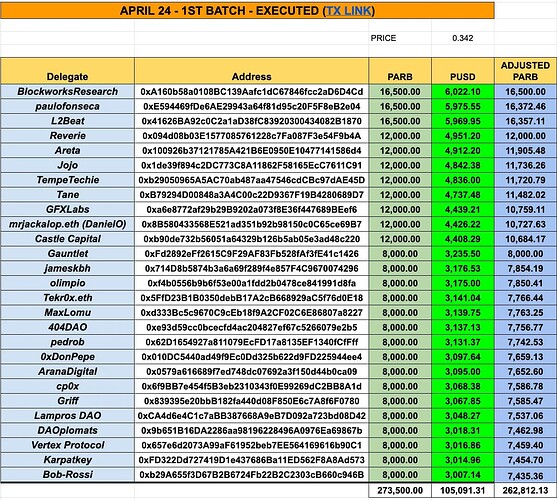
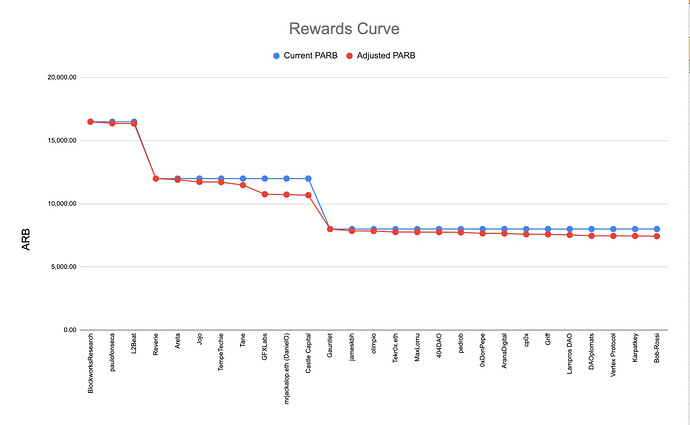
The minimum score to get a Reward is 50 Total Participation Points (TPP) for Tier X and 65 Total Participation Points (TPP) for Tier 3.
To determine which delegates will receive monthly payments, we will continue using the dashboard developed by Karma.
Note: The program manager may adjust the scoring parameters without the need for a DAO Vote, provided they inform the DAO of the reasons for the changes.
1. Participation Rate (PR90) – Weight: 15 points
Tracks delegate voting activity over the past 90 days to measure consistency in participation.
Formula: (PR90 * 15) / 100
Example: If a delegate has a PR90 of 80%, their score for this metric is:
(80 * 15) / 100 = 12
2. Snapshot Voting (SV) – Weight: 20 points
Measures participation in voting on Snapshot proposals during the evaluation month.
Formula: (SV(Rn) / SV(Tn)) * 20
Example: If a delegate votes on 8 out of 10 proposals, their score for this metric is:
(8 / 10) * 20 = 16
3. Tally Voting (TV) – Weight: 25 points
Measures on-chain voting participation using the Tally platform.
Formula: (TV(Rn) / TV(Tn)) * 25
Example: If a delegate votes on 9 out of 12 proposals, their score for this metric is:
(9 / 12) * 25 = 18.75
4. Voting Power Multiplier (VPM)
A linear function that adjusts the scoring of the Voting Participation parameters by using a multiplier based on the Average Monthly VP of each Delegate.
Formula: 0.00000005063 * Delegate VP (monthly avg) + 0.7974685
1. DF (Delegate Feedback Score) - Weight: 40 points
Assesses the quality of a delegate’s feedback using a rubric with five criteria (e.g., clarity, depth, relevance). Feedback is scored from 0 to 10 (0 is reserved for penalties), and the presence in discussions acts as a multiplier.
Formula: (Σ qualitative criteria / 50) * 40 * Multiplier
Example: If a delegate scores 40/50 on the rubric and participates in 80% of discussions (multiplier = 1.2): (40 / 50) * 40 * 1.2 = 38.4
2. Bonus Points (BP) – Extra 30 points
Awarded for exceptional contributions, such as attending governance calls.
| Governance Activity | New Bonus |
|---|---|
| Governance Report Call | 1.25% BP per call |
| Open Discussion of Proposals Call | 1.25% BP per call |
| Max Bonus Cap | 5% BP |
| Metric | Weight | Formula |
|---|---|---|
| Participation Rate (PR) | 15 | (PR90 * 15) / 100 |
| Snapshot Voting (SV) | 20 | (SV(Rn) / SV(Tn)) * 20 |
| Tally Voting (TV) | 25 | (TV(Rn) / TV(Tn)) * 25 |
| Voting Power Multiplier (VPM) | 0.8 to 1 | 0.00000005063 * Delegate VP (monthly avg) + 0.7974685 |
| Delegate Feedback (DF) | 40 | (Σ rubric score / 50) * 40 * Multiplier |
| Bonus Points (BP) | Extra | +30 TP |
It combines all the aforementioned parameters to calculate the delegate’s overall score and it follows these steps:
Formula: (PR% + SV% + TV%) * VPM + DF% + BP
Determines the monthly compensation in USD based on TP% and tier.
Formula:=MIN(4200, SI(TIER=X, 1000 + (TP-50)*(1500-1000)/(65-50), SI(TIER=3, 1800 + (TP-65)*(2000-1800)/(75-65), SI(TIER=2, 2500 + (TP-90)*(3000-2500)/(90-75), SI(TIER=1, 3600 + (4200-3600)/(100-90), 0)))))
Converts USD payment to ARB, capped by a tier-specific limit.
Formula:IF(PUSD/ARB Price > Tier Cap; Tier Cap; PUSD/ARB Price)
Note: Tier cap only applies if it’s the best delegate of the Tier, see details about Adjusted Cap Method above.
The rubric assesses the valid feedback provided by the delegate throughout the month (from day 1 at 00:00 UTC to the last day of the month at 23:59:59 UTC), based on a summary of their participation in various proposals and discussions. The aim is to measure the consistency, quality, and overall impact of their contributions.
Here is a breakdown of each criterion included in the rubric:
1. Data Collection and filtering: At the end of the month, the complete set of contributions by each DIP Participant across all discussions on the forum is reviewed and the Program Manager will consult with the different proposers/key stakeholders to determine whether or not to include contributions made in the forum.
A criterion is established to determine when a comment is considered valid or invalid:
Clarifications:
2. Overall Evaluation: After gathering all contributions considered “valid” for the month, a rubric is used to assess the delegate’s overall performance on each criterion, based on a holistic view of their participation.
3. Score Assignment: A level of 1 to 5 is assigned to each criterion, based on the consistency and quality of the DIP Participant’s contributions over the month. Each level has an assigned score, from 1 to 10. (0 is reserved for penalties)
4. Monthly Report: A qualitative and quantitative report summarizing the DIP Participant’s performance over the month is then produced.
Each rubric criterion has levels with an assigned score, from 1 to 10, depending on the level achieved.
The initial score is obtained by adding the first five criteria, while the final score results from applying the “Presence in Discussions” multiplier to the initial average score. The maximum Initial Score is 50 points, and 40 points for the Final Score.
Vote-buying platforms will be excluded from the Delegate Incentive Program, given that these platforms operate with their own economic incentives for how the Voting Power they acquire is used. The Program Manager reserves the right to revisit this decision if, in the future, the DAO gains greater clarity on the matter and finds it feasible to use the DIP as a mechanism for alignment with vote-buying platforms. This means that, if consensus is reached, pathways may be proposed to allow these platforms to participate in the program for the benefit of the DAO.
If DIP Participants disagree with the results presented by the Karma Dashboard at the beginning of each month, they have a four-day period to contest them.
To raise a dispute, delegates must post a message in the forum using the following template:
The DIP administrator will address the issue promptly, with a resolution expected within a maximum of 4 days.
Important clarifications:
The program administrator will have the right to expel a delegate if they attempt to game or exploit the program or if the DIP Participant does not comply with the DIP’s Terms and Conditions. This decision is at the discretion of the program administrator. In all cases, the ban is permanent.
The affected DIP Participant may submit an appeal to the Arbitrum Foundation, which would act as a neutral mediator in the situation and have the authority to ratify, change, or revoke the Program Manager’s decision.
The Program Manager will have the right to suspend a DIP Participant if commits a fault that, in the Program Manager’s judgment, is insufficient cause for expulsion. The decision and duration of the suspension are at the discretion of the program administrator (duration can’t exceed the program’s current iteration).
The affected DIP Participant may submit an appeal to the Arbitrum Foundation, which would act as a neutral mediator in the situation and have the authority to ratify, change, or revoke the Program Manager’s decision.
The Program Manager will have the right to penalize a DIP Participant if commits a fault that, in the Program Manager’s judgment, is insufficient cause for expulsion or suspension. The penalty could consist of allocating negative bonus points or marking a comment as valid with a score of 0 points to affect the average score in the Delegates’ Feedback Parameter.
The affected DIP Participant may submit an appeal to the Arbitrum Foundation, which would act as a neutral mediator in the situation and have the authority to ratify, change, or revoke the Program Manager’s decision.
In all cases (Ban, Suspension or Penalty), in the future and once OpCo is fully operational, responsibility for the resolution of conflicts can be transferred to the OpCo at the Program Manager’s discretion. The Program Manager will acknowledge when this transfer can take place and make it public on the governance forum when it goes into effect.
At the moment of approving the 1.5 proposal, we had a Program Growth Clause that allowed the Program Manager to reopen discussions on the budget:
In light of the increase in Eligible Participants, the addition of new responsibilities such as the formalization of our authority to determine cases of non-compliance with the Terms and Conditions / DAO Code of Conduct, and our commitment to carry out a Business Development effort to onboard new DIP Participants into the program, we propose a 25% increase in the Program Manager’s compensation for the remaining four months.
The SEEDGov team and Karma will continue to collaborate to maintain and manage this new version of the DIP.
Over the past six months, our team has successfully built and maintained the DAO’s compensation dashboard. Based on this experience, we anticipate the following work for the upcoming year:
We commit to delivering:
Despite what we mentioned in the Program’s Growth Clause, the administrative budget won’t undergo any significant changes
Total: $204,000 ($16,000 per month from November to July and $20,000 from August to October) (4 months remaining at the time of writing this post)
With the DAO’s shifting priorities and reduced operational burden for delegates, we believe the original goals may no longer be fully aligned with the current context. It’s important to note that this proposal was approved nearly 9 months ago, and naturally, in a fast-moving environment like crypto, some expectations become outdated.
The program naturally has two main objectives today:
Considering this, we propose the following KPIs for the remaining months:
The SEEDGov team and Karma are committed to gathering feedback, obtaining more information, and implementing the necessary changes to optimize performance. Considering the new duration of the program, the Program Administrator reserves the right to make changes in the scoring methodology by giving public notice in the forum.
For the purpose of publishing the final text of the amended proposal on the public forum and Snapshot, we present it below:
The program was initially approved for 12 months starting in November 2024; therefore, the last month of this iteration will be October 2025.
ArbitrumDAO may cancel the program or modify parameters, such as scoring methodology, through a Snapshot vote where the number of FOR votes to modify or wind down the initiative meets 3% of the votable supply level. If there are more voting options than the basic FOR/AGAINST/ABSTAIN, the option with the largest number of votes will be applied, given that the options to modify/cancel the initiative together exceed the 3% of the votable supply level.
The DIP initially included the requirement that each DIP Participant must adhere to the social agreements reached by the DAO:
Each delegate must adhere to all social agreements reached through Snapshot, including those outlined in proposals such as ‘Improving Predictability in Arbitrum DAO’s Operations,’ ‘Should the DAO Create COI & Self Voting Policies?,’ ‘Incentives Detox Proposal,’ and any other proposals or codes of conduct that may be approved in the future.
In this iteration, and in light of what is outlined in the Rationale, we incorporated a specific set of Terms and Conditions for the program, to which DIP Participants must adhere to participate in the DIP.
DIP Participants: An individual or entity who applied to the Delegate Incentive Program and it’s eligible to participate in it, and/or is compensated via the DIP.
DAO Contributor: An individual or entity who willingly engages in Arbitrum governance and/or is compensated via a DAO-approved program.
Community Guidelines: The rules of engagement for the Arbitrum DAO forum as outlined and enforced by the Arbitrum Foundation.
Conflict of Interest (COI): A situation where a contributor, or any entity with which a contributor has a direct professional or financial relationship, stands to directly benefit from the outcome of a proposal or election.
DIP Participants should always strive to uphold the seven community values stated below:
DIP Participants must adhere to the remaining social agreements reached by the DAO, with the understanding that, if there are contradictions between a Social Agreement (such as the DAO’s Code of Conduct) and the DIP’s Terms and Conditions, then the DIP’s policies shall take precedence.
All DIP Participants are expected to abide by the DIP’s Terms and Conditions. The DIP’s Program Manager is the one responsible for determining violations of the Terms and Conditions and reserves the right to take what it deems as appropriate action, which may include but is not limited to, issuing a penalty, a warning, suspension, or a total removal from the program. Any DAO member can raise a concern to the Program Manager concerning a DIP Participant failing to uphold the DIP’s Terms and Conditions, and the Program Manager must provide an answer; however, the final determination and resulting course of action will depend on the Program Manager and/or the Appeal Process.
Regarding the appeals process, the following mechanism had previously been defined:
The affected delegate may request a Snapshot vote to ratify, change, or revoke the Administrator’s decision. This serves as a one-time appeal, and the decision made by the DAO will be final.
In the new iteration, appeals of any type of sanction (whether suspension or removal from the program) should be submitted by the affected DIP Participant to the Arbitrum Foundation, which would act as a neutral mediator in the situation and have the authority to ratify, change, or revoke the Program Manager’s decision.
In the future and once OpCo is fully operational, responsibility for the resolution of conflicts can be transferred to the OpCo at the Program Manager’s discretion. The Program Manager will acknowledge when this transfer can take place and make it public on the governance forum when it goes into effect.
The requirements to participate in the program are as follows:
Delegates who meet the requirements must confirm their participation in the DIP via the DIP Application Thread. Delegates can join the program anytime within 12 months, provided they meet the specified criteria. To minimize the potential for manipulation, delegates who sign up until the third day of the month will be included in the incentive calculations for that month. The Program Manager reserves the right to apply exceptions regarding this rule, as long as it provides a rationale for this decision.
It is important to mention that it won’t be necessary for the DIP Participants already registered to complete the compliance process again
As a final note, it is worth mentioning that we rely on the good faith of participants regarding COI Disclosure and urge them to keep this information as up-to-date as possible so that if a new conflict arises, both the Program Administrator and the DAO can be aware of it.
Note: Any delegate who chooses to withdraw from the program can indicate their intention to opt out by posting a message in the forum.
We will maintain this parameter at 50 delegates.
The Tier determines the final Reward (USD). Since Rewards are being calculated in USD but paid in ARB, each tier has an ARB Cap.
| Tier | TP% | Min (USD) | Max (USD) | ARB Cap |
|---|---|---|---|---|
| 1 | 90–100% | $3,600 | $4,200 | 12,350 |
| 2 | 75–90% | $2,500 | $3,000 | 8,800 |
| 3 | 65–75% | $1,800 | $2,000 | 5,900 |
| X | 50–65% | $1,000 | $1,500 | 4,400 |
The ARB Caps have been recalculated using 80% of the VWAP from the last 30 days at the time the Snapshot vote is published.
Note: The ARB 30-day VWAP on July 31st is $0.425 therefore the 80% of the VWAP is $0.34 which is the price used to recalculate the ARB Caps.
Monthly payments will be made using the last 7-day VWAP on the day the transaction is submitted to the Arbitrum Foundation.
Payments to delegates are expected to be processed in ARB from the Arbitrum Foundation Controlled Address between the 20th and the last day of each month.
Please note that this is an estimated timeline intended as guidance and does not constitute a binding deadline, as the actual payment date will depend on two factors:
It is also important to consider that any new DIP Participants who become eligible for a reward for the first time will need to complete the Arbitrum Foundation’s Compliance process. As a result, disbursements in these cases may be delayed beyond the dates specified.
Let’s suppose:
ARB Price = $0.20
Theoretical Max Payout for Delegate 1 = $4,200 → 21,000 ARB
Tier Cap = 15,700 ARB
Step 1: Calculate the adjustment ratio
Step 2: Apply that ratio to all theoretical ARB payouts within the Tier
Example with March Payments Batch 1:
The minimum score to get a Reward is 50 Total Participation Points (TPP) for Tier X and 65 Total Participation Points (TPP) for Tier 3.
To determine which delegates will receive monthly payments, we will continue using the dashboard developed by Karma.
Note: The program manager may adjust the scoring parameters without the need for a DAO Vote, provided they inform the DAO of the reasons for the changes.
1. Participation Rate (PR90) – Weight: 15 points
Tracks delegate voting activity over the past 90 days to measure consistency in participation.
Formula: (PR90 * 15) / 100
Example: If a delegate has a PR90 of 80%, their score for this metric is:
(80 * 15) / 100 = 12
2. Snapshot Voting (SV) – Weight: 20 points
Measures participation in voting on Snapshot proposals during the evaluation month.
Formula: (SV(Rn) / SV(Tn)) * 20
Example: If a delegate votes on 8 out of 10 proposals, their score for this metric is:
(8 / 10) * 20 = 16
3. Tally Voting (TV) – Weight: 25 points
Measures on-chain voting participation using the Tally platform.
Formula: (TV(Rn) / TV(Tn)) * 25
Example: If a delegate votes on 9 out of 12 proposals, their score for this metric is:
(9 / 12) * 25 = 18.75
4. Voting Power Multiplier (VPM)
A linear function that adjusts the scoring of the Voting Participation parameters by using a multiplier based on the Average Monthly VP of each Delegate.
Formula: 0.00000005063 * Delegate VP (monthly avg) + 0.7974685
1. DF (Delegate Feedback Score) - Weight: 40 points
Assesses the quality of a delegate’s feedback using a rubric with five criteria (e.g., clarity, depth, relevance). Feedback is scored from 0 to 10 (0 is reserved for penalties), and the presence in discussions acts as a multiplier.
Formula: (Σ qualitative criteria / 50) * 40 * Multiplier
Example: If a delegate scores 40/50 on the rubric and participates in 80% of discussions (multiplier = 1.2): (40 / 50) * 40 * 1.2 = 38.4
2. Bonus Points (BP) – Extra 30 points
Awarded for exceptional contributions, such as attending governance calls.
| Governance Activity | New Bonus |
|---|---|
| Governance Report Call | 1.25% BP per call |
| Open Discussion of Proposals Call | 1.25% BP per call |
| Max Bonus Cap | 5% BP |
| Metric | Weight | Formula |
|---|---|---|
| Participation Rate (PR) | 15 | (PR90 * 15) / 100 |
| Snapshot Voting (SV) | 20 | (SV(Rn) / SV(Tn)) * 20 |
| Tally Voting (TV) | 25 | (TV(Rn) / TV(Tn)) * 25 |
| Voting Power Multiplier (VPM) | 0.8 to 1 | 0.00000005063 * Delegate VP (monthly avg) + 0.7974685 |
| Delegate Feedback (DF) | 40 | (Σ rubric score / 50) * 40 * Multiplier |
| Bonus Points (BP) | Extra | +30 TP |
It combines all the aforementioned parameters to calculate the delegate’s overall score and it follows these steps:
Formula: (PR% + SV% + TV%) * VPM + DF% + BP
Determines the monthly compensation in USD based on TP% and tier.
Formula:=MIN(4200, SI(TIER=X, 1000 + (TP-50)*(1500-1000)/(65-50), SI(TIER=3, 1800 + (TP-65)*(2000-1800)/(75-65), SI(TIER=2, 2500 + (TP-90)*(3000-2500)/(90-75), SI(TIER=1, 3600 + (4200-3600)/(100-90), 0)))))
Converts USD payment to ARB, capped by a tier-specific limit.
Formula:IF(PUSD/ARB Price > Tier Cap; Tier Cap; PUSD/ARB Price)
Note: Tier cap only applies if it’s the best delegate of the Tier, see details about Adjusted Cap Method above.
The rubric assesses the valid feedback provided by the delegate throughout the month (from day 1 at 00:00 UTC to the last day of the month at 23:59:59 UTC), based on a summary of their participation in various proposals and discussions. The aim is to measure the consistency, quality, and overall impact of their contributions.
Here is a breakdown of each criterion included in the rubric:
1. Data Collection and filtering: At the end of the month, the complete set of contributions by each DIP Participant across all discussions on the forum is reviewed and the Program Manager will consult with the different proposers/key stakeholders to determine whether or not to include contributions made in the forum.
A criterion is established to determine when a comment is considered valid or invalid:
Clarifications:
2. Overall Evaluation: After gathering all contributions considered “valid” for the month, a rubric is used to assess the delegate’s overall performance on each criterion, based on a holistic view of their participation.
3. Score Assignment: A level of 1 to 5 is assigned to each criterion, based on the consistency and quality of the DIP Participant’s contributions over the month. Each level has an assigned score, from 1 to 10. (0 is reserved for penalties)
4. Monthly Report: A qualitative and quantitative report summarizing the DIP Participant’s performance over the month is then produced.
Each rubric criterion has levels with an assigned score, from 1 to 10, depending on the level achieved.
The initial score is obtained by adding the first five criteria, while the final score results from applying the “Presence in Discussions” multiplier to the initial average score. The maximum Initial Score is 50 points, and 40 points for the Final Score.
Vote-buying platforms will be excluded from the Delegate Incentive Program, given that these platforms operate with their own economic incentives for how the Voting Power they acquire is used. The Program Manager reserves the right to revisit this decision if, in the future, the DAO gains greater clarity on the matter and finds it feasible to use the DIP as a mechanism for alignment with vote-buying platforms. This means that, if consensus is reached, pathways may be proposed to allow these platforms to participate in the program for the benefit of the DAO.
If DIP Participants disagree with the results presented by the Karma Dashboard at the beginning of each month, they have a four-day period to contest them.
To raise a dispute, delegates must post a message in the forum using the following template:
The DIP administrator will address the issue promptly, with a resolution expected within a maximum of 4 days.
Important clarifications:
The program administrator will have the right to expel a delegate if they attempt to game or exploit the program or if the DIP Participant does not comply with the DIP’s Terms and Conditions. This decision is at the discretion of the program administrator. In all cases, the ban is permanent.
The affected DIP Participant may submit an appeal to the Arbitrum Foundation, which would act as a neutral mediator in the situation and have the authority to ratify, change, or revoke the Program Manager’s decision.
The Program Manager will have the right to suspend a DIP Participant if commits a fault that, in the Program Manager’s judgment, is insufficient cause for expulsion. The decision and duration of the suspension are at the discretion of the program administrator (duration can’t exceed the program’s current iteration).
The affected DIP Participant may submit an appeal to the Arbitrum Foundation, which would act as a neutral mediator in the situation and have the authority to ratify, change, or revoke the Program Manager’s decision.
The Program Manager will have the right to penalize a DIP Participant if commits a fault that, in the Program Manager’s judgment, is insufficient cause for expulsion or suspension. The penalty could consist of allocating negative bonus points or marking a comment as valid with a score of 0 points to affect the average score in the Delegates’ Feedback Parameter.
The affected DIP Participant may submit an appeal to the Arbitrum Foundation, which would act as a neutral mediator in the situation and have the authority to ratify, change, or revoke the Program Manager’s decision.
In all cases (Ban, Suspension or Penalty), in the future and once OpCo is fully operational, responsibility for the resolution of conflicts can be transferred to the OpCo at the Program Manager’s discretion. The Program Manager will acknowledge when this transfer can take place and make it public on the governance forum when it goes into effect.
At the moment of approving the 1.5 proposal, we had a Program Growth Clause that allowed the Program Manager to reopen discussions on the budget:
In light of the increase in Eligible Participants, the addition of new responsibilities such as the formalization of our authority to determine cases of non-compliance with the Terms and Conditions / DAO Code of Conduct, and our commitment to carry out a Business Development effort to onboard new DIP Participants into the program, we propose a 25% increase in the Program Manager’s compensation for the remaining four months.
The SEEDGov team and Karma will continue to collaborate to maintain and manage this new version of the DIP.
Over the past six months, our team has successfully built and maintained the DAO’s compensation dashboard. Based on this experience, we anticipate the following work for the upcoming year:
We commit to delivering:
Despite what we mentioned in the Program’s Growth Clause, the administrative budget won’t undergo any significant changes
Total: $204,000 ($16,000 per month from November to July and $20,000 from August to October) (4 months remaining at the time of writing this post)
With the DAO’s shifting priorities and reduced operational burden for delegates, we believe the original goals may no longer be fully aligned with the current context. It’s important to note that this proposal was approved nearly 9 months ago, and naturally, in a fast-moving environment like crypto, some expectations become outdated.
The program naturally has two main objectives today:
Considering this, we propose the following KPIs for the remaining months:
The SEEDGov team and Karma are committed to gathering feedback, obtaining more information, and implementing the necessary changes to optimize performance. Considering the new duration of the program, the Program Administrator reserves the right to make changes in the scoring methodology by giving public notice in the forum.


https://forum.arbitrum.foundation/t/proposal-updates-to-the-dip-the-complete-1-7-version/29635/39

https://forum.arbitrum.foundation/t/proposal-updates-to-the-dip-the-complete-1-7-version/29635/37

https://forum.arbitrum.foundation/t/proposal-updates-to-the-dip-the-complete-1-7-version/29635/36?u=ocandocrypto

Democratising lobbyism, on-chain. Check out lobbyfi.xyz
https://forum.arbitrum.foundation/t/proposal-updates-to-the-dip-the-complete-1-7-version/29635/39
https://forum.arbitrum.foundation/t/proposal-updates-to-the-dip-the-complete-1-7-version/29635/37
https://forum.arbitrum.foundation/t/proposal-updates-to-the-dip-the-complete-1-7-version/29635/36?u=ocandocrypto
Democratising lobbyism, on-chain. Check out lobbyfi.xyz

Glad to see the continued evolution of this program.

https://forum.arbitrum.foundation/t/tekr0x-eth-delegate-communication-thread/24804/21?u=tekr0x.eth
The Event Horizon Community voted on this proposal (ehARB-126): EventHorizon.vote/vote/arbitrum/ehARB-126

The Event Horizon Community voted FOR: UPGRADE TO V1.7 on this proposal (ehARB-126): EventHorizon.vote/vote/arbitrum/ehARB-126

For: This proposal facilitates seamless governance by clarifying terms, incentivizing delegate participation, and improving dispute resolution, empowering the strategic vision.

https://forum.arbitrum.foundation/t/proposal-updates-to-the-dip-the-complete-1-7-version/29635/30?u=griff

https://forum.arbitrum.foundation/t/proposal-updates-to-the-dip-the-complete-1-7-version/29635/29

https://forum.arbitrum.foundation/t/proposal-updates-to-the-dip-the-complete-1-7-version/29635/27?u=euphoria

https://forum.arbitrum.foundation/t/gfx-labs-delegate-communication-thread/13794

https://forum.arbitrum.foundation/t/tempetechie-eth-delegate-communication-thread/27225/11#p-72963-snapshot-proposal-non-constitutional-updates-to-the-dip-the-complete-17-versionhttpssnapshotboxsarbitrumfoundationethproposal0x008f190725018c3db0e6464bf31d44f09a4d7773fd1486dff0c52c27b8aba289-3

this new version will, every month, distribute $55k in rewards to delegates on average, and cost $27.5k to run. this is roughly a 50% overhead on admin which clearly shows that the proposed design of this program is not fit for purpose. we should design a way better program that runs with way less overhead and subjectivity. https://forum.arbitrum.foundation/t/proposal-updates-to-the-dip-the-complete-1-7-version/29635/26?u=paulofonseca
Glad to see the continued evolution of this program.
https://forum.arbitrum.foundation/t/tekr0x-eth-delegate-communication-thread/24804/21?u=tekr0x.eth
The Event Horizon Community voted on this proposal (ehARB-126): EventHorizon.vote/vote/arbitrum/ehARB-126
The Event Horizon Community voted FOR: UPGRADE TO V1.7 on this proposal (ehARB-126): EventHorizon.vote/vote/arbitrum/ehARB-126
For: This proposal facilitates seamless governance by clarifying terms, incentivizing delegate participation, and improving dispute resolution, empowering the strategic vision.
https://forum.arbitrum.foundation/t/proposal-updates-to-the-dip-the-complete-1-7-version/29635/30?u=griff
https://forum.arbitrum.foundation/t/proposal-updates-to-the-dip-the-complete-1-7-version/29635/29
https://forum.arbitrum.foundation/t/proposal-updates-to-the-dip-the-complete-1-7-version/29635/27?u=euphoria
https://forum.arbitrum.foundation/t/gfx-labs-delegate-communication-thread/13794
https://forum.arbitrum.foundation/t/tempetechie-eth-delegate-communication-thread/27225/11#p-72963-snapshot-proposal-non-constitutional-updates-to-the-dip-the-complete-17-versionhttpssnapshotboxsarbitrumfoundationethproposal0x008f190725018c3db0e6464bf31d44f09a4d7773fd1486dff0c52c27b8aba289-3
this new version will, every month, distribute $55k in rewards to delegates on average, and cost $27.5k to run. this is roughly a 50% overhead on admin which clearly shows that the proposed design of this program is not fit for purpose. we should design a way better program that runs with way less overhead and subjectivity. https://forum.arbitrum.foundation/t/proposal-updates-to-the-dip-the-complete-1-7-version/29635/26?u=paulofonseca

FOR — The “legacy” Tether bridge predates the canonical USDT contract, fragments liquidity, and leaves an extra surface for exploits or spoofed deposits. Disabling it now—after months of notice and with exchange integrations already migrated—consolidates all USDT flow into the single, audited canonical contract. Users holding the legacy token can still redeem 1:1, so no funds are stranded. This clean-up lowers long-term support overhead, eliminates a security foot-gun, and makes the network simpler for wallets, dApps, and new institutional treasuries that are considering an Arbitrum deployment.
FOR — The “legacy” Tether bridge predates the canonical USDT contract, fragments liquidity, and leaves an extra surface for exploits or spoofed deposits. Disabling it now—after months of notice and with exchange integrations already migrated—consolidates all USDT flow into the single, audited canonical contract. Users holding the legacy token can still redeem 1:1, so no funds are stranded. This clean-up lowers long-term support overhead, eliminates a security foot-gun, and makes the network simpler for wallets, dApps, and new institutional treasuries that are considering an Arbitrum deployment.

Thank you for this contribution and the explanations offered. I support the proposal. I just have a small contribution on this:
Thank you for this contribution and the explanations offered. I support the proposal. I just have a small contribution on this:
Vote-buying platforms will be excluded from the Delegate Incentive Program, given that these platforms operate with their own economic incentives for how the Voting Power they acquire is used.
As discussed on the call on July 29, 2025 - Open Discussion of Proposals Governance Call, having vote-buying platforms in the program may be beneficial if they align with the DAO’s wants. However, clear structures and criteria should be put in place (like a set of rules) to ensure that proposals are not only decided exclusively by vote-buyers but by the community as a whole. (Maybe put a cap on the % vote buyers can be incentivized with)
It would be disadvantageous for the DAO to lock these platforms from the incentives if they can show tangible (or in other cases “invisible”) contributions in governance issues.

Hey everyone, publishing the recording from the Open Community Call that took place on 23rd July 2025.
Recording (23.7.2025) Chat Log (23.7.2025) Gemini Notes
FYI: For some reason, the transcription failed and we do not have the file, sorry for that.

Thanks for putting up the well-thought proposal! As a builder & delegate, we embrace the idea of differentiating delegate and contributor, and support the structure change that attracts both of them to contribute.
We are on board with the direction of decreasing incentives since the activities required are less generally and the introduction of committee. But usually a more mild trending down might find its way easier so that some delegates can adapt accordingly. If 40% percent is a bit aggressive, 20% might be a good start.
Thank you for this contribution and the explanations offered. I support the proposal. I just have a small contribution on this:
Thank you for this contribution and the explanations offered. I support the proposal. I just have a small contribution on this:
Vote-buying platforms will be excluded from the Delegate Incentive Program, given that these platforms operate with their own economic incentives for how the Voting Power they acquire is used.
As discussed on the call on July 29, 2025 - Open Discussion of Proposals Governance Call, having vote-buying platforms in the program may be beneficial if they align with the DAO’s wants. However, clear structures and criteria should be put in place (like a set of rules) to ensure that proposals are not only decided exclusively by vote-buyers but by the community as a whole. (Maybe put a cap on the % vote buyers can be incentivized with)
It would be disadvantageous for the DAO to lock these platforms from the incentives if they can show tangible (or in other cases “invisible”) contributions in governance issues.
Hey everyone, publishing the recording from the Open Community Call that took place on 23rd July 2025.
Recording (23.7.2025) Chat Log (23.7.2025) Gemini Notes
FYI: For some reason, the transcription failed and we do not have the file, sorry for that.
Thanks for putting up the well-thought proposal! As a builder & delegate, we embrace the idea of differentiating delegate and contributor, and support the structure change that attracts both of them to contribute.
We are on board with the direction of decreasing incentives since the activities required are less generally and the introduction of committee. But usually a more mild trending down might find its way easier so that some delegates can adapt accordingly. If 40% percent is a bit aggressive, 20% might be a good start.

That's correct Paulo! Thanks for pointing it
That's correct Paulo! Thanks for pointing it

In alignment with the Arbitrum Foundation’s previous stance on vote buying (here), we support SeedGov’s decision to omit vote buying platforms from the DIP.
We believe that the DIP should incentivize good delegate participation, rather than participation for participation’s sake. The program shouldn't, for example, incentivize behaviour which while participatory, potentially undermines DAO's economic security via vote buying. Furthermore, we believe it's important that vote buying platforms become mature enough for the community to better understand their actual impact before being included in such programs.
In alignment with the Arbitrum Foundation’s previous stance on vote buying (here), we support SeedGov’s decision to omit vote buying platforms from the DIP.
We believe that the DIP should incentivize good delegate participation, rather than participation for participation’s sake. The program shouldn't, for example, incentivize behaviour which while participatory, potentially undermines DAO's economic security via vote buying. Furthermore, we believe it's important that vote buying platforms become mature enough for the community to better understand their actual impact before being included in such programs.
If vote buying platforms were to be included, we believe that it would only make sense to reward them for voting ‘abstain’ (which, in the case of the largest vote buying platform, is the default when no one buys its vote), as the platform generates revenue if users purchase for/against votes already.
On another note, we see significant room for improvement in how the DIP is structured and what kind of tangible outcomes it brings to the DAO, e.g., a clear delineation between contributor and delegate is needed. Consequently, we believe that the work on a 2.0 version of the DIP should be accelerated.
In alignment with the Arbitrum Foundation’s previous stance on vote buying (here), we support SeedGov’s decision to omit vote buying platforms from the DIP.
We believe that the DIP should incentivize good delegate participation, rather than participation for participation’s sake. The program shouldn't, for example, incentivize behaviour which while participatory, potentially undermines DAO's economic security via vote buying. Furthermore, we believe it's important that vote buying platforms become mature enough for the community to better understand their actual impact before being included in such programs.
In alignment with the Arbitrum Foundation’s previous stance on vote buying (here), we support SeedGov’s decision to omit vote buying platforms from the DIP.
We believe that the DIP should incentivize good delegate participation, rather than participation for participation’s sake. The program shouldn't, for example, incentivize behaviour which while participatory, potentially undermines DAO's economic security via vote buying. Furthermore, we believe it's important that vote buying platforms become mature enough for the community to better understand their actual impact before being included in such programs.
If vote buying platforms were to be included, we believe that it would only make sense to reward them for voting ‘abstain’ (which, in the case of the largest vote buying platform, is the default when no one buys its vote), as the platform generates revenue if users purchase for/against votes already.
On another note, we see significant room for improvement in how the DIP is structured and what kind of tangible outcomes it brings to the DAO, e.g., a clear delineation between contributor and delegate is needed. Consequently, we believe that the work on a 2.0 version of the DIP should be accelerated.

Just a general comment based on the feedback from delegates
I hope someone can explain to me why delegates vote For, yet raise a large number of concerns about the proposal in their justifications.
Just a general comment based on the feedback from delegates
I hope someone can explain to me why delegates vote For, yet raise a large number of concerns about the proposal in their justifications.
Delegates - if you disagree with something, you can simply vote Against. The current program is already in place, and these changes would only apply for a couple of months until the new 2.0 program is introduced - so why agree to something that doesn’t suit you?
If you’re offered 5 good and 5 bad changes, the right approach is to first remove the 5 bad ones and only then approve the proposal. There’s nothing wrong with rejecting a proposal - it’s just a reason to reflect and improve it. I don’t understand why one would accept a compromise that they’re clearly unhappy with in such a controversial situation

The following reflects the views of L2BEAT’s governance team, composed of @krst, @Sinkas, and @Manugotsuka, and it’s based on their combined research, fact-checking, and ideation.
We are voting FOR, although we are quite critical of this proposal.
The following reflects the views of L2BEAT’s governance team, composed of @krst, @Sinkas, and @Manugotsuka, and it’s based on their combined research, fact-checking, and ideation.
We are voting FOR, although we are quite critical of this proposal.
In general, we are supportive of restructuring the DIP program and reducing DAO’s spend on it. However, the restructuring should come first, with cost reduction being a byproduct rather than a primary goal. We should first clarify what we want to incentivize delegates and contributors to do, what activities are desirable, and which activities will be rewarded.
From the current proposal structure and justification provided, it can be inferred that delegate participation is most valued in terms of voting and meeting quorum. The proposal states that the delegate workload is lower than it used to be and provides an explanation for this:
Lower activity in the DAO … due to a more institutionalized environment, with the emergence of Evaluation Committees, the OpCo, Entropy as Governance Facilitator, and both the Arbitrum Foundation and OCL playing a more active role in the DAO
As we mentioned during the DIP call, this statement so far is rather questionable. Almost all initiatives that are ongoing right now in the DAO originated from DAO contributors and delegates’ initiatives:
There would be no Arbitrum Treasury Management if not for STEP, which came from the Treasury Sustainability Working Group that came from Plurality Labs’ Firestarters program
There would be no DRIP if not for STIP and later variations, DETOX discussions, ARDC incentives analysis, and various proposals (like the IOSG wake-up call proposal) coming from the DAO to improve on the incentives.
The D.A.O Grants program comes from the Questbook Delegated Domain Allocator program
Arbitrum Audit Program originated as the ADPC Audit Subsidy program
AGV is a DAO-originated and DAO-led initiative
Hackathon Continuation is a DAO-originated initiative
OpCo originated from delegate discussions at ETHDenver
DAO Events Budget originated from DAO-led GovHack events
SOS discussions are being driven by the community, while AAEs, other than Entropy, are not. participating in them
Many initiatives within the DAO, such as the Arbitrum Ventures Initiative, DAO events, and marketing working groups, were put on hold under the assumption that the AAEs would take them over and drive them forward. However, nothing has materialized on that front yet.
We would argue that the current lower activity in the DAO is not due to an increase in the activity of AAEs, but rather because of a lack of activity from them. We were, and still are, supportive of the Vision for the future of Arbitrum proposed by the Arbitrum Foundation. However, we must acknowledge that, four months after its publication, we have seen very little initiative from AF or other entities to make it work.
In our opinion, that does not justify lowering the incentives for delegates, unless the goal is just to limit the community activity in the DAO and reduce the delegates' role to just ratifying future proposals put forward by the AAEs. This current proposal does not address these issues, therefore, we would like to amplify @Arbitrum Foundation's request:
On another note, we see significant room for improvement in how the DIP is structured and what kind of tangible outcomes it brings to the DAO, e.g., a clear delineation between contributor and delegate is needed. Consequently, we believe that the work on a 2.0 version of the DIP should be accelerated.
We hope the Arbitrum Foundation will take a more active role in the public discussion around the program, aligning it with their vision for the future of Arbitrum and clarifying expectations for contributors and delegates.
Due to our concerns, we were initially considering voting against this proposal, but after discussing it with @SEEDGov, we understand that this new format allows us to reduce SEED overhead on delegate assessment, which will allow them to put more resources into working on the new version that will address proper clarification of contributor paths and delegate roles. So we decided to support it.
As in @web3citizenxyz representation, voting abstain for this proposal. Below the rationale:

The following reflects the views of GMX’s Governance Committee, and is based on the combined research, evaluation, consensus, and ideation of various committee members.
We appreciate the work put in by Seed Latam in the Delegate incentive program. We support the changes as it will help reduce the cost and will have a tighter structure and reward delegates for the amount of work they have put in not rewarding for the sake of incentives. We are in favour of the proposal.

I voted FOR in this proposal. I understand the reasoning behind the suggested changes and the limitations that can be done right now. My suggestion is that the v2 should be shared with the whole DAO with enough time for a proper discussion, so it becomes a better iteration.

We’ve voted For this proposal. No additional comments at this time. Thanks to @SEEDGov for the work done here.

Thank you for catching that, @paulofonseca.
We’ve updated our rationale to reflect the corrected figures and context, and these edits didn’t change our overall stance on the proposal.
the admin budget is not unchanged. on the contrary, it’s going to increase by 25% with the activation of the Program Growth Clause in this proposal, as can be seen here:
Although I’m a relatively new delegate, which means I would naturally benefit from the program staying exactly as it is, I support the reduction in compensation. This change will decrease the DAO’s expenses, something I view positively.
I also agree with the increase in the token threshold to 500,000, as it helps prevent individuals from joining the DAO solely to farm the treasury. That said, I do appreciate that current delegates remain eligible. If that weren’t the case, it would feel somewhat unfair — given that eligibility requires a time commitment of at least three months before any potential compensation is even received. Reaching the 50,000 token threshold isn’t simple either, so I feel there is a fair degree of respect shown toward the work some of us have already put in.
We vote in favor of this proposal.
Given the ongoing structural transformations within Arbitrum DAO and considering the historically high costs associated with the DIP, the proposed reduction in expenses is reasonable and timely. Additionally, while voting participation alone does not fully capture delegate performance, introducing Tier X to encourage higher voting participation aligns effectively with the DAO’s governance objectives.
We vote in favor of this proposal.
Given the ongoing structural transformations within Arbitrum DAO and considering the historically high costs associated with the DIP, the proposed reduction in expenses is reasonable and timely. Additionally, while voting participation alone does not fully capture delegate performance, introducing Tier X to encourage higher voting participation aligns effectively with the DAO’s governance objectives.
However, we share concerns highlighted by @paulofonseca regarding the increased administrative budget despite a significant reduction in delegate incentives.
We understand that the newly added Business Development effort will indeed require additional resources.
However, given limited resources and the overarching goal of fostering greater delegate engagement in forum discussions and voting, it seems counterproductive to maintain administrative expenses at these levels while substantially cutting delegate rewards. The administrative budget should be streamlined through program simplification or restructuring to achieve a more efficient allocation of resources.
Addressing this issue, however, would require substantial structural changes to the DIP. Therefore, we chose not to vote against this specific proposal based on this concern alone. Nevertheless, we believe this aspect should be addressed during the upcoming DIP revision process for the next term.

We will ABSTAIN from this proposal.
While the DIP update introduces improvements and recent clarifications show responsiveness to delegate feedback, we remain concerned about the threshold increase to 500K $ARB. This approach risks favoring large delegates and reducing incentives for smaller ones to stay active.
We will ABSTAIN from this proposal.
While the DIP update introduces improvements and recent clarifications show responsiveness to delegate feedback, we remain concerned about the threshold increase to 500K $ARB. This approach risks favoring large delegates and reducing incentives for smaller ones to stay active.
We recognize SEEDGov’s impactful work for DAOs and appreciate the effort to make the program clearer and fairer, but our concerns about concentration of voting power remain.
Just a general comment based on the feedback from delegates
I hope someone can explain to me why delegates vote For, yet raise a large number of concerns about the proposal in their justifications.
Just a general comment based on the feedback from delegates
I hope someone can explain to me why delegates vote For, yet raise a large number of concerns about the proposal in their justifications.
Delegates - if you disagree with something, you can simply vote Against. The current program is already in place, and these changes would only apply for a couple of months until the new 2.0 program is introduced - so why agree to something that doesn’t suit you?
If you’re offered 5 good and 5 bad changes, the right approach is to first remove the 5 bad ones and only then approve the proposal. There’s nothing wrong with rejecting a proposal - it’s just a reason to reflect and improve it. I don’t understand why one would accept a compromise that they’re clearly unhappy with in such a controversial situation
The following reflects the views of L2BEAT’s governance team, composed of @krst, @Sinkas, and @Manugotsuka, and it’s based on their combined research, fact-checking, and ideation.
We are voting FOR, although we are quite critical of this proposal.
The following reflects the views of L2BEAT’s governance team, composed of @krst, @Sinkas, and @Manugotsuka, and it’s based on their combined research, fact-checking, and ideation.
We are voting FOR, although we are quite critical of this proposal.
In general, we are supportive of restructuring the DIP program and reducing DAO’s spend on it. However, the restructuring should come first, with cost reduction being a byproduct rather than a primary goal. We should first clarify what we want to incentivize delegates and contributors to do, what activities are desirable, and which activities will be rewarded.
From the current proposal structure and justification provided, it can be inferred that delegate participation is most valued in terms of voting and meeting quorum. The proposal states that the delegate workload is lower than it used to be and provides an explanation for this:
Lower activity in the DAO … due to a more institutionalized environment, with the emergence of Evaluation Committees, the OpCo, Entropy as Governance Facilitator, and both the Arbitrum Foundation and OCL playing a more active role in the DAO
As we mentioned during the DIP call, this statement so far is rather questionable. Almost all initiatives that are ongoing right now in the DAO originated from DAO contributors and delegates’ initiatives:
There would be no Arbitrum Treasury Management if not for STEP, which came from the Treasury Sustainability Working Group that came from Plurality Labs’ Firestarters program
There would be no DRIP if not for STIP and later variations, DETOX discussions, ARDC incentives analysis, and various proposals (like the IOSG wake-up call proposal) coming from the DAO to improve on the incentives.
The D.A.O Grants program comes from the Questbook Delegated Domain Allocator program
Arbitrum Audit Program originated as the ADPC Audit Subsidy program
AGV is a DAO-originated and DAO-led initiative
Hackathon Continuation is a DAO-originated initiative
OpCo originated from delegate discussions at ETHDenver
DAO Events Budget originated from DAO-led GovHack events
SOS discussions are being driven by the community, while AAEs, other than Entropy, are not. participating in them
Many initiatives within the DAO, such as the Arbitrum Ventures Initiative, DAO events, and marketing working groups, were put on hold under the assumption that the AAEs would take them over and drive them forward. However, nothing has materialized on that front yet.
We would argue that the current lower activity in the DAO is not due to an increase in the activity of AAEs, but rather because of a lack of activity from them. We were, and still are, supportive of the Vision for the future of Arbitrum proposed by the Arbitrum Foundation. However, we must acknowledge that, four months after its publication, we have seen very little initiative from AF or other entities to make it work.
In our opinion, that does not justify lowering the incentives for delegates, unless the goal is just to limit the community activity in the DAO and reduce the delegates' role to just ratifying future proposals put forward by the AAEs. This current proposal does not address these issues, therefore, we would like to amplify @Arbitrum Foundation's request:
On another note, we see significant room for improvement in how the DIP is structured and what kind of tangible outcomes it brings to the DAO, e.g., a clear delineation between contributor and delegate is needed. Consequently, we believe that the work on a 2.0 version of the DIP should be accelerated.
We hope the Arbitrum Foundation will take a more active role in the public discussion around the program, aligning it with their vision for the future of Arbitrum and clarifying expectations for contributors and delegates.
Due to our concerns, we were initially considering voting against this proposal, but after discussing it with @SEEDGov, we understand that this new format allows us to reduce SEED overhead on delegate assessment, which will allow them to put more resources into working on the new version that will address proper clarification of contributor paths and delegate roles. So we decided to support it.
As in @web3citizenxyz representation, voting abstain for this proposal. Below the rationale:
The following reflects the views of GMX’s Governance Committee, and is based on the combined research, evaluation, consensus, and ideation of various committee members.
We appreciate the work put in by Seed Latam in the Delegate incentive program. We support the changes as it will help reduce the cost and will have a tighter structure and reward delegates for the amount of work they have put in not rewarding for the sake of incentives. We are in favour of the proposal.
I voted FOR in this proposal. I understand the reasoning behind the suggested changes and the limitations that can be done right now. My suggestion is that the v2 should be shared with the whole DAO with enough time for a proper discussion, so it becomes a better iteration.
We’ve voted For this proposal. No additional comments at this time. Thanks to @SEEDGov for the work done here.
Thank you for catching that, @paulofonseca.
We’ve updated our rationale to reflect the corrected figures and context, and these edits didn’t change our overall stance on the proposal.
the admin budget is not unchanged. on the contrary, it’s going to increase by 25% with the activation of the Program Growth Clause in this proposal, as can be seen here:
Although I’m a relatively new delegate, which means I would naturally benefit from the program staying exactly as it is, I support the reduction in compensation. This change will decrease the DAO’s expenses, something I view positively.
I also agree with the increase in the token threshold to 500,000, as it helps prevent individuals from joining the DAO solely to farm the treasury. That said, I do appreciate that current delegates remain eligible. If that weren’t the case, it would feel somewhat unfair — given that eligibility requires a time commitment of at least three months before any potential compensation is even received. Reaching the 50,000 token threshold isn’t simple either, so I feel there is a fair degree of respect shown toward the work some of us have already put in.
We vote in favor of this proposal.
Given the ongoing structural transformations within Arbitrum DAO and considering the historically high costs associated with the DIP, the proposed reduction in expenses is reasonable and timely. Additionally, while voting participation alone does not fully capture delegate performance, introducing Tier X to encourage higher voting participation aligns effectively with the DAO’s governance objectives.
We vote in favor of this proposal.
Given the ongoing structural transformations within Arbitrum DAO and considering the historically high costs associated with the DIP, the proposed reduction in expenses is reasonable and timely. Additionally, while voting participation alone does not fully capture delegate performance, introducing Tier X to encourage higher voting participation aligns effectively with the DAO’s governance objectives.
However, we share concerns highlighted by @paulofonseca regarding the increased administrative budget despite a significant reduction in delegate incentives.
We understand that the newly added Business Development effort will indeed require additional resources.
However, given limited resources and the overarching goal of fostering greater delegate engagement in forum discussions and voting, it seems counterproductive to maintain administrative expenses at these levels while substantially cutting delegate rewards. The administrative budget should be streamlined through program simplification or restructuring to achieve a more efficient allocation of resources.
Addressing this issue, however, would require substantial structural changes to the DIP. Therefore, we chose not to vote against this specific proposal based on this concern alone. Nevertheless, we believe this aspect should be addressed during the upcoming DIP revision process for the next term.
We will ABSTAIN from this proposal.
While the DIP update introduces improvements and recent clarifications show responsiveness to delegate feedback, we remain concerned about the threshold increase to 500K $ARB. This approach risks favoring large delegates and reducing incentives for smaller ones to stay active.
We will ABSTAIN from this proposal.
While the DIP update introduces improvements and recent clarifications show responsiveness to delegate feedback, we remain concerned about the threshold increase to 500K $ARB. This approach risks favoring large delegates and reducing incentives for smaller ones to stay active.
We recognize SEEDGov’s impactful work for DAOs and appreciate the effort to make the program clearer and fairer, but our concerns about concentration of voting power remain.
the admin budget is not unchanged. on the contrary, it’s going to increase by 25% with the activation of the Program Growth Clause in this proposal, as can be seen here:
At the moment of approving the 1.5 proposal, we had a Program Growth Clause that allowed the Program Manager to reopen discussions on the budget:
Although the proposed administrative budget is sufficient in both versions, we understand that if there is a considerable increase in registrations, the workload would increase significantly. That is why we will incorporate a clause where if the program exceeds 65 registered delegates (which is the number that we believe we could cover with the budget requested) we will reopen discussions in the forum on the budget, also considering the possibility of increasing the number of delegates incentivized.
In light of the increase in Eligible Participants, the addition of new responsibilities such as the formalization of our authority to determine cases of non-compliance with the Terms and Conditions / DAO Code of Conduct, and our commitment to carry out a Business Development effort to onboard new DIP Participants into the program, we propose a 25% increase in the Program Manager’s compensation for the remaining four months.
Although I’m a relatively new delegate, which means I would naturally benefit from the program staying exactly as it is, I support the reduction in compensation. This change will decrease the DAO’s expenses, something I view positively.
I also agree with the increase in the token threshold to 500,000, as it helps prevent individuals from joining the DAO solely to farm the treasury. That said, I do appreciate that current delegates remain eligible. If that weren’t the case, it would feel somewhat unfair — given that eligibility requires a time commitment of at least three months before any potential compensation is even received. Reaching the 50,000 token threshold isn’t simple either, so I feel there is a fair degree of respect shown toward the work some of us have already put in.
Ultimately, from my first to my last vote, I will always support proposals that reasonably reduce expenses and those that increase revenue for the DAO.
Finally, I view more than positive the exclusion of vote-buying platforms. Everyone has their own mindset and makes their own choices, but this kind of platform is strongly against my work ethic
The former led in my voting FOR in this proposal.
MY VOTE: For: Upgrade to v1.7
I’m voting for this proposal but I want to be transparent that I have concerns about the DIP program as it stands today. The original intention is good. We all want to support governance participation, reward delegates who contribute, and bring more structure to how value is recognized in the DAO. But over time the program has become bloated and difficult to manage. The overhead it creates is significant. It takes time and energy away from the actual work of growing the ecosystem. And the process feels increasingly misaligned with the spirit of a lean and resilient DAO. I don’t think small fixes will be enough. If this program is going to continue, it needs a complete redesign. We need clearer goals and simpler mechanisms to evaluate impact, and I would love to see AI tools like x23.ai more integrated into the process. We need to reduce friction and make it easier to participate without creating extra bureaucracy. And we need to do a better job at capturing the kinds of contributions that actually move Arbitrum forward. It’s also important to remember that the DIP program should be about strategy discussion and roadmap alignment, not execution. Those are two very different responsibilities. We shouldn’t confuse high-level governance decisions with individual contributions. If we want work to get done, we either need to hire people directly or create a well-designed reward system for contributions. But we need to be clear about what we’re trying to achieve and how each action fits into a broader strategic framework. Otherwise we risk blurring responsibilities and losing focus. My vote in favor is largely about supporting the addition of Tier X. I see this as an interesting experiment that might activate some of the larger delegates and encourage them to engage more with the process. If it leads to more people reading proposals, showing up, and voting, that could create positive momentum meanwhile we are also strengthening quorum. I still believe in the potential of a program like DIP. But to live up to that potential, we need to be honest about what is and isn’t working. A full revamp is needed. And if we do that work together, I think we can create something that serves the DAO better and lasts.

Thanks to @SEEDGov for the work that went into this proposal and for continuing to engage with the community. We appreciate the decision to delay the vote and remove retroactive changes for July. We also support the broader goal of improving the Delegate Incentive Program to reflect the current needs and maturity of the DAO.
That said, we will be voting Against DIP v1.7 in its current form. While the proposal introduces a number of meaningful improvements, there are still several concerns that we believe need to be addressed before it can move forward.
Thanks to @SEEDGov for the work that went into this proposal and for continuing to engage with the community. We appreciate the decision to delay the vote and remove retroactive changes for July. We also support the broader goal of improving the Delegate Incentive Program to reflect the current needs and maturity of the DAO.
That said, we will be voting Against DIP v1.7 in its current form. While the proposal introduces a number of meaningful improvements, there are still several concerns that we believe need to be addressed before it can move forward.
One of our main concerns is the introduction of Tier X. While this may help improve quorum by activating high-voting-power delegates, the structure heavily favors large token holders. In contrast, small and mid-sized delegates are still expected to contribute significantly in order to qualify. This creates a dynamic that feels unbalanced. It might help the DAO reach higher voting participation numerically, but we question what value this brings in the long term if it comes at the cost of devaluing meaningful engagement. The goal of the program should not just be to pass proposals more easily, but to foster thoughtful discussion and active participation across a broad set of contributors.
Smaller and mid-sized delegates are often the ones who take on the more intensive governance work. This includes reviewing proposals, participating in calls, drafting feedback, and contributing to proposal development. These responsibilities require time and effort. Under DIP v1.6, there was already a multiplier that rewarded delegates with higher voting power. With Tier X, the system appears to shift even more benefits toward large holders while making it harder for smaller delegates to stay motivated. In the long run, this could reduce the number of people contributing meaningfully, even if overall quorum looks stronger.
We are also concerned about the proposal to raise the minimum eligibility threshold to 500,000 ARB. While we understand the operational reasoning, this change would exclude many mid-sized delegates who have consistently shown up and delivered value to the DAO. It could also create a much higher barrier to entry for new contributors. Many motivated participants do not begin their journey with large voting power. Removing their opportunity to grow into the program could limit the future delegate pipeline and discourage wider participation.
On the topic of scoring, we believe that removing the ability to dispute subjective evaluations entirely may reduce transparency. While we understand that the evaluation process will now involve more stakeholders and coordination, having no formal channel to raise concerns may cause issues in edge cases. A lightweight dispute process would help maintain fairness without significantly increasing administrative burden.
We also want to acknowledge the proposed 40 percent reduction in delegate rewards. While this may be supported by recent activity data, the cut feels sudden. A more gradual adjustment could help maintain contributor motivation and give people time to adapt. Additionally, although the number of proposals may have decreased, the level of impact required to remain eligible has not changed. Delegates typically still contribute to three or more proposals each cycle. The work required to meet the threshold is still meaningful and should be reflected in the reward structure.
Lastly, we want to echo @paulofonseca about the program’s overall overhead. While delegate rewards are being reduced, the combined budget for the Program Manager and other service providers such as Karma remains unchanged. Some responsibilities, such as managing disputes, have been removed, which raises the question of whether the scope and cost of these roles should be adjusted. At present, the overhead cost is nearly half the amount allocated to delegate rewards, which feels disproportionately high compared to similar incentive programs. We believe it would be beneficial to explore ways to reduce this overhead and redirect more of the budget toward contributors who are directly involved in governance.
In summary, we support the overall intent behind DIP v1.7 and recognize the effort that has gone into improving the program. However, we believe more work is needed to ensure that it remains inclusive, transparent, and sustainable. We hope to see further iterations that address these concerns and look forward to continuing the discussion.
The core issue lies elsewhere - the DIP claims to promote broader participation in voting, and LobbyFi is arguably one of the most effective contributors to that goal.
Yet, instead of being rewarded for their positive impact, they are being penalized. Their financial model is irrelevant here - what matters is the value they bring, and they absolutely deserve to be rewarded for it.
The following reflects the views of the Lampros DAO governance team, composed of Chain_L (@Blueweb) and @Euphoria, based on our combined research, analysis, and ideation.
We are voting FOR this proposal in the Snapshot voting.
The following reflects the views of the Lampros DAO governance team, composed of Chain_L (@Blueweb) and @Euphoria, based on our combined research, analysis, and ideation.
We are voting FOR this proposal in the Snapshot voting.
We recognize that evolving the DIP is essential as Arbitrum DAO grows, governance processes become more mature, and the role of delegates continues to shift. The move to introduce Tier X for high-voting power delegates, to recalibrate compensation reflecting a lower overall governance workload, and to make feedback assessment more transparent and objective are all clear signals that the DIP aims to adapt to a changing ecosystem.
However, as delegates with less VP, we are especially sensitive to how program changes can influence the inclusiveness and diversity of everyone. Our experience matches the sentiment that insightful questions, research, and onboarding energy frequently emerge from smaller delegates who may not hold large amounts of voting power but have a significant investment in the DAO’s quality and long-term success. We have seen, time and again, that Arbitrum benefits when the tent remains open to these perspectives.
It is for this reason that we particularly echo the concerns raised by other delegates, like @0xDonPepe mentioned, regarding the stringency of the DF scoring and its compounded effect when combined with the voting power multiplier. With only around 12% of delegates presently clearing the DF bar under the current, less strict system, increasing the difficulty and combining it with a high voting power threshold risks closing the door to smaller and independent delegates. At a time when the DIP is one of the last open doors for such participation and recognition, we worry about inadvertently entrenching governance around the largest holders and institutional actors, to the detriment of dynamism and decentralization.
While we recognize the logic for introducing Tier X (appreciate the thinking of the team to focus on increasing voting in DAO) and for focusing incentives and program energy where the most voting power can be activated, we urge caution so that these changes do not inadvertently diminish the existing pipeline for new and diverse delegates. The 40% reduction in compensation is significant and, while the justification is grounded in lower overall proposal workload and increased institutional involvement, we recommend ongoing review to avoid discouraging the participation of contributors whose involvement is critical, especially as new delegates start contributing in Arbitrum DAO. Rewarding voting activity alone for large delegates, while increasing the requirements for smaller ones, should be regularly reassessed to ensure it does not yield a disengaged or lopsided ecosystem.
On the subject of vote-buying platforms, we agree that exclusion from DIP incentives is a sound decision until there is consensus and a robust framework to ensure meaningful alignment. The language that leaves the possibility for future inclusion if proper controls are in place demonstrates an appropriately measured approach.
In summary, we vote FOR DIP v1.7, acknowledging the thoroughness of the process, the clarity of documentation, and the clear need for DIP to remain responsive and sustainable as Arbitrum grows. Our support comes with genuine encouragement to keep inclusiveness and diversity of delegate voices as a core priority, to normalize DF scoring wherever possible to the actual best performer each month rather than an impossible ideal, and to ensure that the program's gates do not shut out newer and smaller contributors who are essential for a thriving DAO. Our decision today is a vote of confidence in the process, paired with a commitment to ensuring Arbitrum’s governance remains open, legitimate, and robust.
voting Against on the current offchain vote because this new version will, every month, distribute $55k in rewards to delegates on average, and cost $27.5k to run. this is roughly a 50% overhead on admin which clearly shows that the proposed design of this program is not fit for purpose. we should design a way better program that runs with way less overhead and subjectivity.
First and foremost, we want to thank all delegates and stakeholders for their valuable feedback — both in this thread and during the two recent governance calls.
To provide greater clarity and reassurance to all delegates and stakeholders, we confirm that the following changes have been made:
First and foremost, we want to thank all delegates and stakeholders for their valuable feedback — both in this thread and during the two recent governance calls.
To provide greater clarity and reassurance to all delegates and stakeholders, we confirm that the following changes have been made:
Adjustment to Delegates’ Feedback Evaluation Criteria
In the original proposal, point 4.3 stated:
“3. The Program Manager may also propose outstanding contributions, provided these are submitted for validation by the OP or other relevant stakeholders.”
This has now been amended to:
“3. The Program Manager may also include outstanding contributions.”
This change ensures that the inclusion of outstanding contributions is not perceived as an additional validation hurdle for participants. The updated process intends to strengthen the assessment by incorporating feedback from proposers and major stakeholders — thereby reducing overreliance on the PM’s subjectivity — not to make the program less inclusive.
Change in TL;DR Wording
Accordingly, we’ve updated the TL;DR phrasing for clarity:
The Delegates’ Feedback parameter will be evaluated more objectively and robustly. (instead of “stringently”).
This aims to avoid confusion regarding the evaluation process. As we’ve stated before, our goal is to make the process more robust and well-grounded — not more restrictive.
Clarification on Vote-Buying Platforms. Previously, the clause stated:
7. Exclusion of vote-buying platforms
Vote-buying platforms will be excluded from the Delegate Incentive Program, given that these platforms operate with their own economic incentives for how the Voting Power they acquire is used.
We’ve now introduced discretionary language to allow for future alignment if the DAO reaches consensus:
7. Exclusion of vote-buying platforms Vote-buying platforms will be excluded from the Delegate Incentive Program, given that these platforms operate with their own economic incentives for how the Voting Power they acquire is used. The Program Manager reserves the right to revisit this decision if, in the future, the DAO gains greater clarity on the matter and finds it feasible to use the DIP as a mechanism for alignment with vote-buying platforms. This means that, if consensus is reached, pathways may be proposed to allow these platforms to participate in the program for the benefit of the DAO.
This leaves the door open for future changes that may enable the DAO and the DIP to better align with such platforms.
DIP’s Terms and Conditions and Requirements to Participate in the DIP
In the original proposal, one of the Requirements to participate in the DIP stated:
Adhere to the DIP’s Terms and Conditions and any other Social Agreement: Each DIP Participant must adhere to the DIP’s Terms and Conditions and all social agreements reached through Snapshot, including those outlined in proposals such as ‘Improving Predictability in Arbitrum DAO’s Operations,’ ‘Should the DAO Create COI & Self Voting Policies?,’ ‘Incentives Detox Proposal,’ [Non-Constitutional] Arbitrum DAO Delegate Code of Conduct + Formalizing the DAO’s Operations and any other proposals or codes of conduct that may be approved in the future. If there are contradictions between a Social Agreement (such as the DAO’s Code of Conduct) and the DIP’s Terms and Conditions, then the DIP’s policies shall take precedence.
Now, we included a sentence that states that current DIP Participants are considered to automatically adhere to the DIP’s Terms and Conditions.
Adhere to the DIP’s Terms and Conditions and any other Social Agreement: Each DIP Participant must adhere to the DIP’s Terms and Conditions and all social agreements reached through Snapshot, including those outlined in proposals such as ‘Improving Predictability in Arbitrum DAO’s Operations,’ ‘Should the DAO Create COI & Self Voting Policies?,’ ‘Incentives Detox Proposal,’ [Non-Constitutional] Arbitrum DAO Delegate Code of Conduct + Formalizing the DAO’s Operations and any other proposals or codes of conduct that may be approved in the future. If there are contradictions between a Social Agreement (such as the DAO’s Code of Conduct) and the DIP’s Terms and Conditions, then the DIP’s policies shall take precedence. Current DIP Participants are considered to automatically adhere to the DIP Terms and Conditions unless they state otherwise. In this case, they will be excluded from the program, as adherence to these Terms and Conditions is a mandatory requirement for participation.
With this, we seek to avoid current participants having to reapply or edit their applications to indicate that they agree to the new Terms and Conditions, leaving the possibility for those who do not agree with these TyCs to withdraw their applications from the program.
Disputes
In the original proposal, the dispute modifications stated:
Rubrics on DF and Bonus Points may receive feedback, but will not be altered.
We have now included a sentence clarifying that the Program Manager reserves the right to make changes to the scoring of DIP Participants once the monthly results have been published:
Rubrics on DF and Bonus Points may receive feedback, but will not be altered. The Program Manager reserves the right to make amendments to the scoring of a DIP Participant after presenting the results.
The aim of this is to prevent the PM from being unable to make amendments if we overlook an important contribution.
Tier’s Caps were recalculated
New table:
| Tier | TP% | Min (USD) | Max (USD) | ARB Cap |
|---|---|---|---|---|
| 1 | 90–100% | $3,600 | $4,200 | 12,350 |
| 2 | 75–90% | $2,500 | $3,000 | 8,800 |
| 3 | 65–75% | $1,800 | $2,000 | 5,900 |
| X | 50–65% | $1,000 | $1,500 | 4,400 |
The ARB Caps have been recalculated using 80% of the VWAP from the last 30 days at the time the Snapshot vote is published.
Note: The ARB 30-day VWAP on July 31st is $0.425, therefore the 80% of the VWAP is $0.34 which is the price used to recalculate the ARB Caps.
We’ll address the remaining comments below:
If less feedback is considered, but is judged using the same criteria that is already applied currently, it only seems possible for overall net scores to go down, not up.
This is unless the judgement criteria becomes more permissive, but I didn’t see any mention of that and it seems contrary to the stated objective for DF to be evaluated “more … stringently”.
@Hawheik already did the math in a previous comment, but it really hit me. If you’ve got around 50k voting power, a perfect voting record, and show up to every call (getting that 5% bonus), you’d still need to score at least 14.6 points in Delegate Feedback to qualify for Tier 3.
Now, on paper that might seem doable. But in reality? Only about 12% of delegates managed to pull that off in the last round. That’s 8 out of 66 people. And now the proposal suggests grading DF even more stringently, narrowing the pool of comments that count, and only giving credit to stuff that has some kind of external validation or clear “impact.”
I get where that’s coming from (we want quality over quantity) but if we’re already at just 12% of people passing that DF bar, making it even stricter is just going to filter out more small but active delegates. That’s not the direction we should be heading in.
We believe the clarifications above should fully address these concerns.
As for your specific points, @0xDonPepe:
We reiterate that we are introducing new perspectives to the evaluation process — not additional barriers. We’ve updated the wording to avoid confusion.
We’ve previously explained why your second suggestion was not feasible from our perspective.
Moving the Voting Power Multiplier (VPM) to the payment calculation would undermine its purpose, which is to adjust the scoring only for voting activity. Applying it to payments would distort results under Delegates’ Feedback and Bonus Points, potentially penalizing high-impact contributors with lower VP (e.g., Tekr0x, who was in Tier 1 in June despite limited VP).
In this iteration, we reserve the right to increase the BP percentage for governance calls and to include other DAO-relevant calls.
We genuinely appreciate your deep feedback and hope these responses are helpful.
Hi @TodayInDeFi !
But we wonder if retroactive activation is necessary?
if there is a vote for DIP 1.7 and that vote retroactively determines if August is 1.6 or 1.7, that changes the participation criteria for August drastically, based on a vote which is concluding in august.
It’s an extremely strange situation that is hard for Delegates to adapt to and is not how laws work or are passed normally.
Why not simply make the DIP vote apply on the next month? this is how normal laws apply: after the vote concludes not retroactively, making it difficult or impossible for the people affected to adapt.
We believe this response should address your concern:
This RFC has been public for two weeks. Given that most of the DAO is already aware of the proposed changes — and that they were also discussed in yesterday’s Open Discussion of Proposals Governance Call — we see no reason to delay implementation further.
Hi @lobbyfi,
Thank you for your respectful feedback and continued commitment to Arbitrum DAO.
Our intention here is not to punish, but rather to act responsibly as Program Managers by ensuring that the incentives distributed serve a meaningful purpose.
With the inclusion of Tier X, if LobbyFi votes in every proposal during a given month, it will automatically qualify. So far, this hasn’t had financial implications, but it will in the future if we don’t include this clause.
Also, while we recognize LobbyFi has contributed meaningfully to Arbitrum DAO in the past, we acknowledge that there’s no clear consensus on how the DIP will ensure long-term alignment — nor how to extend that alignment framework to other vote-buying platforms.
Ideally, we would like to use this program — or another mechanism — to align LobbyFi’s incentives with those of the DAO. But under current conditions, providing incentives without such alignment guardrails would reduce the program’s incentive to a technicality, rather than a tool for impact.
Having said that, we want to leave the door open to the possibility of revisiting this decision once the DAO has more clarity on how to best align with these platforms, which is why we changed the clause.
Hi @karpatkey !
We have one clarification we’d like to ask:
Yes — in practice, that’s exactly right. Eligible delegates can opt for voting-only participation and fall into Tier X, or engage more deeply and qualify for higher tiers. No declaration is needed — the scoring process will determine the outcome.
Hi @404DAO
The proposal suggests an ~40% reduction in rewards across all tiers. We believe this reduction is premature and potentially detrimental for several reasons:
We encourage the proposers to delay any reduction in compensation until a more rigorous evaluation of delegate workload and contribution quality can be completed under the new structure.
We understand your concern, but we don’t believe the rationale is lacking in justifications.
Objectively, voting volume has declined significantly since 2024, which is well-supported in our midterm report. Additionally, several structural changes are already in place, and those changes will lower the workload for delegates going forward — not just DRIP, but also the ATMC, increased Foundation involvement, and the OpCo’s new setup (which eliminates the need for Snapshot votes to approve Service Provider contracts in many cases).
As for talent retention, we believe the revised compensation structure remains highly competitive, especially in the top tiers.
We acknowledge that Tier X participants likely do not have governance as their primary focus, but we urge caution in relaxing their participation requirements too much. We want to ensure voting remains high-context and avoid incentivizing low-context voting to meet quorum:
There may be some confusion here. Tier X is designed to acknowledge delegates with significant VP who consistently vote but currently lack the bandwidth to contribute beyond that. It’s also a mechanism to re-activate voting from delegates who’ve been passive despite holding large amounts of VP.
We caution against evaluating delegates purely through a “return on incentivized VP” lens. Participation from smaller or newer delegates brings:
Cutting off their funding purely based on raw VP efficiency undermines basic talent retention principles, community building, and decentralization.
We agree — ROI should not be reduced to just ARB per USD spent.
That’s why our KPIs include a specific section recognizing high-impact contributors, regardless of VP:
We are likely forgetting to mention others (apologies if that’s the case). The key point is that, after speaking with most of them, it’s clear they’ve all been able to affirm that the DIP allowed them to dedicate meaningful time and effort to Arbitrum DAO — and that, without programs like this, they likely wouldn’t have found a sustainable path to long-term collaboration.
We encourage SeedGov to provide regular reporting on their business development efforts, including visibility into the protocols they are engaging with and updates on the progress of those conversations.
Great point — we’ll include updates on our BD efforts in future monthly reports.
Thanks again for all your feedback. While we may not agree on every point, we deeply value the time and care you’ve put into these discussions — and we hope this latest round of clarifications and improvements reflects that.

Thank you for the thoughtful updates and continued effort to improve the Delegates Incentive Program (DIP). While we agree with the goal of refining the program and building a more robust delegate ecosystem, we have several concerns and suggestions based on the proposed changes.
Thank you for the thoughtful updates and continued effort to improve the Delegates Incentive Program (DIP). While we agree with the goal of refining the program and building a more robust delegate ecosystem, we have several concerns and suggestions based on the proposed changes.
The proposal suggests an ~40% reduction in rewards across all tiers. We believe this reduction is premature and potentially detrimental for several reasons:
Insufficient justification: There is no clear rationale for why the number is set at 40%. Was this based on cost modeling, delegate output metrics, or private discussions with stakeholders?
Misaligned with stated objectives: The proposal itself notes, “It is a fact that a significant number of stakeholders require these incentives to justify the time they dedicate…” This makes a 40% cut contradictory to the program’s goals of improving delegate quality and consistency.
Risk of talent flight: Lowering compensation makes delegate participation less competitive relative to other DAOs. This risks reducing Arbitrum’s ability to retain or attract experienced contributors—something even highlighted in Entropy’s recent funding proposal.
We encourage the proposers to delay any reduction in compensation until a more rigorous evaluation of delegate workload and contribution quality can be completed under the new structure.
We acknowledge that Tier X participants likely do not have governance as their primary focus, but we urge caution in relaxing their participation requirements too much. We want to ensure voting remains high-context and avoid incentivizing low-context voting to meet quorum:
Tier X participants bring valuable context to proposals and governance discussions. Providing a “handicap” in the name of flexibility may unintentionally reduce the diversity of high-context feedback the DAO needs.
A better model may be to pair Tier X members with DAO-provided support (e.g. part-time governance interns) rather than reduce expectations outright.
The proposal notes that workload will decrease due to increased involvement from the Arbitrum Foundation and Offchain Labs. However:
As L2Beat pointed out during the most recent SOS call, this involvement is not yet materialized, and claiming workload is set to decrease is presumptive.
In reality, delegates are currently spending significant time engaging with the proposed organizational changes, in telegram, and participating in community calls. Reducing rewards before a measurable drop in workload is unjustified.
We caution against evaluating delegates purely through a “return on incentivized VP” lens. Participation from smaller or newer delegates brings:
Unique perspectives and skillsets
Diverse backgrounds
Accountability to larger delegates
Cutting off their funding purely based on raw VP efficiency undermines basic talent retention principles, community building, and decentralization.
While we support reducing Program Manager discretion and increasing stakeholder consultation:
Removing disputes is not the answer. Stakeholders consulted in contribution reviews may themselves have biases or conflicts of interest.
We recommend maintaining a lightweight, transparent dispute mechanism that allows for:
Public airing of concerns
Delegate feedback on questionable contribution assessments
Better checks and balances on centralized authority
This strikes a better balance between streamlining and accountability.
We encourage SeedGov to provide regular reporting on their business development efforts, including visibility into the protocols they are engaging with and updates on the progress of those conversations.
We remain supportive of efforts to improve the DIP and appreciate the iterative nature of this proposal. However, several notable changes feel either under-justified or misaligned with the current reality of delegate involvement. We look forward to continued discussion and improvement of this critical program.

Thank you for the detailed update — we appreciate the thoughtful revisions and the effort to adapt the program to current participation trends.
We have one clarification we'd like to ask:
Thank you for the detailed update — we appreciate the thoughtful revisions and the effort to adapt the program to current participation trends.
We have one clarification we'd like to ask:

We dont have a huge pushback on this, (although it would be good to keep having a mechanism for smaller delegate participation, either through DIP or an alternate mechanism)
But we wonder if retroactive activation is necessary?
We dont have a huge pushback on this, (although it would be good to keep having a mechanism for smaller delegate participation, either through DIP or an alternate mechanism)
But we wonder if retroactive activation is necessary?
if there is a vote for DIP 1.7 and that vote retroactively determines if August is 1.6 or 1.7, that changes the participation criteria for August drastically, based on a vote which is concluding in august.
It's an extremely strange situation that is hard for Delegates to adapt to and is not how laws work or are passed normally.
Why not simply make the DIP vote apply on the next month? this is how normal laws apply: after the vote concludes not retroactively, making it difficult or impossible for the people affected to adapt.

Hey everyone, I wanted to share some thoughts, especially around the proposed changes to Delegate Feedback (DF) and how the scoring math shakes out for smaller delegates.
DF Thresholds in Practice
Hey everyone, I wanted to share some thoughts, especially around the proposed changes to Delegate Feedback (DF) and how the scoring math shakes out for smaller delegates.
DF Thresholds in Practice
@Hawheik already did the math in a previous comment, but it really hit me. If you’ve got around 50k voting power, a perfect voting record, and show up to every call (getting that 5% bonus), you’d still need to score at least 14.6 points in Delegate Feedback to qualify for Tier 3.
Now, on paper that might seem doable. But in reality? Only about 12% of delegates managed to pull that off in the last round. That’s 8 out of 66 people. And now the proposal suggests grading DF even more stringently, narrowing the pool of comments that count, and only giving credit to stuff that has some kind of external validation or clear “impact.”
I get where that's coming from (we want quality over quantity) but if we’re already at just 12% of people passing that DF bar, making it even stricter is just going to filter out more small but active delegates. That’s not the direction we should be heading in.
DIP is the last open door
Here’s the bigger picture. With OpCo becoming more involved and AAE's managing most of the DAO stuff, things are naturally getting more centralized. That’s not necessarily evil, sometimes you need structure. But it also means that fewer and fewer people are in charge of more and more of what happens.
And that’s where DIP comes in. The DIP program is honestly one of the last open spaces in the DAO where new, small, or independent delegates can actually participate, get recognized, and be rewarded. If we now make DF harder to earn and gate everything behind a Voting Power multiplier that’s applied to the eligibility formula, we’re basically slamming the door shut on everyone who doesn’t already have big bags or institutional backing.
A few suggestions
If we want to keep things fair and avoid concentration, here’s what I’d propose:
At the end of the day, I do see where SEED is coming from: the rewards need trimming, and the system needs to be fairer. But we shouldn’t fix one problem by creating another, especially if that problem is pushing out the exact kind of people we need more of.
Let’s not forget what made this DAO strong in the first place: people showing up, giving feedback, asking dumb questions (guilty), and building legitimacy from the ground up.

We believe this can be addressed. What do you think about adding: “The Program Manager reserves the right to apply exceptions regarding this rule, as long as it provides a rationale for this decision”?
Hey everyone!
First and foremost, we want to thank the delegates for their valuable feedback, both here in the thread and during yesterday’s Community Call.
To provide clarity and reassurance to all delegates and stakeholders, we confirm that the following changes have been made:
Secondly, I believe the additional restrictions to what comments and feedback will be considered for the Delegates' Feedback rubric in scoring will further reduce what's already a very restrictive category.
In our opinion, the vote buying platform exclusion makes total sense - these platforms already have incentives to participate, and do not need additional ones.
Vote-buying platforms will be excluded from the Delegate Incentive Program, given that these platforms operate with their own economic incentives for how the Voting Power they acquire is used.

gm, thanks Seed for the proposed changes. The 40% compensation reduction seems reasonable to me as the (passive) activity of a delegate has dropped significantly in recent months. On the new tier and changes proposed, I am in favor, though I’m less affected than other delegate: I’d like to hear their thoughts.
In anticipation of v2, I am looking forward to a mindset change from "delegates discuss in the forum and vote" to "delegates are contributors".
Hi @Paulofonseca ! Good question!
The difference is that the original proposal approved certain discretionary powers for the Program Manager to modify parameters related to the scoring/assessment framework:

In this regard, the changes made between v1.5 and v1.6 solely affected scoring parameters within the assessment, as was agreed upon when the on-chain vote was conducted.

As a larger delegate, we understand some sensitivities around commenting on the delegate threshold. That said, it makes sense for Arbitrum DAO's financial sustainability and voting incentivization. We support re-evaluating and exploring new and alternative funding routes for value creation (contribution) versus incentives for delegate participation (quorum, voting, etc.).

Thanks for this elaborate proposal. While it is obviously not great for me as tiny delegate the logic and financial rationale behind it makes absolute sense.
One idea while you are trying to reach out to the 35 contributors with ≥500,000 voting power: Maybe it makes sense to create a “portfolio” (easy to share and read) of smaller delegates who most likely will stop participating sooner or later and share them with larger delegates (who are not yet really participating)
the admin budget is not unchanged. on the contrary, it’s going to increase by 25% with the activation of the Program Growth Clause in this proposal, as can be seen here:
At the moment of approving the 1.5 proposal, we had a Program Growth Clause that allowed the Program Manager to reopen discussions on the budget:
Although the proposed administrative budget is sufficient in both versions, we understand that if there is a considerable increase in registrations, the workload would increase significantly. That is why we will incorporate a clause where if the program exceeds 65 registered delegates (which is the number that we believe we could cover with the budget requested) we will reopen discussions in the forum on the budget, also considering the possibility of increasing the number of delegates incentivized.
In light of the increase in Eligible Participants, the addition of new responsibilities such as the formalization of our authority to determine cases of non-compliance with the Terms and Conditions / DAO Code of Conduct, and our commitment to carry out a Business Development effort to onboard new DIP Participants into the program, we propose a 25% increase in the Program Manager’s compensation for the remaining four months.
Although I’m a relatively new delegate, which means I would naturally benefit from the program staying exactly as it is, I support the reduction in compensation. This change will decrease the DAO’s expenses, something I view positively.
I also agree with the increase in the token threshold to 500,000, as it helps prevent individuals from joining the DAO solely to farm the treasury. That said, I do appreciate that current delegates remain eligible. If that weren’t the case, it would feel somewhat unfair — given that eligibility requires a time commitment of at least three months before any potential compensation is even received. Reaching the 50,000 token threshold isn’t simple either, so I feel there is a fair degree of respect shown toward the work some of us have already put in.
Ultimately, from my first to my last vote, I will always support proposals that reasonably reduce expenses and those that increase revenue for the DAO.
Finally, I view more than positive the exclusion of vote-buying platforms. Everyone has their own mindset and makes their own choices, but this kind of platform is strongly against my work ethic
The former led in my voting FOR in this proposal.
MY VOTE: For: Upgrade to v1.7
I’m voting for this proposal but I want to be transparent that I have concerns about the DIP program as it stands today. The original intention is good. We all want to support governance participation, reward delegates who contribute, and bring more structure to how value is recognized in the DAO. But over time the program has become bloated and difficult to manage. The overhead it creates is significant. It takes time and energy away from the actual work of growing the ecosystem. And the process feels increasingly misaligned with the spirit of a lean and resilient DAO. I don’t think small fixes will be enough. If this program is going to continue, it needs a complete redesign. We need clearer goals and simpler mechanisms to evaluate impact, and I would love to see AI tools like x23.ai more integrated into the process. We need to reduce friction and make it easier to participate without creating extra bureaucracy. And we need to do a better job at capturing the kinds of contributions that actually move Arbitrum forward. It’s also important to remember that the DIP program should be about strategy discussion and roadmap alignment, not execution. Those are two very different responsibilities. We shouldn’t confuse high-level governance decisions with individual contributions. If we want work to get done, we either need to hire people directly or create a well-designed reward system for contributions. But we need to be clear about what we’re trying to achieve and how each action fits into a broader strategic framework. Otherwise we risk blurring responsibilities and losing focus. My vote in favor is largely about supporting the addition of Tier X. I see this as an interesting experiment that might activate some of the larger delegates and encourage them to engage more with the process. If it leads to more people reading proposals, showing up, and voting, that could create positive momentum meanwhile we are also strengthening quorum. I still believe in the potential of a program like DIP. But to live up to that potential, we need to be honest about what is and isn’t working. A full revamp is needed. And if we do that work together, I think we can create something that serves the DAO better and lasts.
Thanks to @SEEDGov for the work that went into this proposal and for continuing to engage with the community. We appreciate the decision to delay the vote and remove retroactive changes for July. We also support the broader goal of improving the Delegate Incentive Program to reflect the current needs and maturity of the DAO.
That said, we will be voting Against DIP v1.7 in its current form. While the proposal introduces a number of meaningful improvements, there are still several concerns that we believe need to be addressed before it can move forward.
Thanks to @SEEDGov for the work that went into this proposal and for continuing to engage with the community. We appreciate the decision to delay the vote and remove retroactive changes for July. We also support the broader goal of improving the Delegate Incentive Program to reflect the current needs and maturity of the DAO.
That said, we will be voting Against DIP v1.7 in its current form. While the proposal introduces a number of meaningful improvements, there are still several concerns that we believe need to be addressed before it can move forward.
One of our main concerns is the introduction of Tier X. While this may help improve quorum by activating high-voting-power delegates, the structure heavily favors large token holders. In contrast, small and mid-sized delegates are still expected to contribute significantly in order to qualify. This creates a dynamic that feels unbalanced. It might help the DAO reach higher voting participation numerically, but we question what value this brings in the long term if it comes at the cost of devaluing meaningful engagement. The goal of the program should not just be to pass proposals more easily, but to foster thoughtful discussion and active participation across a broad set of contributors.
Smaller and mid-sized delegates are often the ones who take on the more intensive governance work. This includes reviewing proposals, participating in calls, drafting feedback, and contributing to proposal development. These responsibilities require time and effort. Under DIP v1.6, there was already a multiplier that rewarded delegates with higher voting power. With Tier X, the system appears to shift even more benefits toward large holders while making it harder for smaller delegates to stay motivated. In the long run, this could reduce the number of people contributing meaningfully, even if overall quorum looks stronger.
We are also concerned about the proposal to raise the minimum eligibility threshold to 500,000 ARB. While we understand the operational reasoning, this change would exclude many mid-sized delegates who have consistently shown up and delivered value to the DAO. It could also create a much higher barrier to entry for new contributors. Many motivated participants do not begin their journey with large voting power. Removing their opportunity to grow into the program could limit the future delegate pipeline and discourage wider participation.
On the topic of scoring, we believe that removing the ability to dispute subjective evaluations entirely may reduce transparency. While we understand that the evaluation process will now involve more stakeholders and coordination, having no formal channel to raise concerns may cause issues in edge cases. A lightweight dispute process would help maintain fairness without significantly increasing administrative burden.
We also want to acknowledge the proposed 40 percent reduction in delegate rewards. While this may be supported by recent activity data, the cut feels sudden. A more gradual adjustment could help maintain contributor motivation and give people time to adapt. Additionally, although the number of proposals may have decreased, the level of impact required to remain eligible has not changed. Delegates typically still contribute to three or more proposals each cycle. The work required to meet the threshold is still meaningful and should be reflected in the reward structure.
Lastly, we want to echo @paulofonseca about the program’s overall overhead. While delegate rewards are being reduced, the combined budget for the Program Manager and other service providers such as Karma remains unchanged. Some responsibilities, such as managing disputes, have been removed, which raises the question of whether the scope and cost of these roles should be adjusted. At present, the overhead cost is nearly half the amount allocated to delegate rewards, which feels disproportionately high compared to similar incentive programs. We believe it would be beneficial to explore ways to reduce this overhead and redirect more of the budget toward contributors who are directly involved in governance.
In summary, we support the overall intent behind DIP v1.7 and recognize the effort that has gone into improving the program. However, we believe more work is needed to ensure that it remains inclusive, transparent, and sustainable. We hope to see further iterations that address these concerns and look forward to continuing the discussion.
The core issue lies elsewhere - the DIP claims to promote broader participation in voting, and LobbyFi is arguably one of the most effective contributors to that goal.
Yet, instead of being rewarded for their positive impact, they are being penalized. Their financial model is irrelevant here - what matters is the value they bring, and they absolutely deserve to be rewarded for it.
The following reflects the views of the Lampros DAO governance team, composed of Chain_L (@Blueweb) and @Euphoria, based on our combined research, analysis, and ideation.
We are voting FOR this proposal in the Snapshot voting.
The following reflects the views of the Lampros DAO governance team, composed of Chain_L (@Blueweb) and @Euphoria, based on our combined research, analysis, and ideation.
We are voting FOR this proposal in the Snapshot voting.
We recognize that evolving the DIP is essential as Arbitrum DAO grows, governance processes become more mature, and the role of delegates continues to shift. The move to introduce Tier X for high-voting power delegates, to recalibrate compensation reflecting a lower overall governance workload, and to make feedback assessment more transparent and objective are all clear signals that the DIP aims to adapt to a changing ecosystem.
However, as delegates with less VP, we are especially sensitive to how program changes can influence the inclusiveness and diversity of everyone. Our experience matches the sentiment that insightful questions, research, and onboarding energy frequently emerge from smaller delegates who may not hold large amounts of voting power but have a significant investment in the DAO’s quality and long-term success. We have seen, time and again, that Arbitrum benefits when the tent remains open to these perspectives.
It is for this reason that we particularly echo the concerns raised by other delegates, like @0xDonPepe mentioned, regarding the stringency of the DF scoring and its compounded effect when combined with the voting power multiplier. With only around 12% of delegates presently clearing the DF bar under the current, less strict system, increasing the difficulty and combining it with a high voting power threshold risks closing the door to smaller and independent delegates. At a time when the DIP is one of the last open doors for such participation and recognition, we worry about inadvertently entrenching governance around the largest holders and institutional actors, to the detriment of dynamism and decentralization.
While we recognize the logic for introducing Tier X (appreciate the thinking of the team to focus on increasing voting in DAO) and for focusing incentives and program energy where the most voting power can be activated, we urge caution so that these changes do not inadvertently diminish the existing pipeline for new and diverse delegates. The 40% reduction in compensation is significant and, while the justification is grounded in lower overall proposal workload and increased institutional involvement, we recommend ongoing review to avoid discouraging the participation of contributors whose involvement is critical, especially as new delegates start contributing in Arbitrum DAO. Rewarding voting activity alone for large delegates, while increasing the requirements for smaller ones, should be regularly reassessed to ensure it does not yield a disengaged or lopsided ecosystem.
On the subject of vote-buying platforms, we agree that exclusion from DIP incentives is a sound decision until there is consensus and a robust framework to ensure meaningful alignment. The language that leaves the possibility for future inclusion if proper controls are in place demonstrates an appropriately measured approach.
In summary, we vote FOR DIP v1.7, acknowledging the thoroughness of the process, the clarity of documentation, and the clear need for DIP to remain responsive and sustainable as Arbitrum grows. Our support comes with genuine encouragement to keep inclusiveness and diversity of delegate voices as a core priority, to normalize DF scoring wherever possible to the actual best performer each month rather than an impossible ideal, and to ensure that the program's gates do not shut out newer and smaller contributors who are essential for a thriving DAO. Our decision today is a vote of confidence in the process, paired with a commitment to ensuring Arbitrum’s governance remains open, legitimate, and robust.
voting Against on the current offchain vote because this new version will, every month, distribute $55k in rewards to delegates on average, and cost $27.5k to run. this is roughly a 50% overhead on admin which clearly shows that the proposed design of this program is not fit for purpose. we should design a way better program that runs with way less overhead and subjectivity.
First and foremost, we want to thank all delegates and stakeholders for their valuable feedback — both in this thread and during the two recent governance calls.
To provide greater clarity and reassurance to all delegates and stakeholders, we confirm that the following changes have been made:
First and foremost, we want to thank all delegates and stakeholders for their valuable feedback — both in this thread and during the two recent governance calls.
To provide greater clarity and reassurance to all delegates and stakeholders, we confirm that the following changes have been made:
Adjustment to Delegates’ Feedback Evaluation Criteria
In the original proposal, point 4.3 stated:
“3. The Program Manager may also propose outstanding contributions, provided these are submitted for validation by the OP or other relevant stakeholders.”
This has now been amended to:
“3. The Program Manager may also include outstanding contributions.”
This change ensures that the inclusion of outstanding contributions is not perceived as an additional validation hurdle for participants. The updated process intends to strengthen the assessment by incorporating feedback from proposers and major stakeholders — thereby reducing overreliance on the PM’s subjectivity — not to make the program less inclusive.
Change in TL;DR Wording
Accordingly, we’ve updated the TL;DR phrasing for clarity:
The Delegates’ Feedback parameter will be evaluated more objectively and robustly. (instead of “stringently”).
This aims to avoid confusion regarding the evaluation process. As we’ve stated before, our goal is to make the process more robust and well-grounded — not more restrictive.
Clarification on Vote-Buying Platforms. Previously, the clause stated:
7. Exclusion of vote-buying platforms
Vote-buying platforms will be excluded from the Delegate Incentive Program, given that these platforms operate with their own economic incentives for how the Voting Power they acquire is used.
We’ve now introduced discretionary language to allow for future alignment if the DAO reaches consensus:
7. Exclusion of vote-buying platforms Vote-buying platforms will be excluded from the Delegate Incentive Program, given that these platforms operate with their own economic incentives for how the Voting Power they acquire is used. The Program Manager reserves the right to revisit this decision if, in the future, the DAO gains greater clarity on the matter and finds it feasible to use the DIP as a mechanism for alignment with vote-buying platforms. This means that, if consensus is reached, pathways may be proposed to allow these platforms to participate in the program for the benefit of the DAO.
This leaves the door open for future changes that may enable the DAO and the DIP to better align with such platforms.
DIP’s Terms and Conditions and Requirements to Participate in the DIP
In the original proposal, one of the Requirements to participate in the DIP stated:
Adhere to the DIP’s Terms and Conditions and any other Social Agreement: Each DIP Participant must adhere to the DIP’s Terms and Conditions and all social agreements reached through Snapshot, including those outlined in proposals such as ‘Improving Predictability in Arbitrum DAO’s Operations,’ ‘Should the DAO Create COI & Self Voting Policies?,’ ‘Incentives Detox Proposal,’ [Non-Constitutional] Arbitrum DAO Delegate Code of Conduct + Formalizing the DAO’s Operations and any other proposals or codes of conduct that may be approved in the future. If there are contradictions between a Social Agreement (such as the DAO’s Code of Conduct) and the DIP’s Terms and Conditions, then the DIP’s policies shall take precedence.
Now, we included a sentence that states that current DIP Participants are considered to automatically adhere to the DIP’s Terms and Conditions.
Adhere to the DIP’s Terms and Conditions and any other Social Agreement: Each DIP Participant must adhere to the DIP’s Terms and Conditions and all social agreements reached through Snapshot, including those outlined in proposals such as ‘Improving Predictability in Arbitrum DAO’s Operations,’ ‘Should the DAO Create COI & Self Voting Policies?,’ ‘Incentives Detox Proposal,’ [Non-Constitutional] Arbitrum DAO Delegate Code of Conduct + Formalizing the DAO’s Operations and any other proposals or codes of conduct that may be approved in the future. If there are contradictions between a Social Agreement (such as the DAO’s Code of Conduct) and the DIP’s Terms and Conditions, then the DIP’s policies shall take precedence. Current DIP Participants are considered to automatically adhere to the DIP Terms and Conditions unless they state otherwise. In this case, they will be excluded from the program, as adherence to these Terms and Conditions is a mandatory requirement for participation.
With this, we seek to avoid current participants having to reapply or edit their applications to indicate that they agree to the new Terms and Conditions, leaving the possibility for those who do not agree with these TyCs to withdraw their applications from the program.
Disputes
In the original proposal, the dispute modifications stated:
Rubrics on DF and Bonus Points may receive feedback, but will not be altered.
We have now included a sentence clarifying that the Program Manager reserves the right to make changes to the scoring of DIP Participants once the monthly results have been published:
Rubrics on DF and Bonus Points may receive feedback, but will not be altered. The Program Manager reserves the right to make amendments to the scoring of a DIP Participant after presenting the results.
The aim of this is to prevent the PM from being unable to make amendments if we overlook an important contribution.
Tier’s Caps were recalculated
New table:
| Tier | TP% | Min (USD) | Max (USD) | ARB Cap |
|---|---|---|---|---|
| 1 | 90–100% | $3,600 | $4,200 | 12,350 |
| 2 | 75–90% | $2,500 | $3,000 | 8,800 |
| 3 | 65–75% | $1,800 | $2,000 | 5,900 |
| X | 50–65% | $1,000 | $1,500 | 4,400 |
The ARB Caps have been recalculated using 80% of the VWAP from the last 30 days at the time the Snapshot vote is published.
Note: The ARB 30-day VWAP on July 31st is $0.425, therefore the 80% of the VWAP is $0.34 which is the price used to recalculate the ARB Caps.
We’ll address the remaining comments below:
If less feedback is considered, but is judged using the same criteria that is already applied currently, it only seems possible for overall net scores to go down, not up.
This is unless the judgement criteria becomes more permissive, but I didn’t see any mention of that and it seems contrary to the stated objective for DF to be evaluated “more … stringently”.
@Hawheik already did the math in a previous comment, but it really hit me. If you’ve got around 50k voting power, a perfect voting record, and show up to every call (getting that 5% bonus), you’d still need to score at least 14.6 points in Delegate Feedback to qualify for Tier 3.
Now, on paper that might seem doable. But in reality? Only about 12% of delegates managed to pull that off in the last round. That’s 8 out of 66 people. And now the proposal suggests grading DF even more stringently, narrowing the pool of comments that count, and only giving credit to stuff that has some kind of external validation or clear “impact.”
I get where that’s coming from (we want quality over quantity) but if we’re already at just 12% of people passing that DF bar, making it even stricter is just going to filter out more small but active delegates. That’s not the direction we should be heading in.
We believe the clarifications above should fully address these concerns.
As for your specific points, @0xDonPepe:
We reiterate that we are introducing new perspectives to the evaluation process — not additional barriers. We’ve updated the wording to avoid confusion.
We’ve previously explained why your second suggestion was not feasible from our perspective.
Moving the Voting Power Multiplier (VPM) to the payment calculation would undermine its purpose, which is to adjust the scoring only for voting activity. Applying it to payments would distort results under Delegates’ Feedback and Bonus Points, potentially penalizing high-impact contributors with lower VP (e.g., Tekr0x, who was in Tier 1 in June despite limited VP).
In this iteration, we reserve the right to increase the BP percentage for governance calls and to include other DAO-relevant calls.
We genuinely appreciate your deep feedback and hope these responses are helpful.
Hi @TodayInDeFi !
But we wonder if retroactive activation is necessary?
if there is a vote for DIP 1.7 and that vote retroactively determines if August is 1.6 or 1.7, that changes the participation criteria for August drastically, based on a vote which is concluding in august.
It’s an extremely strange situation that is hard for Delegates to adapt to and is not how laws work or are passed normally.
Why not simply make the DIP vote apply on the next month? this is how normal laws apply: after the vote concludes not retroactively, making it difficult or impossible for the people affected to adapt.
We believe this response should address your concern:
This RFC has been public for two weeks. Given that most of the DAO is already aware of the proposed changes — and that they were also discussed in yesterday’s Open Discussion of Proposals Governance Call — we see no reason to delay implementation further.
Hi @lobbyfi,
Thank you for your respectful feedback and continued commitment to Arbitrum DAO.
Our intention here is not to punish, but rather to act responsibly as Program Managers by ensuring that the incentives distributed serve a meaningful purpose.
With the inclusion of Tier X, if LobbyFi votes in every proposal during a given month, it will automatically qualify. So far, this hasn’t had financial implications, but it will in the future if we don’t include this clause.
Also, while we recognize LobbyFi has contributed meaningfully to Arbitrum DAO in the past, we acknowledge that there’s no clear consensus on how the DIP will ensure long-term alignment — nor how to extend that alignment framework to other vote-buying platforms.
Ideally, we would like to use this program — or another mechanism — to align LobbyFi’s incentives with those of the DAO. But under current conditions, providing incentives without such alignment guardrails would reduce the program’s incentive to a technicality, rather than a tool for impact.
Having said that, we want to leave the door open to the possibility of revisiting this decision once the DAO has more clarity on how to best align with these platforms, which is why we changed the clause.
Hi @karpatkey !
We have one clarification we’d like to ask:
Yes — in practice, that’s exactly right. Eligible delegates can opt for voting-only participation and fall into Tier X, or engage more deeply and qualify for higher tiers. No declaration is needed — the scoring process will determine the outcome.
Hi @404DAO
The proposal suggests an ~40% reduction in rewards across all tiers. We believe this reduction is premature and potentially detrimental for several reasons:
We encourage the proposers to delay any reduction in compensation until a more rigorous evaluation of delegate workload and contribution quality can be completed under the new structure.
We understand your concern, but we don’t believe the rationale is lacking in justifications.
Objectively, voting volume has declined significantly since 2024, which is well-supported in our midterm report. Additionally, several structural changes are already in place, and those changes will lower the workload for delegates going forward — not just DRIP, but also the ATMC, increased Foundation involvement, and the OpCo’s new setup (which eliminates the need for Snapshot votes to approve Service Provider contracts in many cases).
As for talent retention, we believe the revised compensation structure remains highly competitive, especially in the top tiers.
We acknowledge that Tier X participants likely do not have governance as their primary focus, but we urge caution in relaxing their participation requirements too much. We want to ensure voting remains high-context and avoid incentivizing low-context voting to meet quorum:
There may be some confusion here. Tier X is designed to acknowledge delegates with significant VP who consistently vote but currently lack the bandwidth to contribute beyond that. It’s also a mechanism to re-activate voting from delegates who’ve been passive despite holding large amounts of VP.
We caution against evaluating delegates purely through a “return on incentivized VP” lens. Participation from smaller or newer delegates brings:
Cutting off their funding purely based on raw VP efficiency undermines basic talent retention principles, community building, and decentralization.
We agree — ROI should not be reduced to just ARB per USD spent.
That’s why our KPIs include a specific section recognizing high-impact contributors, regardless of VP:
We are likely forgetting to mention others (apologies if that’s the case). The key point is that, after speaking with most of them, it’s clear they’ve all been able to affirm that the DIP allowed them to dedicate meaningful time and effort to Arbitrum DAO — and that, without programs like this, they likely wouldn’t have found a sustainable path to long-term collaboration.
We encourage SeedGov to provide regular reporting on their business development efforts, including visibility into the protocols they are engaging with and updates on the progress of those conversations.
Great point — we’ll include updates on our BD efforts in future monthly reports.
Thanks again for all your feedback. While we may not agree on every point, we deeply value the time and care you’ve put into these discussions — and we hope this latest round of clarifications and improvements reflects that.
Thank you for the thoughtful updates and continued effort to improve the Delegates Incentive Program (DIP). While we agree with the goal of refining the program and building a more robust delegate ecosystem, we have several concerns and suggestions based on the proposed changes.
Thank you for the thoughtful updates and continued effort to improve the Delegates Incentive Program (DIP). While we agree with the goal of refining the program and building a more robust delegate ecosystem, we have several concerns and suggestions based on the proposed changes.
The proposal suggests an ~40% reduction in rewards across all tiers. We believe this reduction is premature and potentially detrimental for several reasons:
Insufficient justification: There is no clear rationale for why the number is set at 40%. Was this based on cost modeling, delegate output metrics, or private discussions with stakeholders?
Misaligned with stated objectives: The proposal itself notes, “It is a fact that a significant number of stakeholders require these incentives to justify the time they dedicate…” This makes a 40% cut contradictory to the program’s goals of improving delegate quality and consistency.
Risk of talent flight: Lowering compensation makes delegate participation less competitive relative to other DAOs. This risks reducing Arbitrum’s ability to retain or attract experienced contributors—something even highlighted in Entropy’s recent funding proposal.
We encourage the proposers to delay any reduction in compensation until a more rigorous evaluation of delegate workload and contribution quality can be completed under the new structure.
We acknowledge that Tier X participants likely do not have governance as their primary focus, but we urge caution in relaxing their participation requirements too much. We want to ensure voting remains high-context and avoid incentivizing low-context voting to meet quorum:
Tier X participants bring valuable context to proposals and governance discussions. Providing a “handicap” in the name of flexibility may unintentionally reduce the diversity of high-context feedback the DAO needs.
A better model may be to pair Tier X members with DAO-provided support (e.g. part-time governance interns) rather than reduce expectations outright.
The proposal notes that workload will decrease due to increased involvement from the Arbitrum Foundation and Offchain Labs. However:
As L2Beat pointed out during the most recent SOS call, this involvement is not yet materialized, and claiming workload is set to decrease is presumptive.
In reality, delegates are currently spending significant time engaging with the proposed organizational changes, in telegram, and participating in community calls. Reducing rewards before a measurable drop in workload is unjustified.
We caution against evaluating delegates purely through a “return on incentivized VP” lens. Participation from smaller or newer delegates brings:
Unique perspectives and skillsets
Diverse backgrounds
Accountability to larger delegates
Cutting off their funding purely based on raw VP efficiency undermines basic talent retention principles, community building, and decentralization.
While we support reducing Program Manager discretion and increasing stakeholder consultation:
Removing disputes is not the answer. Stakeholders consulted in contribution reviews may themselves have biases or conflicts of interest.
We recommend maintaining a lightweight, transparent dispute mechanism that allows for:
Public airing of concerns
Delegate feedback on questionable contribution assessments
Better checks and balances on centralized authority
This strikes a better balance between streamlining and accountability.
We encourage SeedGov to provide regular reporting on their business development efforts, including visibility into the protocols they are engaging with and updates on the progress of those conversations.
We remain supportive of efforts to improve the DIP and appreciate the iterative nature of this proposal. However, several notable changes feel either under-justified or misaligned with the current reality of delegate involvement. We look forward to continued discussion and improvement of this critical program.
Thank you for the detailed update — we appreciate the thoughtful revisions and the effort to adapt the program to current participation trends.
We have one clarification we'd like to ask:
Thank you for the detailed update — we appreciate the thoughtful revisions and the effort to adapt the program to current participation trends.
We have one clarification we'd like to ask:
We dont have a huge pushback on this, (although it would be good to keep having a mechanism for smaller delegate participation, either through DIP or an alternate mechanism)
But we wonder if retroactive activation is necessary?
We dont have a huge pushback on this, (although it would be good to keep having a mechanism for smaller delegate participation, either through DIP or an alternate mechanism)
But we wonder if retroactive activation is necessary?
if there is a vote for DIP 1.7 and that vote retroactively determines if August is 1.6 or 1.7, that changes the participation criteria for August drastically, based on a vote which is concluding in august.
It's an extremely strange situation that is hard for Delegates to adapt to and is not how laws work or are passed normally.
Why not simply make the DIP vote apply on the next month? this is how normal laws apply: after the vote concludes not retroactively, making it difficult or impossible for the people affected to adapt.
Hey everyone, I wanted to share some thoughts, especially around the proposed changes to Delegate Feedback (DF) and how the scoring math shakes out for smaller delegates.
DF Thresholds in Practice
Hey everyone, I wanted to share some thoughts, especially around the proposed changes to Delegate Feedback (DF) and how the scoring math shakes out for smaller delegates.
DF Thresholds in Practice
@Hawheik already did the math in a previous comment, but it really hit me. If you’ve got around 50k voting power, a perfect voting record, and show up to every call (getting that 5% bonus), you’d still need to score at least 14.6 points in Delegate Feedback to qualify for Tier 3.
Now, on paper that might seem doable. But in reality? Only about 12% of delegates managed to pull that off in the last round. That’s 8 out of 66 people. And now the proposal suggests grading DF even more stringently, narrowing the pool of comments that count, and only giving credit to stuff that has some kind of external validation or clear “impact.”
I get where that's coming from (we want quality over quantity) but if we’re already at just 12% of people passing that DF bar, making it even stricter is just going to filter out more small but active delegates. That’s not the direction we should be heading in.
DIP is the last open door
Here’s the bigger picture. With OpCo becoming more involved and AAE's managing most of the DAO stuff, things are naturally getting more centralized. That’s not necessarily evil, sometimes you need structure. But it also means that fewer and fewer people are in charge of more and more of what happens.
And that’s where DIP comes in. The DIP program is honestly one of the last open spaces in the DAO where new, small, or independent delegates can actually participate, get recognized, and be rewarded. If we now make DF harder to earn and gate everything behind a Voting Power multiplier that’s applied to the eligibility formula, we’re basically slamming the door shut on everyone who doesn’t already have big bags or institutional backing.
A few suggestions
If we want to keep things fair and avoid concentration, here’s what I’d propose:
At the end of the day, I do see where SEED is coming from: the rewards need trimming, and the system needs to be fairer. But we shouldn’t fix one problem by creating another, especially if that problem is pushing out the exact kind of people we need more of.
Let’s not forget what made this DAO strong in the first place: people showing up, giving feedback, asking dumb questions (guilty), and building legitimacy from the ground up.
We believe this can be addressed. What do you think about adding: “The Program Manager reserves the right to apply exceptions regarding this rule, as long as it provides a rationale for this decision”?
Hey everyone!
First and foremost, we want to thank the delegates for their valuable feedback, both here in the thread and during yesterday’s Community Call.
To provide clarity and reassurance to all delegates and stakeholders, we confirm that the following changes have been made:
Secondly, I believe the additional restrictions to what comments and feedback will be considered for the Delegates' Feedback rubric in scoring will further reduce what's already a very restrictive category.
In our opinion, the vote buying platform exclusion makes total sense - these platforms already have incentives to participate, and do not need additional ones.
Vote-buying platforms will be excluded from the Delegate Incentive Program, given that these platforms operate with their own economic incentives for how the Voting Power they acquire is used.
gm, thanks Seed for the proposed changes. The 40% compensation reduction seems reasonable to me as the (passive) activity of a delegate has dropped significantly in recent months. On the new tier and changes proposed, I am in favor, though I’m less affected than other delegate: I’d like to hear their thoughts.
In anticipation of v2, I am looking forward to a mindset change from "delegates discuss in the forum and vote" to "delegates are contributors".
Hi @Paulofonseca ! Good question!
The difference is that the original proposal approved certain discretionary powers for the Program Manager to modify parameters related to the scoring/assessment framework:
In this regard, the changes made between v1.5 and v1.6 solely affected scoring parameters within the assessment, as was agreed upon when the on-chain vote was conducted.
As a larger delegate, we understand some sensitivities around commenting on the delegate threshold. That said, it makes sense for Arbitrum DAO's financial sustainability and voting incentivization. We support re-evaluating and exploring new and alternative funding routes for value creation (contribution) versus incentives for delegate participation (quorum, voting, etc.).
Thanks for this elaborate proposal. While it is obviously not great for me as tiny delegate the logic and financial rationale behind it makes absolute sense.
One idea while you are trying to reach out to the 35 contributors with ≥500,000 voting power: Maybe it makes sense to create a “portfolio” (easy to share and read) of smaller delegates who most likely will stop participating sooner or later and share them with larger delegates (who are not yet really participating)
We believe this can be addressed. What do you think about adding: “The Program Manager reserves the right to apply exceptions regarding this rule, as long as it provides a rationale for this decision”?
This way, if there is a force majeure situation (verifiable) that prevents a contributor from maintaining their on-chain voting activity above 75%, a grace period could be granted.
In my opinion, adding more layers of subjective judgement that requires disclosure of potentially highly personal information for DIP Participants for the chance to throw themselves at the mercy of the DIP Program Managers, is the exact opposite of what I would like to see. Perhaps it's a geo-social difference or something, but I personally find that idea to be offensive.
I think a more permissive system, applied to all DIP Participants equally, is the way to go.
Finally, with the new system, if a contribution brought value to the discussion, it is very likely that a relevant stakeholder will highlight it — it will no longer depend solely on our criteria. Therefore, we believe that instead of being more “restrictive,” it could actually be more inclusive, as we are incorporating different perspectives into the assessment.
If less feedback is considered, but is judged using the same criteria that is already applied currently, it only seems possible for overall net scores to go down, not up.
This is unless the judgement criteria becomes more permissive, but I didn't see any mention of that and it seems contrary to the stated objective for DF to be evaluated "more ... stringently".
Hey everyone!
First and foremost, we want to thank the delegates for their valuable feedback, both here in the thread and during yesterday’s Community Call.
To provide clarity and reassurance to all delegates and stakeholders, we confirm that the following changes have been made:
I suggest (on the lines of what I wrote in the past):
— Min flat compensation for voting on snapshot and tally: the number of votes required will be much lower going forward. — Structure and entry points for delegates to contribute, even if not full time / involved in the AAEs. There’s demand for activities like project support, mentorship, events, and new initiatives: delegates should be encouraged to plug into these. I’ve spoken to projects actively looking for this kind of help, and the DAO could fill that gap.
— Reward exclusivity. It still puzzles me how we treat the same people who work only for Arbitrum and people who also work for Optimism, zksync ecc.. Their opinion cannot be unbiased and fully committed to the success of Arbitrum.
— Mix USDC and ARB payment. We must share in the success and downsides of our own economy
Thanks for the thoughtful feedback—we’ll certainly take it into account as we look toward v2.0.
Regarding your first two points, we’re fully aligned. This is exactly why we believe the upcoming Contributors Program will be a key entry point for new contributors to Arbitrum DAO.
On the topic of exclusivity, we understand your concerns. It’s a sensitive matter that will likely need broader discussion during the design phase of v2.0.
Finally, on compensation: we agree that it would be interesting to explore a structure that guarantees a fixed USD-equivalent base (regardless of the asset used for payment) along with fixed amounts in ARB. We’re aligned with this direction.
We are on board with the direction of decreasing incentives since the activities required are less generally and the introduction of committee. But usually a more mild trending down might find its way easier so that some delegates can adapt accordingly. If 40% percent is a bit aggressive, 20% might be a good start.
Thank you for the support! At this stage, we believe the 40% reduction is backed by strong data and reflects the DAO’s evolving context—but we’re still actively seeking more feedback from other delegates on this point.
Thanks so much for the thoughtful and in-depth feedback — we’ll go point by point:
First, regarding the introduction of Tier X, we understand and appreciate the intent to improve quorum by encouraging more participation from high-VP delegates. That said, we are not entirely confident that rewarding voting alone, without any expectation for broader engagement, will lead to long-term value creation for the DAO. There is a possibility that some delegates may simply vote in order to receive compensation, while others who regularly contribute to discussions, attend governance calls, and help shape proposals are held to higher expectations. This could discourage smaller but highly engaged delegates who have consistently added value. We are also curious whether there has been any outreach or analysis to better understand why many high-VP delegates have chosen not to participate to date. If these delegates have not clearly expressed interest in joining under easier terms, it may be worth exploring other ways to encourage meaningful engagement or to incentivize further delegation to already active contributors.
Regarding Tier X, the proposal states:
In other words, delegates eligible for Tier X still have incentives to go beyond just voting, as they can level up to higher tiers through meaningful contributions.
One of the main goals of this new tier is inclusion — to recognize big delegates who have consistently voted but haven’t received any acknowledgment due to their limited bandwidth to contribute beyond voting.
On the concern about discouraging smaller delegates: we respectfully disagree. The program already expects smaller delegates to contribute beyond voting to receive incentives, given that the voting power they bring to the DAO does not carry the same weight as, say, a 5M ARB delegate. We believe this distinction is reasonable.
Second, regarding the proposed reduction in delegate compensation, we see the logic in aligning rewards with a lighter overall workload. At the same time, we believe it is worth considering whether this same principle could be extended to other roles in the program. As proposal volume, dispute rates, and subjective evaluations decrease, it seems that the responsibilities of the Program Manager may have also been reduced. If efficiency and fairness are important goals of this update, it may be valuable to revisit whether current administrative compensation still reflects the level of ongoing effort. More broadly, we would also note that the drop in proposal activity is not solely the result of streamlined processes. It also reflects a need for greater support of the delegates who continue to take initiative and contribute to proposal development. Ensuring that these contributors remain incentivized feels especially important for the health and sustainability of the DAO.
To clarify:
The subjective evaluation process has not been reduced, but rather strengthened. The Program Manager is now expected to engage with key DAO stakeholders to assess the value of participants’ contributions in a more robust and consensus-driven manner.
The time currently spent resolving disputes will be reallocated to new responsibilities — particularly, proactive business development to onboard inactive delegates with significant voting power. This goes beyond DMs and includes conducting calls, offering mentorship, and building tailored onboarding paths.
We do not believe our responsibilities have decreased — quite the opposite. We're also committing to a sensitive and high-stakes role: enforcing the Terms and Conditions and mediating conflicts between DIP participants and contributors. This responsibility has reputational implications for SEEDGov and is aligned with the Code of Conduct that is currently up for vote:
All contributors are expected to abide by the Code of Conduct. Enforcement will take place through any program that financially compensates performing governance activities, such as rewards for voting/forum activity, or participation in DAO-approved programs where contributors are directly elected to facilitate the programs.
The program manager, council, or comparable facilitator in charge of the program is the one responsible for determining violations of the Code of Conduct and reserves the right to take what it deems as appropriate action, which may include but is not limited to, issuing a warning, suspension, or removal from the program. Any community member can raise a concern to the party responsible for managing the program with respect to a contributor failing to uphold the Code of Conduct. While the responsible party is required to acknowledge receipt of the concern and investigate the matter, the final determination and resulting course of action, which may include dismissing the concern, will depend on the underlying program’s structure.
If there are contradictions between the Code of Conduct and the specific program that is compensating a contributor, then the policies of the program shall take precedence. It is assumed that a program will define its own appeal process, but if it does not, then the conflict resolution section (next) will be the default appeal approach.
Lastly, we wanted to briefly share a thought on the removal of dispute rights for subjective scoring. We understand the desire to reduce friction and simplify operations. However, a complete removal of this process might limit transparency and participant confidence. If the number of disputes in recent months was unusually high, it could suggest a need for clearer standards or improved communication. Perhaps there is room for a more balanced solution that keeps dispute rights available in a limited or well-defined way, while still reducing the burden on the program administrator.
On this point, we’d like to highlight this section of the proposal:
Finally, considering the previous point, we believe that by achieving a more robust and consensus-based assessment, there will no longer be grounds to dispute the subjective aspects of the program. If a contribution is not considered valuable by the Program Manager, nor by the person who initiated the discussion or proposal, and no other relevant stakeholder (e.g., AAEs or contributors with ≥500,000 ARB delegated) highlights the contribution — whether publicly or privately — then it can reasonably be argued that there is insufficient basis to consider the contribution valuable and therefore eligible for rewards under the terms of the program.
We believe that with the proposed upgrades — especially involving third-party feedback — the assessment process will become significantly more robust. While subjectivity won’t disappear entirely, the absence of recognition from any relevant stakeholder (including the Program Manager, AAEs, proposers, and high-VP contributors) indicates that a contribution likely lacks sufficient merit to qualify for rewards. In such cases, disputes would become redundant.
Thank you for the detailed and thoughtful feedback. As we did with Curia, we’ll go point by point:
We completely agree with this point and confirm that the proposal will not be put up for a vote today. We’ll provide at least one more week to gather additional feedback from the community.
Our intention was never to rush the process or ignore delegate input. Rather, we aimed to keep the process as fluid as possible so that changes could be implemented promptly — something we believe would ultimately benefit the DAO.
We’ve heard similar concerns from other delegates and stakeholders. To clarify, there will be no retroactive application of changes for July. However, if this proposal is passed in early August, then it will be effective for that month, since the delegates will have been aware of the proposed changes in advance.
There may have been a misunderstanding here. On the call, we specified that large delegates — not small ones — should face lower barriers to participate in the program.
The goal of raising the threshold to 500,000 ARB is not to reduce admin workload, but to improve economic efficiency, particularly with regard to incentivizing voting behavior. As outlined in the proposal:
This figure is enlightening regarding how cost-effective it is to incentivize small delegates’ voting activity. While this was a deliberate approach during the early phase of the program—to attract talent and enrich the DAO with greater pluralism and human capital—this “investment” should naturally be scaled down over time as these smaller contributors are successfully onboarded into full-time DAO roles (as occurred with Pedrob and the OAT, for example). It’s important to mention that these onboardings are, of course, based on the merit of the contributor, and not every participant in the program will necessarily end up working full-time for an AAE or any other DAO initiative.
The 500K threshold is directly related to the voting power that a cluster of delegates can contribute. Initially, we considered incentivizing only the Top 50 delegates within Tier X — this cutoff was somewhat arbitrary. However, when we looked at the next 15 delegates (ranked 51–65), we found they collectively hold just over 10M VP. While the “ROI” (in this case, ARB per USD Spent actively voting) of incentivizing voting activity from these 15 delegates is lower than that of the Top 50, 10M VP is a significant figure that shouldn’t be overlooked. Our goal is to identify and support the cluster of delegates holding the largest amount of VP. Based on current data, there are approximately 65 delegates with 500K VP or more. Below that point, the VP per delegate drops steeply. As such, the “ROI” of incentivizing delegates beyond the Top 65 declines sharply, along with the additional amount of VP being incentivized.
We respectfully disagree. In fact, removing Tier X would be counterproductive, as it is meant to bring in consistent voters who may not have the bandwidth to contribute more deeply.
We don’t see a high risk of farming:
We appreciate your view, but this element is not part of the proposed changes — it was introduced earlier and we believe it continues to function as intended.
The multiplier was designed to reward proportional impact fairly and transparently. As we’ve previously communicated, its purpose is to strike a balance between effort and influence. At this time, we see no compelling reason to change or remove it.
As we discussed with Curia and on the Community Call, there are a few key points to clarify here:
Based on these KPIs, the monthly compensation for the program operator should be determined
At last, linking the operator’s KPI to payments should be excluded so that the operator is not interested in specific reductions for specific delegates in accordance with the KPI
We think we already addressed this in a prior post. A few thoughts:
We do appreciate the suggestion for anonymous evaluations and are open to further exploring this in the v2.0 design phase.
Thank you for the detailed and thoughtful feedback.
We believe this can be addressed. What do you think about adding: “The Program Manager reserves the right to apply exceptions regarding this rule, as long as it provides a rationale for this decision”?
This way, if there is a force majeure situation (verifiable) that prevents a contributor from maintaining their on-chain voting activity above 75%, a grace period could be granted.
The second requirement that will cause such an expulsion is any failure, in the DIP Program Manager’s opinion, of a participant to “Adhere to the DIP’s Terms and Conditions and any other Social Agreement”, which I think most of us can agree is a matter of subjective judgement.
Indeed, it is subjective, and that’s why there is the possibility to appeal our decision to the Arbitrum Foundation:
In the new iteration, appeals of any type of sanction (whether a penalty, suspension or removal from the program) should be submitted by the affected DIP Participant to the Arbitrum Foundation, which would act as a neutral mediator in the situation and have the authority to ratify, change, or revoke the Program Manager’s decision.
Regarding the assessment of DF, if we implemented this, we would end up over-compensating every month. Not every month has comments that deserve the maximum score; the level and quality of activity vary, and certainly not every comment adds value.
That said, there have been delegates who received the maximum score, and during those months, it was easier to "normalize" proportionally for the rest using those comments as a benchmark.
Finally, with the new system, if a contribution brought value to the discussion, it is very likely that a relevant stakeholder will highlight it — it will no longer depend solely on our criteria. Therefore, we believe that instead of being more “restrictive,” it could actually be more inclusive, as we are incorporating different perspectives into the assessment.
Secondly, I believe the additional restrictions to what comments and feedback will be considered for the Delegates' Feedback rubric in scoring will further reduce what's already a very restrictive category.
A criterion is established to determine when a comment is considered valid or invalid:
Based on this proposal and my napkin math, a DIP participant around 50k Voting Power, a perfect voting record and no additional bonus points except perfect meeting participation, will require at least a 14.6 Delegate Feedback score. On the surface this may sound doable, reading the first few paragraphs of the Delegate Feedback scoring, but in practice for the most recent set of results only ~12% of all DIP participants, 8 out of 66, achieved this feat.
This proposal now sets out to make the Delegate Feedback scoring done "more ... stringently", which appears to mean "consider far fewer comments". It seems like an obvious consequence of this will be on average lower DF scores across the board.
Napkin: 65 - ((15 + 20 + 25) * 0.8 * 1.05) = 14.599999999999994
I think this change should be outright stricken, and if anything feedback grading should be made more permissive, not less. This proposal posits less need for future delegate engagement due to upcoming organizational changes. If this is true, DIP Program Manager workload should also be reducing proportionally, enabling them to continue, at minimum, with Delegate Feedback grading as-is now, instead of needing to further reduce the set of comments considered.
Instead of this, I think a worthwhile improvement to the DF category is to normalize all Delegate Feedback scores proportionally to the highest-scoring DF for each month, such that the highest score is normalized up to the maximum score (40) and all others are scaled up proportionally. This naturally compares each delegate's feed to the Best Possible Delegate for that month, instead of an unobtainable Perfect Ideal Dream Delegate.
1. DF (Delegate Feedback Score)
Assesses the quality of a delegate’s feedback using a rubric with five criteria (e.g., clarity, depth, relevance). Feedback is scored from 0 to 10 (0 is reserved for penalties), and the presence in discussions acts as a multiplier.
If this category is kept as-is in the proposal, I think this paragraph should be updated as it no longer captures the essence of what Delegate Feedback does. Perhaps a new rubric could instead be something like this:
DI (Delegate Influence Score)
Assesses the influence a delegate has over proposals, by assessing only delegate feedback, be it public or private, that lead to tangible proposal changes. That feedback is then judged using a rubric with five criteria (e.g., clarity, depth, relevance).
When summarized in this way it seems logical that this update will incentivize delegates to early and eager involvement in proposals specifically for the purposes of getting mentioned by the proposer as a significant contributor, but at the cost of reduced incentive for DIP Participants to engage with proposals that are further along in the process. I don't think that constitutes an improvement over the current process.
Vote-buying platforms will be excluded from the Delegate Incentive Program, given that these platforms operate with their own economic incentives for how the Voting Power they acquire is used.
First, we want to acknowledge the effort that has gone into this proposal. We’ve previously shared our concerns about point Nr. 7 directly with Gianluca from @SEEDGov in private, and we appreciate the dialogue. However, unfortunately, our feedback has not been reflected in the current version of the proposal.
Our primary concern is the proposed ban on so-called "vote-buying" services from the delegate incentive program, i.e. LobbyFi, the only service of this type operating on Arbitrum as of now. We believe this measure will not produce any positive outcomes for the Arbitrum DAO. On the contrary, we feel it may be counterproductive.
One of the key goals of the original Delegate Incentive Program was to increase governance engagement and (!) participation . Over the past year, LobbyFi has actively contributed to achieving these very goals, albeit without receiving any incentives to date. We have worked to align our protocol with the long-term health and security of the DAO, and have done so voluntarily, not obtaining a single penny from the DAO to date.
Banning our protocol at this stage feels like a punishment for good-faith participation. LobbyFi has operated within the Arbitrum ecosystem for over a year without attempting to manipulate the DIP. This decision would set a discouraging precedent for any similar service in the future that wishes to operate transparently and in alignment with the DAO. Echoing the sentiments of other delegates, we do not see how this encourages positive and aligned behaviour.
Regardless of whether or not this clause is included in the final proposal, LobbyFi remains fully committed to acting in alignment with the Arbitrum DAO. At the same time, this clause does not appear to have any bearing on the financial aspects of the program (since LobbyFi has not been getting any payments through DIP anyway), and we cannot see any benefits of having it in, while the downsides are evident. Hopefully, this point can be reconsidered.
gm, thanks Seed for the proposed changes. The 40% compensation reduction seems reasonable to me as the (passive) activity of a delegate has dropped significantly in recent months. On the new tier and changes proposed, I am in favor, though I’m less affected than other delegate: I’d like to hear their thoughts.
In anticipation of v2, I am looking forward to a mindset change from "delegates discuss in the forum and vote" to "delegates are contributors".
I suggest (on the lines of what I wrote in the past):
— Min flat compensation for voting on snapshot and tally: the number of votes required will be much lower going forward. — Structure and entry points for delegates to contribute, even if not full time / involved in the AAEs. There’s demand for activities like project support, mentorship, events, and new initiatives: delegates should be encouraged to plug into these. I’ve spoken to projects actively looking for this kind of help, and the DAO could fill that gap.
— Reward exclusivity. It still puzzles me how we treat the same people who work only for Arbitrum and people who also work for Optimism, zksync ecc.. Their opinion cannot be unbiased and fully committed to the success of Arbitrum.
— Mix USDC and ARB payment. We must share in the success and downsides of our own economy
Hi @Paulofonseca ! Good question!
The difference is that the original proposal approved certain discretionary powers for the Program Manager to modify parameters related to the scoring/assessment framework:
In this regard, the changes made between v1.5 and v1.6 solely affected scoring parameters within the assessment, as was agreed upon when the on-chain vote was conducted.
The key point here is that the Program Manager does not have the authority to make changes to the reward amounts, modify the minimum requirements for joining the program, or, more importantly, define the new Terms and Conditions of the DIP.
For any of these, we believe it is necessary to obtain a clear consensus from the delegates.
One idea while you are trying to reach out to the 35 contributors with ≥500,000 voting power: Maybe it makes sense to create a “portfolio” (easy to share and read) of smaller delegates who most likely will stop participating sooner or later and share them with larger delegates (who are not yet really participating)
In a way giving them the potential to match - in this way you will be using the knowledge & expertise they managed to built up during the first version of the DIP.
Hi @Tamara! Just to clarify, in your specific case (or in the case of any other delegate already enrolled), the change in the threshold does not impact your ability to continue participating in the program. Delegates who have already enrolled with ≥50,000 ARB delegated will still be able to participate in the DIP.
Regarding your suggestion, it seems like an excellent idea, particularly for cases where large but inactive delegates hold their own tokens and could consider redelegating. In any case, for the upcoming v2.0 of the program, we anticipate that smaller delegates will be able to participate as Contributors (rather than as delegates) regardless of the Voting Power they hold.
The mentioned portfolio could also serve as a “talent pool,” highlighting contributors who are adding value to the DAO — not only as a means of increasing Voting Power, but also as a way to help outstanding contributors gain access to different positions within the DAO through the merit and reputation earned from their contributions to the community.
We will be hosting an Open Community Call next Wednesday, July 23rd, at 4:00 PM UTC to provide a brief walkthrough of the new version 1.7 and to answer questions or gather feedback.
Thanks for this elaborate proposal. While it is obviously not great for me as tiny delegate the logic and financial rationale behind it makes absolute sense.
One idea while you are trying to reach out to the 35 contributors with ≥500,000 voting power: Maybe it makes sense to create a “portfolio” (easy to share and read) of smaller delegates who most likely will stop participating sooner or later and share them with larger delegates (who are not yet really participating)
In a way giving them the potential to match - in this way you will be using the knowledge & expertise they managed to built up during the first version of the DIP.
I have two somewhat separate points I would like to make, so I will make two separate posts.
First, I find the current proposal far too eager to cut off grandfathered DIP participants.
I have two somewhat separate points I would like to make, so I will make two separate posts.
First, I find the current proposal far too eager to cut off grandfathered DIP participants.
if in any given month they fail to meet ... any ... requirement (as example maintaining a PR90≥75%) ... they will be required to reapply and meet the 500,000 ARB threshold
In practice this means that existing sub-500k ARB participants must maintain a nearly perfect record of voting, or be locked out. Go to the hospital for a month? You're out. Have a family emergency that takes you away for a few inopportune, high-activity weeks? You're out.
The second requirement that will cause such an expulsion is any failure, in the DIP Program Manager's opinion, of a participant to "Adhere to the DIP’s Terms and Conditions and any other Social Agreement", which I think most of us can agree is a matter of subjective judgement.
I think this is far too strict. It would be far better to apply a permissive time window, such as "a failure of a grandfathered DIP participant to qualify for a period of 6 months renders them ineligible to continue with a grandfathered status, and they must reapply under the current requirements".
Yesterday we discussed the new version on the call, but there was clearly not enough time for everyone to express their opinions on all the comments, so I should write down all my thoughts based on the results of this call
The goal of the DIP is to ensure engaged, responsible, and high-quality participation of delegates in the governance of Arbitrum, so I will be starting from these goals in my reasoning
Yesterday we discussed the new version on the call, but there was clearly not enough time for everyone to express their opinions on all the comments, so I should write down all my thoughts based on the results of this call
The goal of the DIP is to ensure engaged, responsible, and high-quality participation of delegates in the governance of Arbitrum, so I will be starting from these goals in my reasoning
I believe some fundamental issues remain in the current version of the program:
Lack of time for community discussion The community has had very little time to review this proposal — only a few days for one of the most comprehensive and complex programs. This creates the impression that either it was rushed or that delegate feedback is not a priority. This does not promote healthy dialogue, I do not see much need for urgent adoption of new changes. Suggestion: Please consider postponing the vote by at least two weeks to allow for meaningful discussion
Retroactive rule-making is unacceptable Establishing rules retroactively is a bad precedent. In every legal system, laws apply only from the moment they are adopted — not retroactively. Applying changes in this way undermines basic governance principles. It would be logical if everyone knew about the upcoming changes a couple of months in advance, but the proposal appeared literally just now. New rules cannot be applied to a month that is already in progress and the participants did not agree to such rules at that time. Suggestion: This clause should be removed, as it contradicts fundamental norms of fair process.
Excessive increase in the entry threshold You just said on the call that you see a problem in the fact that there are small delegates and they need to be encouraged, and then you propose a barrier that simply won’t let such delegates into the system. Raising the minimum delegation to 500,000 ARB (a 10x increase) creates a major barrier for smaller but active delegates. This will likely shrink the number of active participants — which goes against the stated goal of the program. I understand this might reduce the review load for the program operator, but the objective of the program is not to simplify operations for administrators. Suggestion: Remove this requirement, especially considering the many other limitations already in place
Tier X incentivizes low-effort participation and system abuse Tier X encourages delegates to accumulate 500,000 ARB and then do nothing beyond voting — yet still receive $1–1.5K. Worse, large delegates can split into multiple 500K wallets to farm rewards, earning far more than an active 2M ARB delegate who contributes meaningfully. On the call L2beat said that everyone goes through KYC and it is not a problem to gather 4 friends just to get money 4-6k just for 2M quorum. Ministro said that a situation where a lot of 500k delegates will go through Tier X is unlikely. But above I just described a situation where previously non-participating users will make several 500k delegates. This Tier does not help in any way with the main purpose of this program. Suggestion: Remove Tier X — it creates opportunities for abuse and undermines the value of substantive contributions
Voting Power Multiplier (0.8) unfairly penalizes smaller delegates When combined with 30 points of subjective scoring, this multiplier can effectively block smaller delegates from qualifying. Since the subjective scores will not be debated, the operator alone decides whether a small delegate gets paid. The new rule itself that it will be impossible to debate 30% of the points is simply unfair and only says that the operator is tired of debating, but it has not yet been possible to build a system where this is excluded. If such disputes exist, there is a problem, and you are not planning to eliminate the problem, but simply to force them to remain silent about it. Suggestion 1: Remove the multiplier entirely. Instead, apply the multiplier to payment amounts, not to eligibility. For example, set a base reward of $Х,ХХХ and scale it with the multiplier — this would be fairer and still acknowledge delegation size without excluding anyone Suggestion 2: Reduce subjective score influence to Tier 1 only, with a 10-point maximum — higher tiers should rely only on objective criteria
The new KPI “ARB per USD Spent” works against small delegates This KPI incentivizes giving rewards only to large delegates to improve cost-efficiency. That contradicts the spirit of the program and discriminates against smaller but active delegates. It turns out that the best KPI result is to pay nothing - you will get the best KPI, but then what is the point of the program? This program should attract the maximum number of delegates, and with this KPI you will only reduce it Suggestion: Remove this KPI entirely — it undermines program inclusiveness
The KPI to attract 5–10 new ≥500K delegates is prone to abuse As I wrote earlier in p.4, this KPI can be gamed by large delegates splitting their holdings across multiple wallets to qualify as new participants. It doesn't guarantee meaningful participation and could lead to artificial token movements. This KPI leads to replacing active small delegates with silent voters, which is contrary to the main objective of the program. Suggestion: Remove this KPI to avoid incentivizing such behavior.
Operational spents are 50% of incentives (27k vs 55k) You have talked a lot about some efficiency of the program. But I see increasing costs for operational expenses. You can say that this is a complex system that requires large human resources and you will be right. BUT it was you who built such a system - make it simpler and more transparent Just imagine the same situation with grants, where the operating costs for a $10 million grant would cost $5 million. Suggestion: It is necessary to exclude the increase in the cost of operating expenses - you determine them yourself and can regulate them
In addition to the comments on the presented version, I have additional thoughts on improving the program:
Based on these KPIs, the monthly compensation for the program operator should be determined
At last, linking the operator's KPI to payments should be excluded so that the operator is not interested in specific reductions for specific delegates in accordance with the KPI
Thank you for the thoughtful and comprehensive update on DIP v1.7. It is clear that a great deal of care has gone into shaping this version of the program, and we truly appreciate the continued efforts to adapt the Delegate Incentive Program to the changing needs of the DAO.
We would like to offer a few reflections that we hope can support the continued refinement of this proposal.
Thank you for the thoughtful and comprehensive update on DIP v1.7. It is clear that a great deal of care has gone into shaping this version of the program, and we truly appreciate the continued efforts to adapt the Delegate Incentive Program to the changing needs of the DAO.
We would like to offer a few reflections that we hope can support the continued refinement of this proposal.
First, regarding the introduction of Tier X, we understand and appreciate the intent to improve quorum by encouraging more participation from high-VP delegates. That said, we are not entirely confident that rewarding voting alone, without any expectation for broader engagement, will lead to long-term value creation for the DAO. There is a possibility that some delegates may simply vote in order to receive compensation, while others who regularly contribute to discussions, attend governance calls, and help shape proposals are held to higher expectations. This could discourage smaller but highly engaged delegates who have consistently added value. We are also curious whether there has been any outreach or analysis to better understand why many high-VP delegates have chosen not to participate to date. If these delegates have not clearly expressed interest in joining under easier terms, it may be worth exploring other ways to encourage meaningful engagement or to incentivize further delegation to already active contributors.
Second, regarding the proposed reduction in delegate compensation, we see the logic in aligning rewards with a lighter overall workload. At the same time, we believe it is worth considering whether this same principle could be extended to other roles in the program. As proposal volume, dispute rates, and subjective evaluations decrease, it seems that the responsibilities of the Program Manager may have also been reduced. If efficiency and fairness are important goals of this update, it may be valuable to revisit whether current administrative compensation still reflects the level of ongoing effort. More broadly, we would also note that the drop in proposal activity is not solely the result of streamlined processes. It also reflects a need for greater support of the delegates who continue to take initiative and contribute to proposal development. Ensuring that these contributors remain incentivized feels especially important for the health and sustainability of the DAO.
Lastly, we wanted to briefly share a thought on the removal of dispute rights for subjective scoring. We understand the desire to reduce friction and simplify operations. However, a complete removal of this process might limit transparency and participant confidence. If the number of disputes in recent months was unusually high, it could suggest a need for clearer standards or improved communication. Perhaps there is room for a more balanced solution that keeps dispute rights available in a limited or well-defined way, while still reducing the burden on the program administrator.
We share these reflections with full respect for the work behind this proposal and in the spirit of open collaboration. Overall, we appreciate the direction this program is taking and hope these points are helpful in further shaping a model that supports both active participation and long-term governance effectiveness within the Arbitrum ecosystem.
We believe this can be addressed. What do you think about adding: “The Program Manager reserves the right to apply exceptions regarding this rule, as long as it provides a rationale for this decision”?
This way, if there is a force majeure situation (verifiable) that prevents a contributor from maintaining their on-chain voting activity above 75%, a grace period could be granted.
In my opinion, adding more layers of subjective judgement that requires disclosure of potentially highly personal information for DIP Participants for the chance to throw themselves at the mercy of the DIP Program Managers, is the exact opposite of what I would like to see. Perhaps it's a geo-social difference or something, but I personally find that idea to be offensive.
I think a more permissive system, applied to all DIP Participants equally, is the way to go.
Finally, with the new system, if a contribution brought value to the discussion, it is very likely that a relevant stakeholder will highlight it — it will no longer depend solely on our criteria. Therefore, we believe that instead of being more “restrictive,” it could actually be more inclusive, as we are incorporating different perspectives into the assessment.
If less feedback is considered, but is judged using the same criteria that is already applied currently, it only seems possible for overall net scores to go down, not up.
This is unless the judgement criteria becomes more permissive, but I didn't see any mention of that and it seems contrary to the stated objective for DF to be evaluated "more ... stringently".
Hey everyone!
First and foremost, we want to thank the delegates for their valuable feedback, both here in the thread and during yesterday’s Community Call.
To provide clarity and reassurance to all delegates and stakeholders, we confirm that the following changes have been made:
I suggest (on the lines of what I wrote in the past):
— Min flat compensation for voting on snapshot and tally: the number of votes required will be much lower going forward. — Structure and entry points for delegates to contribute, even if not full time / involved in the AAEs. There’s demand for activities like project support, mentorship, events, and new initiatives: delegates should be encouraged to plug into these. I’ve spoken to projects actively looking for this kind of help, and the DAO could fill that gap.
— Reward exclusivity. It still puzzles me how we treat the same people who work only for Arbitrum and people who also work for Optimism, zksync ecc.. Their opinion cannot be unbiased and fully committed to the success of Arbitrum.
— Mix USDC and ARB payment. We must share in the success and downsides of our own economy
Thanks for the thoughtful feedback—we’ll certainly take it into account as we look toward v2.0.
Regarding your first two points, we’re fully aligned. This is exactly why we believe the upcoming Contributors Program will be a key entry point for new contributors to Arbitrum DAO.
On the topic of exclusivity, we understand your concerns. It’s a sensitive matter that will likely need broader discussion during the design phase of v2.0.
Finally, on compensation: we agree that it would be interesting to explore a structure that guarantees a fixed USD-equivalent base (regardless of the asset used for payment) along with fixed amounts in ARB. We’re aligned with this direction.
We are on board with the direction of decreasing incentives since the activities required are less generally and the introduction of committee. But usually a more mild trending down might find its way easier so that some delegates can adapt accordingly. If 40% percent is a bit aggressive, 20% might be a good start.
Thank you for the support! At this stage, we believe the 40% reduction is backed by strong data and reflects the DAO’s evolving context—but we’re still actively seeking more feedback from other delegates on this point.
Thanks so much for the thoughtful and in-depth feedback — we’ll go point by point:
First, regarding the introduction of Tier X, we understand and appreciate the intent to improve quorum by encouraging more participation from high-VP delegates. That said, we are not entirely confident that rewarding voting alone, without any expectation for broader engagement, will lead to long-term value creation for the DAO. There is a possibility that some delegates may simply vote in order to receive compensation, while others who regularly contribute to discussions, attend governance calls, and help shape proposals are held to higher expectations. This could discourage smaller but highly engaged delegates who have consistently added value. We are also curious whether there has been any outreach or analysis to better understand why many high-VP delegates have chosen not to participate to date. If these delegates have not clearly expressed interest in joining under easier terms, it may be worth exploring other ways to encourage meaningful engagement or to incentivize further delegation to already active contributors.
Regarding Tier X, the proposal states:
In other words, delegates eligible for Tier X still have incentives to go beyond just voting, as they can level up to higher tiers through meaningful contributions.
One of the main goals of this new tier is inclusion — to recognize big delegates who have consistently voted but haven’t received any acknowledgment due to their limited bandwidth to contribute beyond voting.
On the concern about discouraging smaller delegates: we respectfully disagree. The program already expects smaller delegates to contribute beyond voting to receive incentives, given that the voting power they bring to the DAO does not carry the same weight as, say, a 5M ARB delegate. We believe this distinction is reasonable.
Second, regarding the proposed reduction in delegate compensation, we see the logic in aligning rewards with a lighter overall workload. At the same time, we believe it is worth considering whether this same principle could be extended to other roles in the program. As proposal volume, dispute rates, and subjective evaluations decrease, it seems that the responsibilities of the Program Manager may have also been reduced. If efficiency and fairness are important goals of this update, it may be valuable to revisit whether current administrative compensation still reflects the level of ongoing effort. More broadly, we would also note that the drop in proposal activity is not solely the result of streamlined processes. It also reflects a need for greater support of the delegates who continue to take initiative and contribute to proposal development. Ensuring that these contributors remain incentivized feels especially important for the health and sustainability of the DAO.
To clarify:
The subjective evaluation process has not been reduced, but rather strengthened. The Program Manager is now expected to engage with key DAO stakeholders to assess the value of participants’ contributions in a more robust and consensus-driven manner.
The time currently spent resolving disputes will be reallocated to new responsibilities — particularly, proactive business development to onboard inactive delegates with significant voting power. This goes beyond DMs and includes conducting calls, offering mentorship, and building tailored onboarding paths.
We do not believe our responsibilities have decreased — quite the opposite. We're also committing to a sensitive and high-stakes role: enforcing the Terms and Conditions and mediating conflicts between DIP participants and contributors. This responsibility has reputational implications for SEEDGov and is aligned with the Code of Conduct that is currently up for vote:
All contributors are expected to abide by the Code of Conduct. Enforcement will take place through any program that financially compensates performing governance activities, such as rewards for voting/forum activity, or participation in DAO-approved programs where contributors are directly elected to facilitate the programs.
The program manager, council, or comparable facilitator in charge of the program is the one responsible for determining violations of the Code of Conduct and reserves the right to take what it deems as appropriate action, which may include but is not limited to, issuing a warning, suspension, or removal from the program. Any community member can raise a concern to the party responsible for managing the program with respect to a contributor failing to uphold the Code of Conduct. While the responsible party is required to acknowledge receipt of the concern and investigate the matter, the final determination and resulting course of action, which may include dismissing the concern, will depend on the underlying program’s structure.
If there are contradictions between the Code of Conduct and the specific program that is compensating a contributor, then the policies of the program shall take precedence. It is assumed that a program will define its own appeal process, but if it does not, then the conflict resolution section (next) will be the default appeal approach.
Lastly, we wanted to briefly share a thought on the removal of dispute rights for subjective scoring. We understand the desire to reduce friction and simplify operations. However, a complete removal of this process might limit transparency and participant confidence. If the number of disputes in recent months was unusually high, it could suggest a need for clearer standards or improved communication. Perhaps there is room for a more balanced solution that keeps dispute rights available in a limited or well-defined way, while still reducing the burden on the program administrator.
On this point, we’d like to highlight this section of the proposal:
Finally, considering the previous point, we believe that by achieving a more robust and consensus-based assessment, there will no longer be grounds to dispute the subjective aspects of the program. If a contribution is not considered valuable by the Program Manager, nor by the person who initiated the discussion or proposal, and no other relevant stakeholder (e.g., AAEs or contributors with ≥500,000 ARB delegated) highlights the contribution — whether publicly or privately — then it can reasonably be argued that there is insufficient basis to consider the contribution valuable and therefore eligible for rewards under the terms of the program.
We believe that with the proposed upgrades — especially involving third-party feedback — the assessment process will become significantly more robust. While subjectivity won’t disappear entirely, the absence of recognition from any relevant stakeholder (including the Program Manager, AAEs, proposers, and high-VP contributors) indicates that a contribution likely lacks sufficient merit to qualify for rewards. In such cases, disputes would become redundant.
Thank you for the detailed and thoughtful feedback. As we did with Curia, we’ll go point by point:
We completely agree with this point and confirm that the proposal will not be put up for a vote today. We’ll provide at least one more week to gather additional feedback from the community.
Our intention was never to rush the process or ignore delegate input. Rather, we aimed to keep the process as fluid as possible so that changes could be implemented promptly — something we believe would ultimately benefit the DAO.
We’ve heard similar concerns from other delegates and stakeholders. To clarify, there will be no retroactive application of changes for July. However, if this proposal is passed in early August, then it will be effective for that month, since the delegates will have been aware of the proposed changes in advance.
There may have been a misunderstanding here. On the call, we specified that large delegates — not small ones — should face lower barriers to participate in the program.
The goal of raising the threshold to 500,000 ARB is not to reduce admin workload, but to improve economic efficiency, particularly with regard to incentivizing voting behavior. As outlined in the proposal:
This figure is enlightening regarding how cost-effective it is to incentivize small delegates’ voting activity. While this was a deliberate approach during the early phase of the program—to attract talent and enrich the DAO with greater pluralism and human capital—this “investment” should naturally be scaled down over time as these smaller contributors are successfully onboarded into full-time DAO roles (as occurred with Pedrob and the OAT, for example). It’s important to mention that these onboardings are, of course, based on the merit of the contributor, and not every participant in the program will necessarily end up working full-time for an AAE or any other DAO initiative.
The 500K threshold is directly related to the voting power that a cluster of delegates can contribute. Initially, we considered incentivizing only the Top 50 delegates within Tier X — this cutoff was somewhat arbitrary. However, when we looked at the next 15 delegates (ranked 51–65), we found they collectively hold just over 10M VP. While the “ROI” (in this case, ARB per USD Spent actively voting) of incentivizing voting activity from these 15 delegates is lower than that of the Top 50, 10M VP is a significant figure that shouldn’t be overlooked. Our goal is to identify and support the cluster of delegates holding the largest amount of VP. Based on current data, there are approximately 65 delegates with 500K VP or more. Below that point, the VP per delegate drops steeply. As such, the “ROI” of incentivizing delegates beyond the Top 65 declines sharply, along with the additional amount of VP being incentivized.
We respectfully disagree. In fact, removing Tier X would be counterproductive, as it is meant to bring in consistent voters who may not have the bandwidth to contribute more deeply.
We don’t see a high risk of farming:
We appreciate your view, but this element is not part of the proposed changes — it was introduced earlier and we believe it continues to function as intended.
The multiplier was designed to reward proportional impact fairly and transparently. As we’ve previously communicated, its purpose is to strike a balance between effort and influence. At this time, we see no compelling reason to change or remove it.
As we discussed with Curia and on the Community Call, there are a few key points to clarify here:
Based on these KPIs, the monthly compensation for the program operator should be determined
At last, linking the operator’s KPI to payments should be excluded so that the operator is not interested in specific reductions for specific delegates in accordance with the KPI
We think we already addressed this in a prior post. A few thoughts:
We do appreciate the suggestion for anonymous evaluations and are open to further exploring this in the v2.0 design phase.
Thank you for the detailed and thoughtful feedback.
We believe this can be addressed. What do you think about adding: “The Program Manager reserves the right to apply exceptions regarding this rule, as long as it provides a rationale for this decision”?
This way, if there is a force majeure situation (verifiable) that prevents a contributor from maintaining their on-chain voting activity above 75%, a grace period could be granted.
The second requirement that will cause such an expulsion is any failure, in the DIP Program Manager’s opinion, of a participant to “Adhere to the DIP’s Terms and Conditions and any other Social Agreement”, which I think most of us can agree is a matter of subjective judgement.
Indeed, it is subjective, and that’s why there is the possibility to appeal our decision to the Arbitrum Foundation:
In the new iteration, appeals of any type of sanction (whether a penalty, suspension or removal from the program) should be submitted by the affected DIP Participant to the Arbitrum Foundation, which would act as a neutral mediator in the situation and have the authority to ratify, change, or revoke the Program Manager’s decision.
Regarding the assessment of DF, if we implemented this, we would end up over-compensating every month. Not every month has comments that deserve the maximum score; the level and quality of activity vary, and certainly not every comment adds value.
That said, there have been delegates who received the maximum score, and during those months, it was easier to "normalize" proportionally for the rest using those comments as a benchmark.
Finally, with the new system, if a contribution brought value to the discussion, it is very likely that a relevant stakeholder will highlight it — it will no longer depend solely on our criteria. Therefore, we believe that instead of being more “restrictive,” it could actually be more inclusive, as we are incorporating different perspectives into the assessment.
Secondly, I believe the additional restrictions to what comments and feedback will be considered for the Delegates' Feedback rubric in scoring will further reduce what's already a very restrictive category.
A criterion is established to determine when a comment is considered valid or invalid:
Based on this proposal and my napkin math, a DIP participant around 50k Voting Power, a perfect voting record and no additional bonus points except perfect meeting participation, will require at least a 14.6 Delegate Feedback score. On the surface this may sound doable, reading the first few paragraphs of the Delegate Feedback scoring, but in practice for the most recent set of results only ~12% of all DIP participants, 8 out of 66, achieved this feat.
This proposal now sets out to make the Delegate Feedback scoring done "more ... stringently", which appears to mean "consider far fewer comments". It seems like an obvious consequence of this will be on average lower DF scores across the board.
Napkin: 65 - ((15 + 20 + 25) * 0.8 * 1.05) = 14.599999999999994
I think this change should be outright stricken, and if anything feedback grading should be made more permissive, not less. This proposal posits less need for future delegate engagement due to upcoming organizational changes. If this is true, DIP Program Manager workload should also be reducing proportionally, enabling them to continue, at minimum, with Delegate Feedback grading as-is now, instead of needing to further reduce the set of comments considered.
Instead of this, I think a worthwhile improvement to the DF category is to normalize all Delegate Feedback scores proportionally to the highest-scoring DF for each month, such that the highest score is normalized up to the maximum score (40) and all others are scaled up proportionally. This naturally compares each delegate's feed to the Best Possible Delegate for that month, instead of an unobtainable Perfect Ideal Dream Delegate.
1. DF (Delegate Feedback Score)
Assesses the quality of a delegate’s feedback using a rubric with five criteria (e.g., clarity, depth, relevance). Feedback is scored from 0 to 10 (0 is reserved for penalties), and the presence in discussions acts as a multiplier.
If this category is kept as-is in the proposal, I think this paragraph should be updated as it no longer captures the essence of what Delegate Feedback does. Perhaps a new rubric could instead be something like this:
DI (Delegate Influence Score)
Assesses the influence a delegate has over proposals, by assessing only delegate feedback, be it public or private, that lead to tangible proposal changes. That feedback is then judged using a rubric with five criteria (e.g., clarity, depth, relevance).
When summarized in this way it seems logical that this update will incentivize delegates to early and eager involvement in proposals specifically for the purposes of getting mentioned by the proposer as a significant contributor, but at the cost of reduced incentive for DIP Participants to engage with proposals that are further along in the process. I don't think that constitutes an improvement over the current process.
Vote-buying platforms will be excluded from the Delegate Incentive Program, given that these platforms operate with their own economic incentives for how the Voting Power they acquire is used.
First, we want to acknowledge the effort that has gone into this proposal. We’ve previously shared our concerns about point Nr. 7 directly with Gianluca from @SEEDGov in private, and we appreciate the dialogue. However, unfortunately, our feedback has not been reflected in the current version of the proposal.
Our primary concern is the proposed ban on so-called "vote-buying" services from the delegate incentive program, i.e. LobbyFi, the only service of this type operating on Arbitrum as of now. We believe this measure will not produce any positive outcomes for the Arbitrum DAO. On the contrary, we feel it may be counterproductive.
One of the key goals of the original Delegate Incentive Program was to increase governance engagement and (!) participation . Over the past year, LobbyFi has actively contributed to achieving these very goals, albeit without receiving any incentives to date. We have worked to align our protocol with the long-term health and security of the DAO, and have done so voluntarily, not obtaining a single penny from the DAO to date.
Banning our protocol at this stage feels like a punishment for good-faith participation. LobbyFi has operated within the Arbitrum ecosystem for over a year without attempting to manipulate the DIP. This decision would set a discouraging precedent for any similar service in the future that wishes to operate transparently and in alignment with the DAO. Echoing the sentiments of other delegates, we do not see how this encourages positive and aligned behaviour.
Regardless of whether or not this clause is included in the final proposal, LobbyFi remains fully committed to acting in alignment with the Arbitrum DAO. At the same time, this clause does not appear to have any bearing on the financial aspects of the program (since LobbyFi has not been getting any payments through DIP anyway), and we cannot see any benefits of having it in, while the downsides are evident. Hopefully, this point can be reconsidered.
gm, thanks Seed for the proposed changes. The 40% compensation reduction seems reasonable to me as the (passive) activity of a delegate has dropped significantly in recent months. On the new tier and changes proposed, I am in favor, though I’m less affected than other delegate: I’d like to hear their thoughts.
In anticipation of v2, I am looking forward to a mindset change from "delegates discuss in the forum and vote" to "delegates are contributors".
I suggest (on the lines of what I wrote in the past):
— Min flat compensation for voting on snapshot and tally: the number of votes required will be much lower going forward. — Structure and entry points for delegates to contribute, even if not full time / involved in the AAEs. There’s demand for activities like project support, mentorship, events, and new initiatives: delegates should be encouraged to plug into these. I’ve spoken to projects actively looking for this kind of help, and the DAO could fill that gap.
— Reward exclusivity. It still puzzles me how we treat the same people who work only for Arbitrum and people who also work for Optimism, zksync ecc.. Their opinion cannot be unbiased and fully committed to the success of Arbitrum.
— Mix USDC and ARB payment. We must share in the success and downsides of our own economy
Hi @Paulofonseca ! Good question!
The difference is that the original proposal approved certain discretionary powers for the Program Manager to modify parameters related to the scoring/assessment framework:
In this regard, the changes made between v1.5 and v1.6 solely affected scoring parameters within the assessment, as was agreed upon when the on-chain vote was conducted.
The key point here is that the Program Manager does not have the authority to make changes to the reward amounts, modify the minimum requirements for joining the program, or, more importantly, define the new Terms and Conditions of the DIP.
For any of these, we believe it is necessary to obtain a clear consensus from the delegates.
One idea while you are trying to reach out to the 35 contributors with ≥500,000 voting power: Maybe it makes sense to create a “portfolio” (easy to share and read) of smaller delegates who most likely will stop participating sooner or later and share them with larger delegates (who are not yet really participating)
In a way giving them the potential to match - in this way you will be using the knowledge & expertise they managed to built up during the first version of the DIP.
Hi @Tamara! Just to clarify, in your specific case (or in the case of any other delegate already enrolled), the change in the threshold does not impact your ability to continue participating in the program. Delegates who have already enrolled with ≥50,000 ARB delegated will still be able to participate in the DIP.
Regarding your suggestion, it seems like an excellent idea, particularly for cases where large but inactive delegates hold their own tokens and could consider redelegating. In any case, for the upcoming v2.0 of the program, we anticipate that smaller delegates will be able to participate as Contributors (rather than as delegates) regardless of the Voting Power they hold.
The mentioned portfolio could also serve as a “talent pool,” highlighting contributors who are adding value to the DAO — not only as a means of increasing Voting Power, but also as a way to help outstanding contributors gain access to different positions within the DAO through the merit and reputation earned from their contributions to the community.
We will be hosting an Open Community Call next Wednesday, July 23rd, at 4:00 PM UTC to provide a brief walkthrough of the new version 1.7 and to answer questions or gather feedback.
Thanks for this elaborate proposal. While it is obviously not great for me as tiny delegate the logic and financial rationale behind it makes absolute sense.
One idea while you are trying to reach out to the 35 contributors with ≥500,000 voting power: Maybe it makes sense to create a “portfolio” (easy to share and read) of smaller delegates who most likely will stop participating sooner or later and share them with larger delegates (who are not yet really participating)
In a way giving them the potential to match - in this way you will be using the knowledge & expertise they managed to built up during the first version of the DIP.
I have two somewhat separate points I would like to make, so I will make two separate posts.
First, I find the current proposal far too eager to cut off grandfathered DIP participants.
I have two somewhat separate points I would like to make, so I will make two separate posts.
First, I find the current proposal far too eager to cut off grandfathered DIP participants.
if in any given month they fail to meet ... any ... requirement (as example maintaining a PR90≥75%) ... they will be required to reapply and meet the 500,000 ARB threshold
In practice this means that existing sub-500k ARB participants must maintain a nearly perfect record of voting, or be locked out. Go to the hospital for a month? You're out. Have a family emergency that takes you away for a few inopportune, high-activity weeks? You're out.
The second requirement that will cause such an expulsion is any failure, in the DIP Program Manager's opinion, of a participant to "Adhere to the DIP’s Terms and Conditions and any other Social Agreement", which I think most of us can agree is a matter of subjective judgement.
I think this is far too strict. It would be far better to apply a permissive time window, such as "a failure of a grandfathered DIP participant to qualify for a period of 6 months renders them ineligible to continue with a grandfathered status, and they must reapply under the current requirements".
Yesterday we discussed the new version on the call, but there was clearly not enough time for everyone to express their opinions on all the comments, so I should write down all my thoughts based on the results of this call
The goal of the DIP is to ensure engaged, responsible, and high-quality participation of delegates in the governance of Arbitrum, so I will be starting from these goals in my reasoning
Yesterday we discussed the new version on the call, but there was clearly not enough time for everyone to express their opinions on all the comments, so I should write down all my thoughts based on the results of this call
The goal of the DIP is to ensure engaged, responsible, and high-quality participation of delegates in the governance of Arbitrum, so I will be starting from these goals in my reasoning
I believe some fundamental issues remain in the current version of the program:
Lack of time for community discussion The community has had very little time to review this proposal — only a few days for one of the most comprehensive and complex programs. This creates the impression that either it was rushed or that delegate feedback is not a priority. This does not promote healthy dialogue, I do not see much need for urgent adoption of new changes. Suggestion: Please consider postponing the vote by at least two weeks to allow for meaningful discussion
Retroactive rule-making is unacceptable Establishing rules retroactively is a bad precedent. In every legal system, laws apply only from the moment they are adopted — not retroactively. Applying changes in this way undermines basic governance principles. It would be logical if everyone knew about the upcoming changes a couple of months in advance, but the proposal appeared literally just now. New rules cannot be applied to a month that is already in progress and the participants did not agree to such rules at that time. Suggestion: This clause should be removed, as it contradicts fundamental norms of fair process.
Excessive increase in the entry threshold You just said on the call that you see a problem in the fact that there are small delegates and they need to be encouraged, and then you propose a barrier that simply won’t let such delegates into the system. Raising the minimum delegation to 500,000 ARB (a 10x increase) creates a major barrier for smaller but active delegates. This will likely shrink the number of active participants — which goes against the stated goal of the program. I understand this might reduce the review load for the program operator, but the objective of the program is not to simplify operations for administrators. Suggestion: Remove this requirement, especially considering the many other limitations already in place
Tier X incentivizes low-effort participation and system abuse Tier X encourages delegates to accumulate 500,000 ARB and then do nothing beyond voting — yet still receive $1–1.5K. Worse, large delegates can split into multiple 500K wallets to farm rewards, earning far more than an active 2M ARB delegate who contributes meaningfully. On the call L2beat said that everyone goes through KYC and it is not a problem to gather 4 friends just to get money 4-6k just for 2M quorum. Ministro said that a situation where a lot of 500k delegates will go through Tier X is unlikely. But above I just described a situation where previously non-participating users will make several 500k delegates. This Tier does not help in any way with the main purpose of this program. Suggestion: Remove Tier X — it creates opportunities for abuse and undermines the value of substantive contributions
Voting Power Multiplier (0.8) unfairly penalizes smaller delegates When combined with 30 points of subjective scoring, this multiplier can effectively block smaller delegates from qualifying. Since the subjective scores will not be debated, the operator alone decides whether a small delegate gets paid. The new rule itself that it will be impossible to debate 30% of the points is simply unfair and only says that the operator is tired of debating, but it has not yet been possible to build a system where this is excluded. If such disputes exist, there is a problem, and you are not planning to eliminate the problem, but simply to force them to remain silent about it. Suggestion 1: Remove the multiplier entirely. Instead, apply the multiplier to payment amounts, not to eligibility. For example, set a base reward of $Х,ХХХ and scale it with the multiplier — this would be fairer and still acknowledge delegation size without excluding anyone Suggestion 2: Reduce subjective score influence to Tier 1 only, with a 10-point maximum — higher tiers should rely only on objective criteria
The new KPI “ARB per USD Spent” works against small delegates This KPI incentivizes giving rewards only to large delegates to improve cost-efficiency. That contradicts the spirit of the program and discriminates against smaller but active delegates. It turns out that the best KPI result is to pay nothing - you will get the best KPI, but then what is the point of the program? This program should attract the maximum number of delegates, and with this KPI you will only reduce it Suggestion: Remove this KPI entirely — it undermines program inclusiveness
The KPI to attract 5–10 new ≥500K delegates is prone to abuse As I wrote earlier in p.4, this KPI can be gamed by large delegates splitting their holdings across multiple wallets to qualify as new participants. It doesn't guarantee meaningful participation and could lead to artificial token movements. This KPI leads to replacing active small delegates with silent voters, which is contrary to the main objective of the program. Suggestion: Remove this KPI to avoid incentivizing such behavior.
Operational spents are 50% of incentives (27k vs 55k) You have talked a lot about some efficiency of the program. But I see increasing costs for operational expenses. You can say that this is a complex system that requires large human resources and you will be right. BUT it was you who built such a system - make it simpler and more transparent Just imagine the same situation with grants, where the operating costs for a $10 million grant would cost $5 million. Suggestion: It is necessary to exclude the increase in the cost of operating expenses - you determine them yourself and can regulate them
In addition to the comments on the presented version, I have additional thoughts on improving the program:
Based on these KPIs, the monthly compensation for the program operator should be determined
At last, linking the operator's KPI to payments should be excluded so that the operator is not interested in specific reductions for specific delegates in accordance with the KPI
Thank you for the thoughtful and comprehensive update on DIP v1.7. It is clear that a great deal of care has gone into shaping this version of the program, and we truly appreciate the continued efforts to adapt the Delegate Incentive Program to the changing needs of the DAO.
We would like to offer a few reflections that we hope can support the continued refinement of this proposal.
Thank you for the thoughtful and comprehensive update on DIP v1.7. It is clear that a great deal of care has gone into shaping this version of the program, and we truly appreciate the continued efforts to adapt the Delegate Incentive Program to the changing needs of the DAO.
We would like to offer a few reflections that we hope can support the continued refinement of this proposal.
First, regarding the introduction of Tier X, we understand and appreciate the intent to improve quorum by encouraging more participation from high-VP delegates. That said, we are not entirely confident that rewarding voting alone, without any expectation for broader engagement, will lead to long-term value creation for the DAO. There is a possibility that some delegates may simply vote in order to receive compensation, while others who regularly contribute to discussions, attend governance calls, and help shape proposals are held to higher expectations. This could discourage smaller but highly engaged delegates who have consistently added value. We are also curious whether there has been any outreach or analysis to better understand why many high-VP delegates have chosen not to participate to date. If these delegates have not clearly expressed interest in joining under easier terms, it may be worth exploring other ways to encourage meaningful engagement or to incentivize further delegation to already active contributors.
Second, regarding the proposed reduction in delegate compensation, we see the logic in aligning rewards with a lighter overall workload. At the same time, we believe it is worth considering whether this same principle could be extended to other roles in the program. As proposal volume, dispute rates, and subjective evaluations decrease, it seems that the responsibilities of the Program Manager may have also been reduced. If efficiency and fairness are important goals of this update, it may be valuable to revisit whether current administrative compensation still reflects the level of ongoing effort. More broadly, we would also note that the drop in proposal activity is not solely the result of streamlined processes. It also reflects a need for greater support of the delegates who continue to take initiative and contribute to proposal development. Ensuring that these contributors remain incentivized feels especially important for the health and sustainability of the DAO.
Lastly, we wanted to briefly share a thought on the removal of dispute rights for subjective scoring. We understand the desire to reduce friction and simplify operations. However, a complete removal of this process might limit transparency and participant confidence. If the number of disputes in recent months was unusually high, it could suggest a need for clearer standards or improved communication. Perhaps there is room for a more balanced solution that keeps dispute rights available in a limited or well-defined way, while still reducing the burden on the program administrator.
We share these reflections with full respect for the work behind this proposal and in the spirit of open collaboration. Overall, we appreciate the direction this program is taking and hope these points are helpful in further shaping a model that supports both active participation and long-term governance effectiveness within the Arbitrum ecosystem.
@SEEDGov just to clarify that following the previous DF criteria, any feedback from delegates in this specific proposal, won't be considered for their DF score since this is a proposal about the DIP, correct?
Why is this needed? why is this a proposal in the first place? @SEEDGov was entrusted to run this program for 1 year, ending next October, and has been changing the program (sometimes even retroactively) from version 1.5 to 1.6 without the need for a proposal and offchain vote.
Why is this needed? why is this a proposal in the first place? @SEEDGov was entrusted to run this program for 1 year, ending next October, and has been changing the program (sometimes even retroactively) from version 1.5 to 1.6 without the need for a proposal and offchain vote.
Why is it different this time?
@SEEDGov just to clarify that following the previous DF criteria, any feedback from delegates in this specific proposal, won't be considered for their DF score since this is a proposal about the DIP, correct?
Why is this needed? why is this a proposal in the first place? @SEEDGov was entrusted to run this program for 1 year, ending next October, and has been changing the program (sometimes even retroactively) from version 1.5 to 1.6 without the need for a proposal and offchain vote.
Why is this needed? why is this a proposal in the first place? @SEEDGov was entrusted to run this program for 1 year, ending next October, and has been changing the program (sometimes even retroactively) from version 1.5 to 1.6 without the need for a proposal and offchain vote.
Why is it different this time?


